Gupta Nishit, Mittal Aditi, Dadu Tina, Choudhary Dharma, Handoo Anil
Department of Haematology, BLK Superspeciality Hospital, Delhi, India, 110005.
Department of Hemato-oncology and Bone marrow transplant, BLK Superspeciality Hospital, Delhi, India, 110005.
Int J Hematol Oncol Stem Cell Res. 2022 Jan 1;16(1):34-46. doi: 10.18502/ijhoscr.v16i1.8440.
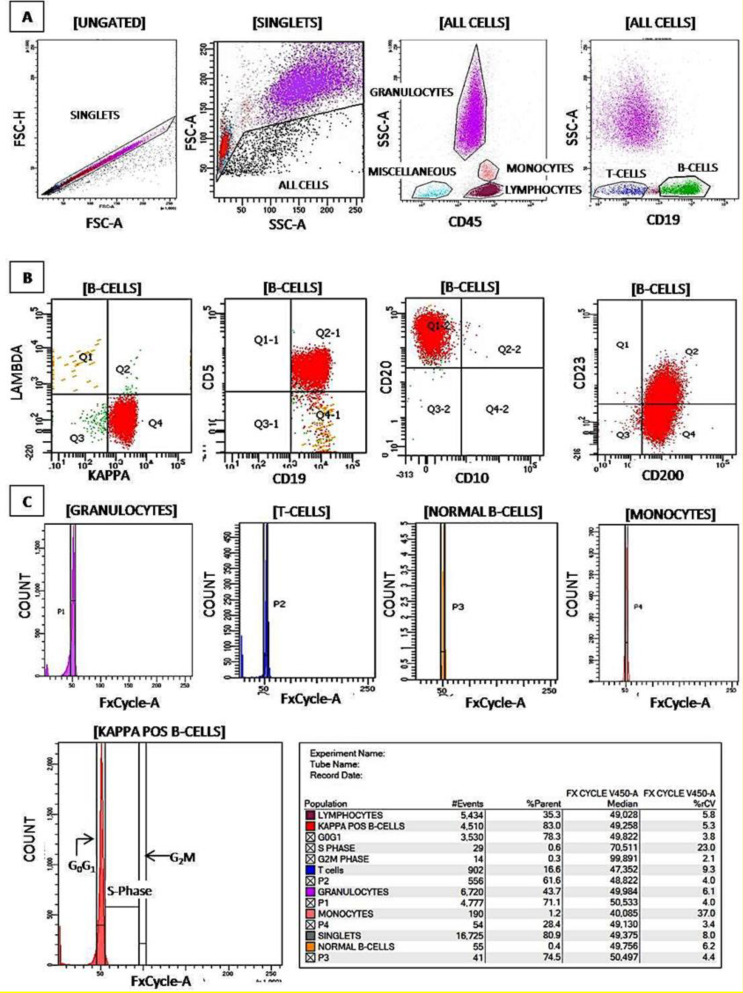
FxCycle Violet (FCV) based flow cytometric (FCM) DNA ploidy analysis is a rapid and simple tool that can substantiate in characterizing the biological behaviour across the spectrum of haematological malignancies and correlates with cytogenetic studies. In this prospective study, we performed simultaneous immunophenotyping with FCV based on ploidy analysis in n=132 consecutive new samples, comprising n=110 samples of haemato-lymphoid neoplasms, including acute leukemias (n=67, 60.9%), CML with myeloid blast crisis (n=1, 0.9%), MDS with excess blasts (n=2, 1.8%), mature B cell/ T cell neoplasms (n=37, 33.7%), multiple myeloma (n=3, 2.7%) along with n=22 normal samples. The FCM DNA data was compared with corresponding conventional karyotyping results, wherever available. In FCM ploidy analysis (n=110), the overall DNA index (DI) ranged from 0.81 to 2.17 and S-Phase fraction (SPF) from 0.1-31.6%. Diploidy was seen in n = 90 (81.8%), low-hyperdiploidy in n = 10 (9.1%), high-hyperdiploidy in n = 7 (6.4%) with one case each (0.9% each) having near-tetraploidy, high-hypodiploidy and low-hypodiploidy. The DI of all viable cell populations in normal samples ranged from 0.96-1.05. Conventional karyotyping was performed in n=76/110 cases (70%) with n= 11/76 (15%) culture failures. The modal chromosome number ranged from 45 to 63. A concordance of 95.4% (n=62/65) was noted with corresponding FCM DI. FCV-based ploidy is a sensitive technique that provides complementary information and ascertains a strong correlation with conventional cytogenetics across all haemato-lymphoid neoplasms. It can detect aneuploidy in all B-ALL and myeloma cases, even in hemodiluted samples with cytogenetic culture failure; supplement the diagnoses of erythroleukemia, and provide a useful screen for a higher grade lymph node disease in lymphoma cases with SPF > 3%.
基于FxCycle Violet(FCV)的流式细胞术(FCM)DNA倍体分析是一种快速且简单的工具,可用于证实各种血液系统恶性肿瘤的生物学行为特征,并与细胞遗传学研究相关。在这项前瞻性研究中,我们对132例连续的新样本进行了基于FCV倍体分析的同步免疫表型分析,其中包括110例血液淋巴系统肿瘤样本,包括急性白血病(67例,60.9%)、伴有髓系母细胞危象的慢性粒细胞白血病(1例,0.9%)、伴有过多母细胞的骨髓增生异常综合征(2例,1.8%)、成熟B细胞/T细胞肿瘤(37例,33.7%)、多发性骨髓瘤(3例,2.7%)以及22例正常样本。只要有相应的传统核型分析结果,就将FCM DNA数据与之进行比较。在FCM倍体分析(110例)中,总体DNA指数(DI)范围为0.81至2.17,S期分数(SPF)为0.1 - 31.6%。二倍体见于90例(81.8%),低超二倍体见于10例(9.1%),高超二倍体见于7例(6.4%),各有1例(各占0.9%)为近四倍体、高亚二倍体和低亚二倍体。正常样本中所有活细胞群体的DI范围为0.96 - 1.05。76/110例(70%)进行了传统核型分析,其中11/76例(15%)培养失败。众数染色体数范围为45至63。与相应的FCM DI的一致性为95.4%(62/65)。基于FCV的倍体分析是一种敏感技术,可提供补充信息,并确定与所有血液淋巴系统肿瘤的传统细胞遗传学有很强的相关性。它可以在所有B淋巴细胞白血病和骨髓瘤病例中检测到非整倍体,即使在细胞遗传学培养失败的血液稀释样本中也能检测到;补充红白血病的诊断,并为SPF>3%的淋巴瘤病例中的高级别淋巴结疾病提供有用的筛查。