Department of Applied Biosciences, Kyungpook National University, Daegu, Korea.
Department of Pediatrics, Severance Fecal Microbiota Transplantation Center, Severance Hospital, Yonsei University College of Medicine, Seoul, Korea.
Gut Liver. 2022 Sep 15;16(5):775-785. doi: 10.5009/gnl210369. Epub 2022 Aug 17.
BACKGROUND/AIMS: Although fecal microbiota transplantation (FMT) has been proven as one of the promising treatments for patients with ulcerative colitis (UC), potential prognostic markers regarding the clinical outcomes of FMT remain elusive.
We collected fecal samples of 10 participants undergoing FMT to treat UC and those from the corresponding donors. We categorized them into two groups: responders and nonresponders. Sequencing of the bacterial 16S rRNA gene was conducted on the samples to explore bacterial composition.
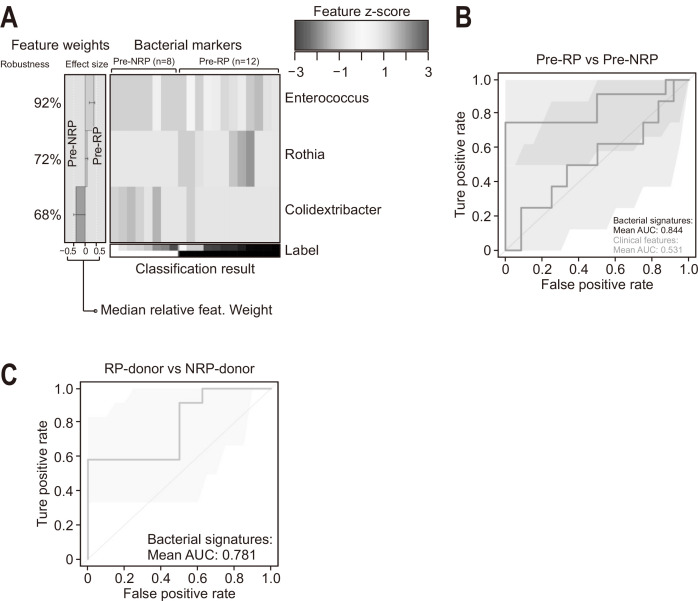
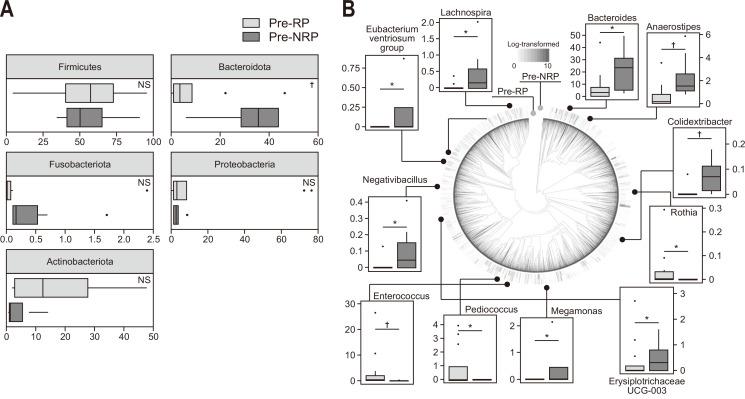
Analyzing the gut microbiota of patients who showed different outcomes in FMT presented a distinct microbial niche. Source tracking analysis showed the nonresponder group had a higher rate of preservation of donor microbiota, underscoring that engraftment degrees are not one of the major drivers for the success of FMT. At the phylum level, Bacteroidetes bacteria were significantly depleted (p<0.003), and three genera, including , , and , were enriched in the responder group before FMT (p=0.003, p=0.025, and p=0.048, respectively). Furthermore, we applied a machine learning algorithm to build a prediction model that might allow the prediction of FMT outcomes, which yielded an area under the receiver operating characteristic (ROC) curve of 0.844. Notably, the microbiota-based model was much better at predicting outcomes than the clinical features model (area under the ROC curve=0.531).
This study is the first to suggest the significance of indigenous microbiota of recipients as a critical factor. The result highlights that bacterial composition should be evaluated before FMT to select suitable patients and achieve better efficiency.
背景/目的:尽管粪便微生物群移植(FMT)已被证明是溃疡性结肠炎(UC)患者的一种有前途的治疗方法,但关于 FMT 临床结果的潜在预后标志物仍难以捉摸。
我们收集了 10 名接受 FMT 治疗 UC 的患者和相应供体的粪便样本。我们将它们分为两组:应答者和无应答者。对样本进行细菌 16S rRNA 基因测序,以探索细菌组成。
分析 FMT 结果不同的患者的肠道微生物群呈现出不同的微生物生态位。来源追踪分析显示,无应答者组供体微生物群保留率较高,这表明定植程度不是 FMT 成功的主要驱动因素之一。在门水平上,拟杆菌门细菌明显减少(p<0.003),并且在 FMT 前,应答者组中三个属,包括 、 和 ,得到了富集(p=0.003,p=0.025 和 p=0.048)。此外,我们应用机器学习算法构建了一个预测模型,该模型可能允许预测 FMT 结果,其接受者操作特征(ROC)曲线下面积为 0.844。值得注意的是,基于微生物组的模型在预测结果方面明显优于基于临床特征的模型(ROC 曲线下面积=0.531)。
本研究首次表明受体固有微生物群作为一个关键因素的重要性。结果强调在进行 FMT 之前应评估细菌组成,以选择合适的患者并提高效率。