School of Stomatology, Weifang Medical University, Weifang, China.
Department of Oral Maxillofacial-Head and Neck Oncology, Ninth People's Hospital affiliated to Shanghai Jiao Tong University School of Medicine, Shanghai, China.
Cancer Med. 2023 Feb;12(3):2702-2712. doi: 10.1002/cam4.5152. Epub 2022 Aug 17.
Recent evidence suggested a potential correlation between BMI and the efficacy of immune checkpoint inhibitors in cancer patients. This study aimed to evaluate the prognostic value of the body mass index (BMI) in recurrent/metastatic head and neck squamous cell carcinoma (R/M HNSCC) patients treat with pembrolizumab.
The current retrospective cohort study enrolled 49 R/M HNSCC patients underwent at least one cycle of pembrolizumab as second-line treatment from June 2018 to October 2020. Survival analysis of immunotherapy prognosis and risk factor analysis of age, gender, BMI, ECOG-PS, CPS, rT-stage, tumor site, and tube feeding.
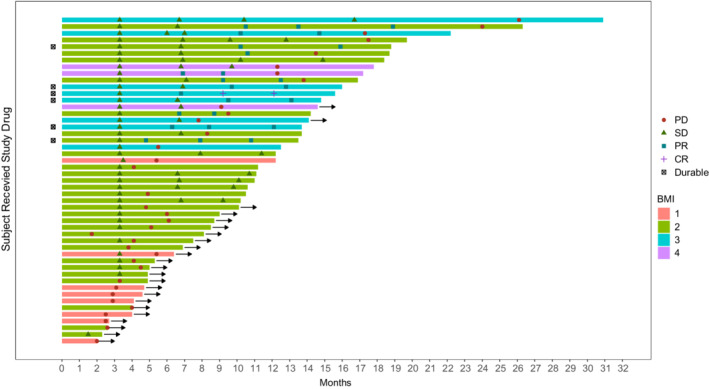
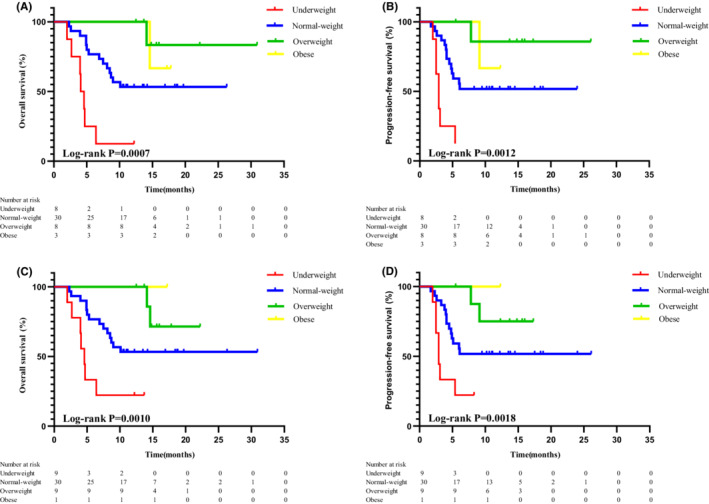
Among the 49 patients, the BMI at the time of immunotherapy ranged from 14.5 to 32.0 kg/m . The Kaplan-Meier analysis showed that the BMI was significantly correlated with overall survival time (OS, p = 0.0007) and progression-free survival time (PFS, p = 0.0012). BMI, gender, prior treatment, serum albumin level, ECOG-PS, CPS and rT-stage were analyzed in multivariate Cox regression model analysis after adjusted for potential confounding clinical variables. Patients with underweight (OS:HR = 6.862, 95% CI:1.566-30.064, p = 0.011; PFS:HR = 5.672, 95% CI:1.364-23.586, p = 0.017);ECOG≥2 (OS:HR = 0.250, 95% CI:0.086-0.731, p = 0.011;PFS:HR = 0.284, 95% CI:0.101-0.805, p = 0.018); CPS <1(OS: HR = 4.34, 95% CI:1.271-15.464, p = 0.019; PFS:HR = 3.859, 95% CI:1.180-12.618, p = 0.025) and rT4-stage(OS:HR = 4.380, 95% CI:1.452-13.209, p = 0.009;PFS: HR = 3.799, 95% CI:1.240-11.638, p = 0.019) suffered higher risk of mortality.
The BMI at the time of clinical diagnosis was showed to be an independent predictive factor for R/M HNSCC patients receiving pembrolizumab. Compared with normal weight patients, underweight patients have worse clinical prognosis.
最近的证据表明,BMI 与癌症患者免疫检查点抑制剂的疗效之间可能存在相关性。本研究旨在评估体重指数(BMI)在接受派姆单抗二线治疗的复发性/转移性头颈部鳞状细胞癌(R/M HNSCC)患者中的预后价值。
本回顾性队列研究纳入了 49 例 R/M HNSCC 患者,这些患者在 2018 年 6 月至 2020 年 10 月期间至少接受了一个周期的派姆单抗二线治疗。对免疫治疗预后的生存分析和年龄、性别、BMI、ECOG-PS、CPS、rT 期、肿瘤部位和管饲等因素的风险因素分析。
在 49 例患者中,免疫治疗时的 BMI 范围为 14.5 至 32.0kg/m²。Kaplan-Meier 分析显示,BMI 与总生存时间(OS,p=0.0007)和无进展生存时间(PFS,p=0.0012)显著相关。在多变量 Cox 回归模型分析中,在调整了潜在混杂的临床变量后,对 BMI、性别、既往治疗、血清白蛋白水平、ECOG-PS、CPS 和 rT 期进行了分析。BMI 低(OS:HR=6.862,95%CI:1.566-30.064,p=0.011;PFS:HR=5.672,95%CI:1.364-23.586,p=0.017);ECOG≥2(OS:HR=0.250,95%CI:0.086-0.731,p=0.011;PFS:HR=0.284,95%CI:0.101-0.805,p=0.018);CPS<1(OS:HR=4.34,95%CI:1.271-15.464,p=0.019;PFS:HR=3.859,95%CI:1.180-12.618,p=0.025)和 rT4 期(OS:HR=4.380,95%CI:1.452-13.209,p=0.009;PFS:HR=3.799,95%CI:1.240-11.638,p=0.019)患者死亡风险更高。
临床诊断时的 BMI 被证明是接受派姆单抗治疗的 R/M HNSCC 患者的独立预测因素。与正常体重患者相比,体重不足患者的临床预后更差。