• 文献检索
  • 文档翻译
  • 深度研究
  • 学术资讯
  • Suppr Zotero 插件Zotero 插件
  • 邀请有礼
  • 套餐&价格
  • 历史记录
应用&插件
Suppr Zotero 插件Zotero 插件浏览器插件Mac 客户端Windows 客户端微信小程序
定价
高级版会员购买积分包购买API积分包
服务
文献检索文档翻译深度研究API 文档MCP 服务
关于我们
关于 Suppr公司介绍联系我们用户协议隐私条款
关注我们

Suppr 超能文献

核心技术专利:CN118964589B侵权必究
粤ICP备2023148730 号-1Suppr @ 2026

文献检索

告别复杂PubMed语法,用中文像聊天一样搜索,搜遍4000万医学文献。AI智能推荐,让科研检索更轻松。

立即免费搜索

文件翻译

保留排版,准确专业,支持PDF/Word/PPT等文件格式,支持 12+语言互译。

免费翻译文档

深度研究

AI帮你快速写综述,25分钟生成高质量综述,智能提取关键信息,辅助科研写作。

立即免费体验

新冠疫情期间 Medicaid 受助人阿片类药物使用障碍治疗参与度的变化趋势。

Trends in Engagement With Opioid Use Disorder Treatment Among Medicaid Beneficiaries During the COVID-19 Pandemic.

机构信息

Department of Family Medicine, Boston University School of Medicine/Boston Medical Center, Boston, Massachusetts.

Department of Public Service and Administration, Texas A&M University, College Station, Texas.

出版信息

JAMA Health Forum. 2022 Mar 11;3(3):e220093. doi: 10.1001/jamahealthforum.2022.0093. eCollection 2022 Mar.

DOI:10.1001/jamahealthforum.2022.0093
PMID:35977284
原文链接:https://pmc.ncbi.nlm.nih.gov/articles/PMC8917419/
Abstract

IMPORTANCE

Disruptions in care during the COVID-19 pandemic may have decreased access to care for patients with opioid use disorder.

OBJECTIVE

To examine trends in opioid use disorder treatment including buprenorphine possession, urine drug testing, and opioid treatment program services during the COVID-19 public health emergency.

DESIGN SETTING AND PARTICIPANTS

This cohort study included 6453 parent and childless adult Medicaid beneficiaries, aged 18 to 64 years, with opioid use disorder and continuous enrollment from December 1, 2018, to September 30, 2020, in Wisconsin. Logistic regression compared differences in study outcomes before, early, and later in the COVID-19 public health emergency. Analyses were conducted from January 2021 to October 2021.

EXPOSURES

Early (March 16, 2020, to May 15, 2020) and later (May 16, 2020, to September 30, 2020) in the public health emergency.

MAIN OUTCOMES AND MEASURES

Person-week outcomes included possession of buprenorphine, completion of outpatient urine drug testing, and receipt of opioid treatment program services.

RESULTS

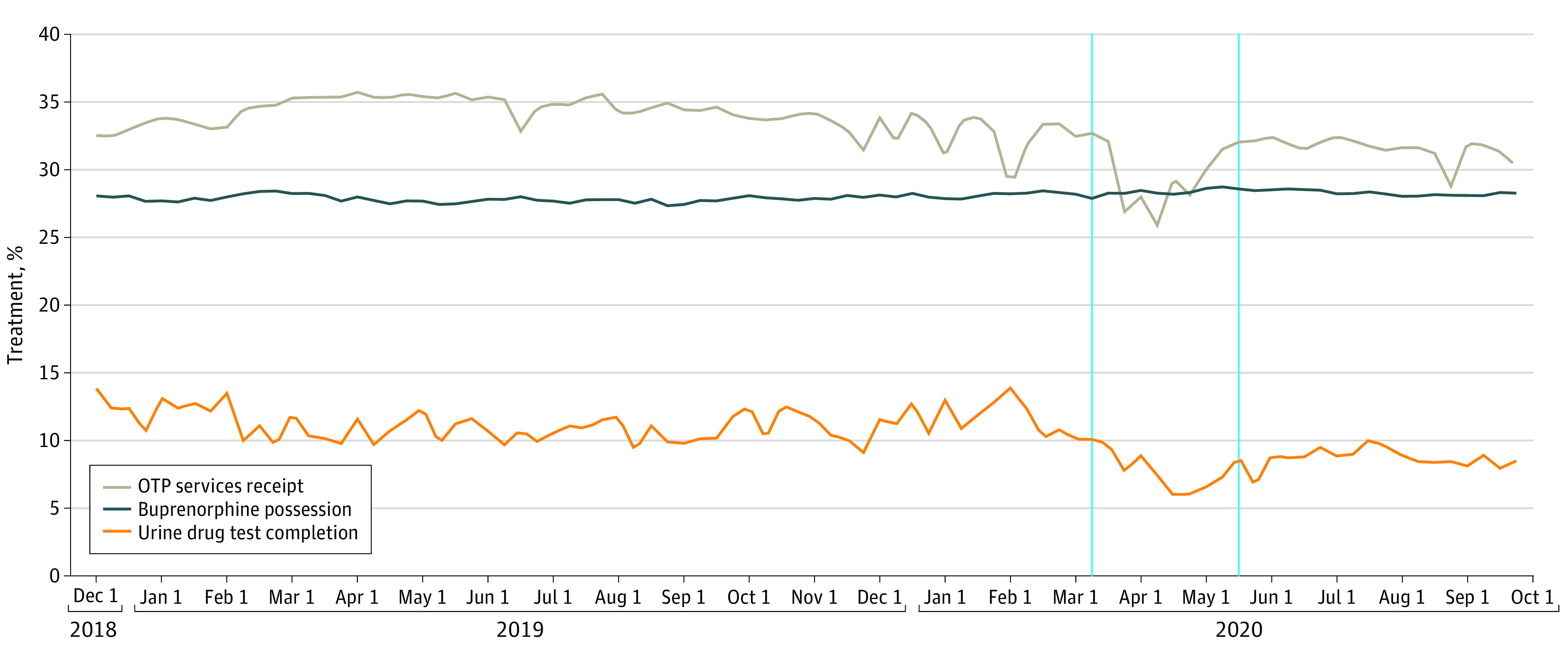
The final cohort of 6453 participants included 3986 (61.8%) childless adults; 5741 (89%) were younger than 50 years, 3435 (53.2%) were women, 5036 (78.0%) White, and 22.0% were racial and ethnic minority groups (American Indian, 269 [4.2%]; Asian, 26 [0.4%]; Black, 458 [7.1%]; Hispanic, 292 [4.5%]; Pacific Islander, 1 [.02%]; Multiracial, 238 [3.7%]). Overall, 2858 (44.3%), 5074 (78.6%), and 2928 (45.4%) received buprenorphine, urine drug testing, or opioid treatment program services during the study period, respectively. Probability of buprenorphine possession did not change in the early or later part of the public health emergency. Probability of urine drug testing initially decreased (marginal effect [ME], -0.04; 95% CI, -0.04 to -0.03;  < .001) and then partially recovered in the later public health emergency (ME, -0.02; 95% CI, -0.03 to -0.02;  < .001). Probability of opioid treatment program services followed a similar pattern, with an early decrease (ME, -0.05; 95% CI, -0.05 to -0.04;  < .001) followed by partial recovery (ME, -0.02; 95% CI, -0.03 to -0.02;  < .001).

CONCLUSIONS AND RELEVANCE

In a sample of continuously enrolled adult Medicaid beneficiaries, the COVID-19 public health emergency was not associated with decreased probability of buprenorphine possession, but was associated with decreased probability of urine drug testing and opioid treatment program services. These findings suggest patients in office-based settings retained access to buprenorphine despite decreased on-site services like urine drug tests, whereas patients at opioid treatment programs experienced greater disruption in care. Given the importance of medications for opioid use disorder in preventing overdose, policy makers should consider permanent policy changes based on lessons learned from the public health emergency to enable ongoing enhanced access to these medications.
https://cdn.ncbi.nlm.nih.gov/pmc/blobs/18de/8917419/b959ee27d218/jamahealthforum-e220093-g001.jpg
摘要

重要性:在 COVID-19 大流行期间,医疗服务中断可能会降低阿片类药物使用障碍患者的医疗服务可及性。

目的:在 COVID-19 公共卫生紧急事件期间,检查阿片类药物使用障碍治疗(包括丁丙诺啡拥有、尿液药物检测和阿片类药物治疗计划服务)的趋势。

设计、设置和参与者:这项队列研究包括威斯康星州 6453 名父母和无子女的成年医疗补助受益人,年龄在 18 至 64 岁之间,患有阿片类药物使用障碍,并从 2018 年 12 月 1 日至 2020 年 9 月 30 日连续入组。逻辑回归比较了 COVID-19 公共卫生紧急事件前后研究结果的差异。分析于 2021 年 1 月至 2021 年 10 月进行。

暴露:公共卫生紧急事件的早期(2020 年 3 月 16 日至 2020 年 5 月 15 日)和后期(2020 年 5 月 16 日至 2020 年 9 月 30 日)。

主要结果和措施:个人周结果包括丁丙诺啡拥有、完成门诊尿液药物检测和接受阿片类药物治疗计划服务。

结果:最终的 6453 名参与者中有 3986 名(61.8%)无子女成年人;5741 名(89%)年龄小于 50 岁,3435 名(53.2%)为女性,5036 名(78.0%)为白人,22.0%为少数民族群体(美洲印第安人,269[4.2%];亚洲人,26[0.4%];黑人,458[7.1%];西班牙裔,292[4.5%];太平洋岛民,1[0.02%];多种族,238[3.7%])。在研究期间,共有 2858 人(44.3%)、5074 人(78.6%)和 2928 人(45.4%)分别接受了丁丙诺啡、尿液药物检测或阿片类药物治疗计划服务。在公共卫生紧急事件的早期和后期,丁丙诺啡拥有的可能性都没有改变。尿液药物检测的可能性最初下降(边际效应[ME],-0.04;95%CI,-0.04 至-0.03;<.001),然后在公共卫生紧急事件的后期部分恢复(ME,-0.02;95%CI,-0.03 至-0.02;<.001)。阿片类药物治疗计划服务也呈现出类似的模式,早期下降(ME,-0.05;95%CI,-0.05 至-0.04;<.001),随后部分恢复(ME,-0.02;95%CI,-0.03 至-0.02;<.001)。

结论和相关性:在连续入组的成年医疗补助受益人群中,COVID-19 公共卫生紧急事件与丁丙诺啡拥有可能性降低无关,但与尿液药物检测和阿片类药物治疗计划服务可能性降低有关。这些发现表明,尽管现场服务(如尿液药物检测)减少,但在门诊环境中,患者仍能获得丁丙诺啡,而在阿片类药物治疗项目中的患者则经历了更大的医疗服务中断。鉴于阿片类药物使用障碍药物对预防过量用药的重要性,政策制定者应考虑根据公共卫生紧急事件吸取的经验教训,做出永久性政策改变,以便为这些药物的持续增强提供机会。

相似文献

1
Trends in Engagement With Opioid Use Disorder Treatment Among Medicaid Beneficiaries During the COVID-19 Pandemic.新冠疫情期间 Medicaid 受助人阿片类药物使用障碍治疗参与度的变化趋势。
JAMA Health Forum. 2022 Mar 11;3(3):e220093. doi: 10.1001/jamahealthforum.2022.0093. eCollection 2022 Mar.
2
Association of Receipt of Opioid Use Disorder-Related Telehealth Services and Medications for Opioid Use Disorder With Fatal Drug Overdoses Among Medicare Beneficiaries Before and During the COVID-19 Pandemic.医疗保险受益人与新冠疫情大流行之前和期间阿片类药物使用障碍相关远程医疗服务和阿片类药物使用障碍药物治疗与致命药物过量的关联。
JAMA Psychiatry. 2023 May 1;80(5):508-514. doi: 10.1001/jamapsychiatry.2023.0310.
3
Receipt of Telehealth Services, Receipt and Retention of Medications for Opioid Use Disorder, and Medically Treated Overdose Among Medicare Beneficiaries Before and During the COVID-19 Pandemic.医疗保险受益人的远程医疗服务的接受情况、阿片类药物使用障碍药物的获得和保留情况,以及在 COVID-19 大流行之前和期间的药物治疗过量情况。
JAMA Psychiatry. 2022 Oct 1;79(10):981-992. doi: 10.1001/jamapsychiatry.2022.2284.
4
Racial and Ethnic Disparities in Buprenorphine and Extended-Release Naltrexone Filled Prescriptions During the COVID-19 Pandemic.在 COVID-19 大流行期间,丁丙诺啡和纳曲酮控释制剂的种族和民族差异。
JAMA Netw Open. 2022 Jun 1;5(6):e2214765. doi: 10.1001/jamanetworkopen.2022.14765.
5
Telemedicine Buprenorphine Initiation and Retention in Opioid Use Disorder Treatment for Medicaid Enrollees.远程医疗在医疗补助受种者阿片类药物使用障碍治疗中的丁丙诺啡起始和维持。
JAMA Netw Open. 2023 Oct 2;6(10):e2336914. doi: 10.1001/jamanetworkopen.2023.36914.
6
Association Between Hospital Adoption of an Emergency Department Treatment Pathway for Opioid Use Disorder and Patient Initiation of Buprenorphine After Discharge.急诊阿片类药物使用障碍治疗路径的采用与患者出院后使用丁丙诺啡的关系。
JAMA Health Forum. 2023 Mar 3;4(3):e230245. doi: 10.1001/jamahealthforum.2023.0245.
7
Overdose, Behavioral Health Services, and Medications for Opioid Use Disorder After a Nonfatal Overdose.过量用药、行为健康服务以及非致死性过量用药后的阿片类药物使用障碍治疗药物。
JAMA Intern Med. 2024 Aug 1;184(8):954-962. doi: 10.1001/jamainternmed.2024.1733.
8
Are North Carolina clinicians delivering opioid use disorder treatment to Medicaid beneficiaries?北卡罗来纳州的临床医生是否为医疗补助受益人群提供阿片类药物使用障碍治疗?
Addiction. 2022 Nov;117(11):2855-2863. doi: 10.1111/add.15854. Epub 2022 Mar 7.
9
Racial and Ethnic Inequities in Buprenorphine and Methadone Utilization Among Reproductive-Age Women with Opioid Use Disorder: an Analysis of Multi-state Medicaid Claims in the USA.美国多州医疗补助索赔中的阿片类药物使用障碍生殖年龄妇女布比卡因和美沙酮利用中的种族和民族不平等现象分析。
J Gen Intern Med. 2023 Dec;38(16):3499-3508. doi: 10.1007/s11606-023-08306-0. Epub 2023 Jul 12.
10
Trends in Methadone Dispensing for Opioid Use Disorder After Medicare Payment Policy Changes.医疗保险支付政策变化后美沙酮治疗阿片类药物使用障碍的趋势。
JAMA Netw Open. 2023 May 1;6(5):e2314328. doi: 10.1001/jamanetworkopen.2023.14328.

引用本文的文献

1
Effects of the Communities That HEAL intervention on initiation, retention, and linkage to medications for opioid use disorder (MOUD): A cluster randomized wait-list controlled trial.“促进健康社区”干预措施对阿片类药物使用障碍药物治疗(MOUD)的启动、持续治疗及衔接的影响:一项整群随机等待列表对照试验
Drug Alcohol Depend. 2025 Sep 1;274:112785. doi: 10.1016/j.drugalcdep.2025.112785. Epub 2025 Jul 9.
2
Substance-induced mental disorders and discontinuation of medication for opioid use disorder.物质所致精神障碍与阿片类物质使用障碍的药物停用
Drug Alcohol Depend. 2025 Jul 1;272:112685. doi: 10.1016/j.drugalcdep.2025.112685. Epub 2025 Apr 22.
3

本文引用的文献

1
The impact of relaxation of methadone take-home protocols on treatment outcomes in the COVID-19 era.美沙酮居家服药方案放宽对 COVID-19 时代治疗效果的影响。
Am J Drug Alcohol Abuse. 2021 Nov 2;47(6):722-729. doi: 10.1080/00952990.2021.1979991. Epub 2021 Oct 20.
2
COVID-19-related policy changes for methadone take-home dosing: A multistate survey of opioid treatment program leadership.美沙酮口服药物维持治疗点与 COVID-19 相关的政策变化:一项针对阿片类药物治疗项目领导层的多州调查。
Subst Abus. 2022;43(1):633-639. doi: 10.1080/08897077.2021.1986768. Epub 2021 Oct 19.
3
Changes in methadone take-home dosing before and after COVID-19.
Telehealth and disparities in opioid use disorder treatment: Medicaid enrollees versus privately insured individuals.
远程医疗与阿片类物质使用障碍治疗中的差异:医疗补助参保者与私人保险者对比
Health Serv Res. 2025 Feb;60(1):e14414. doi: 10.1111/1475-6773.14414. Epub 2024 Dec 9.
4
Methadone treatment utilization and overdose trends among Medicaid beneficiaries in New Jersey before and during the COVID-19 pandemic.新泽西州医疗补助受益人的美沙酮治疗利用情况和 COVID-19 大流行前后的过量用药趋势。
J Subst Use Addict Treat. 2024 Dec;167:209476. doi: 10.1016/j.josat.2024.209476. Epub 2024 Aug 7.
5
National- and State-Level Pharmacy-Based Buprenorphine Dispensing, United States 2019-2021.2019 - 2021年美国国家级和州级基于药房的丁丙诺啡配药情况
J Gen Intern Med. 2024 Aug;39(10):1951-1953. doi: 10.1007/s11606-024-08829-0. Epub 2024 May 28.
6
Retrospective study investigating naloxone prescribing and cost in US Medicaid and Medicare patients.回顾性研究调查了美国医疗补助和医疗保险患者中纳洛酮的处方和费用。
BMJ Open. 2024 May 1;14(5):e078592. doi: 10.1136/bmjopen-2023-078592.
7
Can telehealth expansion boost health care utilization specifically for patients with substance use disorders relative to patients with other types of chronic disease?远程医疗的扩张是否能专门针对患有物质使用障碍的患者,提高他们的医疗利用率,而不是其他类型的慢性病患者?
PLoS One. 2024 Apr 1;19(4):e0299397. doi: 10.1371/journal.pone.0299397. eCollection 2024.
8
How Does Telehealth Expansion Change Access to Healthcare for Patients With Different Types of Substance Use Disorders?远程医疗的扩展如何改变不同类型物质使用障碍患者获得医疗保健的机会?
Subst Use Addctn J. 2024 Jul;45(3):473-485. doi: 10.1177/29767342241236028. Epub 2024 Mar 17.
9
Navigating addiction treatment during COVID-19: policy insights from state health leaders.新冠疫情期间的成瘾治疗导航:来自州卫生领导人的政策见解
Health Aff Sch. 2024 Jan 29;2(2):qxae007. doi: 10.1093/haschl/qxae007. eCollection 2024 Feb.
10
Patients' and Clinicians' Experiences with In-person, Video, and Phone Modalities for Opioid Use Disorder Treatment: A Qualitative Study.患者和临床医生在阿片类药物使用障碍治疗中对面对面、视频和电话模式的体验:一项定性研究。
J Gen Intern Med. 2024 Sep;39(12):2179-2186. doi: 10.1007/s11606-023-08586-6. Epub 2024 Jan 16.
美沙酮带药回家剂量在新冠疫情前后的变化。
J Subst Abuse Treat. 2022 Feb;133:108552. doi: 10.1016/j.jsat.2021.108552. Epub 2021 Jun 24.
4
Methadone Access for Opioid Use Disorder During the COVID-19 Pandemic Within the United States and Canada.美沙酮获取用于治疗阿片类药物使用障碍在新冠大流行期间的美国和加拿大。
JAMA Netw Open. 2021 Jul 1;4(7):e2118223. doi: 10.1001/jamanetworkopen.2021.18223.
5
Use of Medications for Treatment of Opioid Use Disorder Among US Medicaid Enrollees in 11 States, 2014-2018.美国 11 个州的医疗补助受助人在 2014-2018 年期间使用药物治疗阿片类药物使用障碍的情况。
JAMA. 2021 Jul 13;326(2):154-164. doi: 10.1001/jama.2021.7374.
6
The new services that opioid treatment programs have adopted in response to COVID-19.阿片类药物治疗项目针对 COVID-19 采取的新服务措施。
J Subst Abuse Treat. 2021 Nov;130:108393. doi: 10.1016/j.jsat.2021.108393. Epub 2021 Apr 9.
7
Changes in methadone program practices and fatal methadone overdose rates in Connecticut during COVID-19.新冠疫情期间康涅狄格州美沙酮项目实践的变化及美沙酮过量致死率
J Subst Abuse Treat. 2021 Dec;131:108449. doi: 10.1016/j.jsat.2021.108449. Epub 2021 Apr 29.
8
Use of buprenorphine for those with employer-sponsored insurance during the initial phase of the COVID-19 pandemic.在 COVID-19 大流行的初始阶段,为有雇主赞助保险的人使用丁丙诺啡。
J Subst Abuse Treat. 2021 Oct;129:108384. doi: 10.1016/j.jsat.2021.108384. Epub 2021 Apr 8.
9
Using telehealth to improve buprenorphine access during and after COVID-19: A rapid response initiative in Rhode Island.利用远程医疗在 COVID-19 期间和之后改善丁丙诺啡的可及性:罗得岛的快速反应倡议。
J Subst Abuse Treat. 2021 May;124:108283. doi: 10.1016/j.jsat.2021.108283. Epub 2021 Jan 20.
10
Identifying individuals with opioid use disorder: Validity of International Classification of Diseases diagnostic codes for opioid use, dependence and abuse.识别患有阿片类药物使用障碍的个体:阿片类药物使用、依赖和滥用的国际疾病分类诊断代码的有效性。
Drug Alcohol Depend. 2021 Apr 1;221:108583. doi: 10.1016/j.drugalcdep.2021.108583. Epub 2021 Feb 13.