Telethon Kids Institute, The University of Western Australia, Perth, WA, Australia.
Children's Hospital Colorado, Pediatric Neurology, University of Colorado School of Medicine, Aurora, USA.
Eur J Hum Genet. 2023 Feb;31(2):169-178. doi: 10.1038/s41431-022-01163-1. Epub 2022 Aug 18.
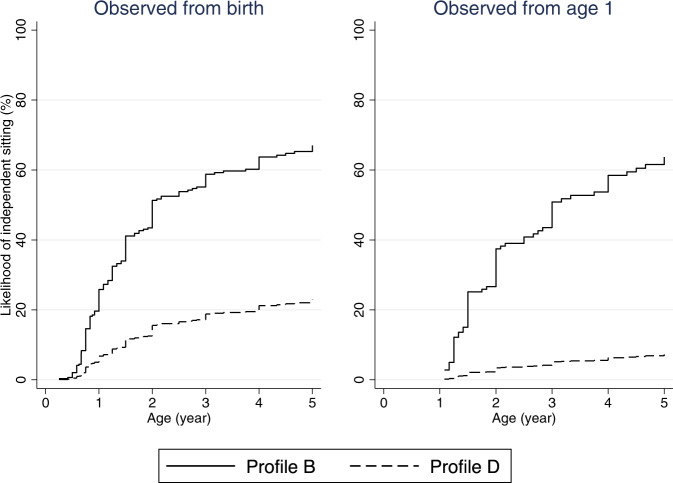
This study investigated the influence of factors at birth and in infancy on the likelihood of achieving major motor milestones in CDKL5 Deficiency Disorder (CDD). Data on 350 individuals with a pathogenic CDKL5 variant was sourced from the International CDKL5 Disorder Database. A first model included factors available at birth (e.g., sex, variant group and mosaicism) and the second additionally included factors available during infancy (e.g., age at seizure onset, number of anti-seizure medications used, experience of a honeymoon period and formal therapy). Cox regression was used to model the time to achieve the milestones. The probability of attaining the outcomes at specific ages was estimated by evaluating the time-to-event function at specific covariate values. Independent sitting and walking were achieved by 177/350 and 57/325 children respectively. By seven years of age, 67.1% of females but only 37.3% of males could sit independently. About a quarter each of females and males achieved independent walking by eight and six years, respectively. When observed from birth, female gender, a late truncating variant and mosaicism impacted most positively on the likelihood of independent sitting. When observed from one year, later seizure onset and experiencing a honeymoon period also improved the likelihood of independent sitting. Factors that favoured sitting (except gender) also improved walking. Having a truncating variant between aa178 and aa781 reduced the likelihood of achieving independent sitting and walking. It is possible to utilise factors occurring early in life to inform the likelihood of future motor development in CDD.
本研究调查了出生和婴儿期因素对 CDKL5 缺乏症(CDD)患者达到主要运动里程碑的可能性的影响。350 名携带致病性 CDKL5 变异体的个体数据来源于国际 CDKL5 障碍数据库。第一个模型包括出生时可获得的因素(例如,性别、变异体组和镶嵌性),第二个模型还包括婴儿期可获得的因素(例如,癫痫发作开始的年龄、使用的抗癫痫药物数量、蜜月期经历和正式治疗)。使用 Cox 回归来建立里程碑的时间模型。通过评估特定协变量值的时间事件函数来估计特定年龄达到结果的概率。177/350 的儿童独立坐着,57/325 的儿童独立行走。7 岁时,67.1%的女性可以独立坐着,而只有 37.3%的男性可以独立坐着。大约四分之一的女性和男性分别在 8 岁和 6 岁时独立行走。从出生开始观察时,女性性别、晚期截断变异体和镶嵌性对独立坐着的可能性影响最大。从一岁开始观察时,癫痫发作较晚和蜜月期的经历也提高了独立坐着的可能性。有利于坐着的因素(除了性别)也提高了行走的可能性。aa178 和 aa781 之间的截断变异体减少了独立坐着和行走的可能性。利用生命早期发生的因素可以告知 CDD 未来运动发育的可能性。