Hummel Aurélie, Oniszczuk Julie, Kervella Delphine, Charbit Marina, Guerrot Dominique, Testa Angelo, Philipponnet Carole, Chauvet Cécile, Guincestre Thomas, Brochard Karine, Benezech Ariane, Figueres Lucile, Belenfant Xavier, Guarnieri Andrea, Demoulin Nathalie, Benetti Elisa, Miglinas Marius, Dessaix Kathleen, Morelle Johann, Angeletti Andrea, Sellier-Leclerc Anne-Laure, Ranchin Bruno, Goussard Guillaume, Hudier Laurent, Bacchetta Justine, Servais Aude, Audard Vincent
Assistance Publique des Hôpitaux de Paris (AP-HP), Hôpital Universitaire Necker-Enfants Malades, Service de Néphrologie et Transplantation, Centre de Référence Maladie Rare "Syndrome Néphrotique Idiopathique" (SNI), Paris, France.
AP-HP, Hôpitaux Universitaires Henri Mondor, Service de Néphrologie et Transplantation, Centre de Référence Maladie Rare SNI, Créteil, France.
Clin Kidney J. 2022 May 6;15(8):1574-1582. doi: 10.1093/ckj/sfac134. eCollection 2022 Aug.
Several cases of idiopathic nephrotic syndrome (INS) relapse following the administration of coronavirus disease 2019 (COVID-19) vaccines have recently been reported, raising questions about the potential relationship between the immune response to COVID-19 vaccination and INS pathogenesis.
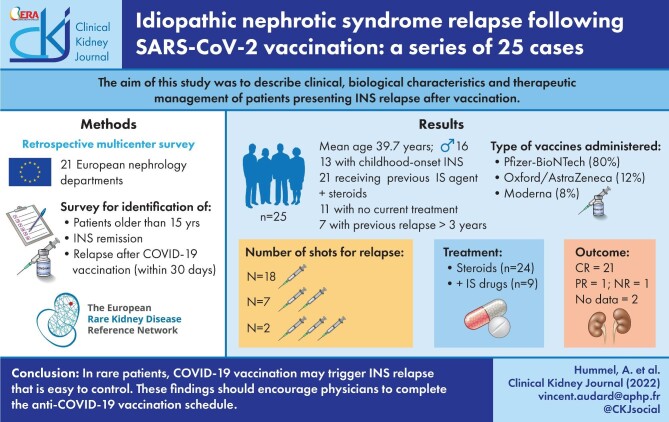
We performed a retrospective multicentre survey describing the clinical and biological characteristics of patients presenting a relapse of INS after COVID-19 vaccination, with an assessment of outcome under treatment.
We identified 25 patients (16 men and 9 women) presenting a relapse within 1 month of a COVID-19 vaccine injection. The glomerular disease was of childhood onset in half of the patients and most patients (21/25) had received at least one immunosuppressive drug in addition to steroids for frequently relapsing or steroid-dependent nephrotic syndrome (NS). All patients were in a stable condition at the time of injection and 11 had no specific treatment. In five patients, the last relapse was reported >5 years before vaccine injection. The Pfizer-BioNTech (BNT162b2) vaccine was used in 80% of the patients. In 18 cases, INS relapse occurred after the first injection, a mean of 17.5 days after vaccination. A second injection was nevertheless administered in 14 of these patients. Five relapses occurred after administration of the second dose and two relapses after the administration of the third dose. All but one of the patients received steroids as first-line treatment, with an additional immunosuppressive agent in nine cases. During follow-up, complete remission was achieved in 21 patients, within 1 month in 17 cases. Only one patient had not achieved at least partial remission after 3 months of follow-up.
This case series suggests that, in rare patients, COVID-19 vaccination may trigger INS relapse that is generally easy to control. These findings should encourage physicians to persuade their patients to complete the COVID-19 vaccination schedule.
最近有几例关于2019冠状病毒病(COVID-19)疫苗接种后特发性肾病综合征(INS)复发的病例报道,这引发了关于对COVID-19疫苗的免疫反应与INS发病机制之间潜在关系的疑问。
我们进行了一项回顾性多中心调查,描述了COVID-19疫苗接种后出现INS复发的患者的临床和生物学特征,并评估了治疗结果。
我们确定了25例患者(16例男性和9例女性)在COVID-19疫苗注射后1个月内出现复发。一半患者的肾小球疾病起病于儿童期,大多数患者(21/25)除了使用类固醇治疗频繁复发或类固醇依赖型肾病综合征(NS)外,还接受了至少一种免疫抑制药物治疗。所有患者在注射疫苗时病情稳定,11例患者未接受特殊治疗。5例患者在疫苗注射前最后一次复发时间超过5年。80%的患者使用了辉瑞 - 生物科技(BNT162b2)疫苗。18例患者在第一次注射后出现INS复发,平均在接种疫苗后17.5天。然而,其中14例患者仍接受了第二次注射。5例复发发生在第二次注射后,2例复发发生在第三次注射后。除1例患者外,所有患者均接受类固醇作为一线治疗,9例患者加用了免疫抑制药物。在随访期间,21例患者实现了完全缓解,其中17例在1个月内实现。只有1例患者在随访3个月后未实现至少部分缓解。
该病例系列表明,在少数患者中,COVID-19疫苗接种可能引发INS复发,而这种复发通常易于控制。这些发现应鼓励医生说服患者完成COVID-19疫苗接种计划。