Flicek Christine B, Sowa Nathaniel A, Long Millie D, Herfarth Hans H, Dorn Spencer D
Department of Psychiatry, University of North Carolina, Chapel Hill, North Carolina, USA.
Division of Gastroenterology and Hepatology, Department of Medicine, University of North Carolina, Chapel Hill, North Carolina, USA.
Inflamm Intest Dis. 2021 Dec 2;7(2):97-103. doi: 10.1159/000521285. eCollection 2022 Jul.
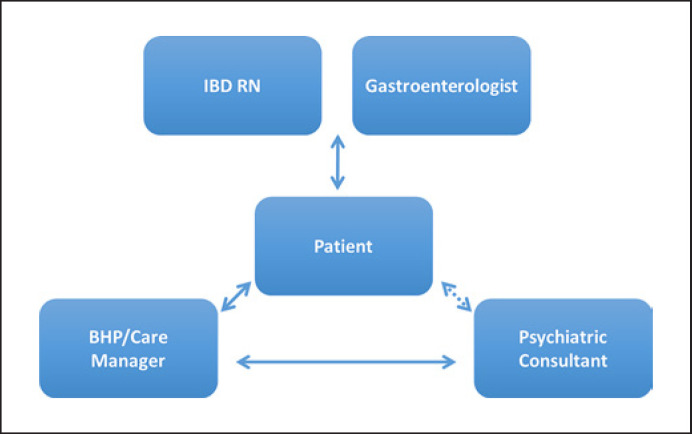
Individuals with inflammatory bowel disease (IBD) are up to twice as likely to suffer from anxiety and/or depression. Collaborative care management (CoCM) is an evidence-based approach to treating behavioral health disorders that have proven effective for a range of conditions in primary care and some specialty settings. This model involves a team-based approach, with care delivered by a care manager (case reviews and behavioral therapy), psychiatrist (case reviews and psychopharmacological recommendations), and medical provider (ongoing care including psychopharmacological prescriptions). We assessed the feasibility and effectiveness of CoCM in reducing anxiety and depressive symptoms in patients with IBD.
Patients with psychological distress identified by clinical impression and/or the results of the Patient Health Questionaire-9 (PHQ-9) and Generalized Anxiety Disorder-7 (GAD-7) were referred to the CoCM program. Data from our 9-month CoCM pilot were collected to assess depression and anxiety response and remission rates. We obtained provider surveys to assess provider acceptability with delivering care in this model.
Though the SARS-CoV2 COVID-19 pandemic interrupted screening, 39 patients enrolled and 19 active participants completed the program. Overall, 47.4% had either a response or remission in depression, while 36.8% had response or remission in anxiety. The gastroenterologists highly agreed that the program was a beneficial resource for their patients and felt comfortable implementing the recommendations.
CoCM is a potentially feasible and well accepted care delivery model for treatment of depression and anxiety in patients with IBD in a specialty gastroenterology clinic setting.
炎症性肠病(IBD)患者患焦虑症和/或抑郁症的可能性高达常人的两倍。协作式护理管理(CoCM)是一种基于证据的治疗行为健康障碍的方法,已被证明对初级保健和一些专科环境中的一系列病症有效。该模式采用团队协作方法,由护理经理(病例审查和行为疗法)、精神科医生(病例审查和精神药理学建议)和医疗服务提供者(包括精神药理学处方在内的持续护理)提供护理。我们评估了CoCM在减轻IBD患者焦虑和抑郁症状方面的可行性和有效性。
通过临床印象和/或患者健康问卷9(PHQ-9)及广泛性焦虑障碍7(GAD-7)的结果确定有心理困扰的患者被转介至CoCM项目。收集我们9个月CoCM试点的数据,以评估抑郁和焦虑反应及缓解率。我们进行了提供者调查,以评估提供者对在该模式下提供护理的接受程度。
尽管严重急性呼吸综合征冠状病毒2(SARS-CoV2)引发的2019冠状病毒病(COVID-19)大流行中断了筛查,但仍有39名患者登记参加,19名活跃参与者完成了该项目。总体而言,47.4%的患者抑郁症状有反应或缓解,而36.8%的患者焦虑症状有反应或缓解。胃肠病学家高度认同该项目对他们的患者是有益资源,并对实施这些建议感到放心。
在专科胃肠病学诊所环境中,CoCM是一种治疗IBD患者抑郁和焦虑的潜在可行且广受接受的护理提供模式。