Yan Xuan-Hui, Yue Zhen-Dong, Zhao Hong-Wei, Wang Lei, Fan Zhen-Hua, Wu Yi-Fan, Meng Ming-Ming, Zhang Ke, Jiang Li, Ding Hui-Guo, Zhang Yue-Ning, Yang Yong-Ping, Liu Fu-Quan
Department of Interventional Therapy, Peking University Ninth School of Clinical Medicine, Beijing Shijitan Hospital, Beijing 100038, China.
Department of Interventional Therapy, Beijing Shijitan Hospital, Capital Medical University, Beijing 100038, China.
World J Gastrointest Surg. 2022 Jun 27;14(6):567-579. doi: 10.4240/wjgs.v14.i6.567.
Patients with hepatocellular carcinoma complicated with main portal vein tumor thrombosis (mPVTT) and cirrhotic portal hypertension (CPH) have an extremely poor prognosis, and there is a lack of a clinically effective treatment paradigm.
To evaluate the efficacy and safety of transjugular intrahepatic portosystemic shunt (TIPS) combined with radioactive seed strand for the treatment of mPVTT patients with CPH.
The clinical data of 83 consecutive patients who underwent TIPS combined with I seed strand placement for mPVTT and CPH from January 2015 to December 2018 were retrospectively reviewed. Procedure-related data (success rate, relief of portal vein pressure and CPH symptoms, and adverse events), PVTT response, and patient survival were assessed through a 2-year follow-up.
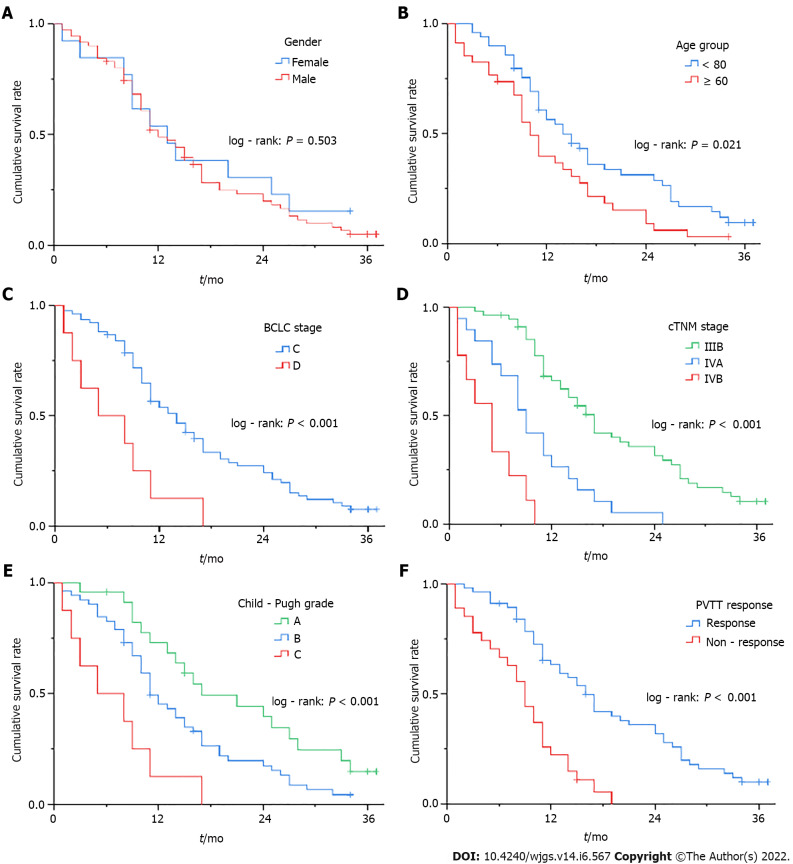
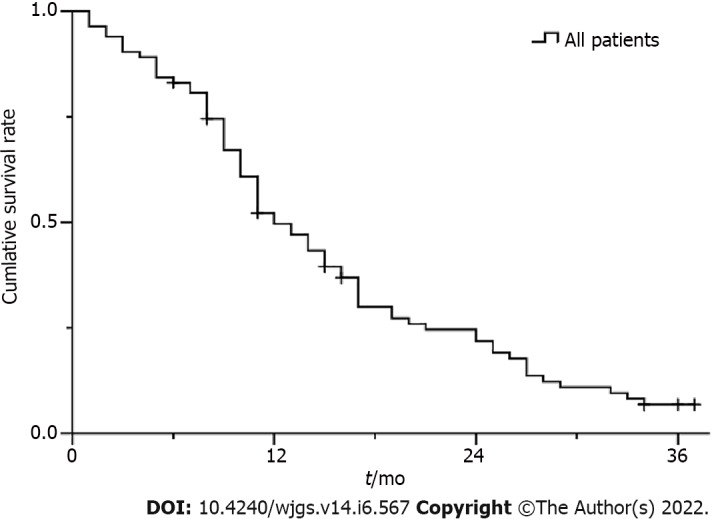
The success rate was 100.0% without perioperative death or procedure-related severe adverse events. The mean portal vein pressure was significantly decreased after the procedure (22.25 ± 7.33 mmHg 35.12 ± 7.94 mmHg, = 20.61, < 0.001). The symptoms of CPH were all effectively relieved within 1 mo. The objective response rate of PVTT was 67.5%. During a mean follow-up of 14.5 ± 9.4 mo (range 1-37 mo), the cumulative survival rates at 6, 12 and 24 mo were 83.1%, 49.7%, and 21.8%, respectively. The median survival time was 12.0 ± 1.3 mo (95% confidence interval: 9.5-14.5). In multivariate Cox regression analysis, body mass index, Child-Pugh grade, cTNM stage, and PVTT response were independent prognostic factors ( < 0.05).
TIPS combined with radioactive seed strand might be effective and safe in treating mPVTT patients with CPH.
肝细胞癌合并主要门静脉肿瘤血栓形成(mPVTT)及肝硬化门静脉高压(CPH)的患者预后极差,且缺乏临床有效的治疗模式。
评估经颈静脉肝内门体分流术(TIPS)联合放射性粒子条治疗mPVTT合并CPH患者的疗效及安全性。
回顾性分析2015年1月至2018年12月连续83例行TIPS联合碘粒子条植入治疗mPVTT和CPH患者的临床资料。通过2年随访评估手术相关数据(成功率、门静脉压力及CPH症状缓解情况、不良事件)、PVTT反应及患者生存情况。
成功率为100.0%,无围手术期死亡或手术相关严重不良事件。术后门静脉平均压力显著降低(22.25±7.33 mmHg比35.12±7.94 mmHg,t = 20.61,P<0.001)。CPH症状均在1个月内有效缓解。PVTT客观缓解率为67.5%。平均随访14.5±9.4个月(范围1 - 37个月),6、12和24个月的累积生存率分别为83.1%、49.7%和21.8%。中位生存时间为12.0±1.3个月(95%置信区间:9.5 - 14.5)。多因素Cox回归分析显示,体重指数、Child-Pugh分级、cTNM分期及PVTT反应是独立预后因素(P<0.05)。
TIPS联合放射性粒子条治疗mPVTT合并CPH患者可能有效且安全。