Department of Visceral Surgery and Medicine, Inselspital, Bern University Hospital, University of Bern, Bern, Switzerland.
Liver Unit, Hospital Privado de Rosario, Santa Fe, Argentina.
Aliment Pharmacol Ther. 2022 Oct;56(7):1194-1204. doi: 10.1111/apt.17192. Epub 2022 Aug 18.
There is limited information on the effects of statins on the outcomes of liver transplantation (LT), regarding either their use by LT recipients or donors.
To analyse the association between statin exposure and recipient and graft survival.
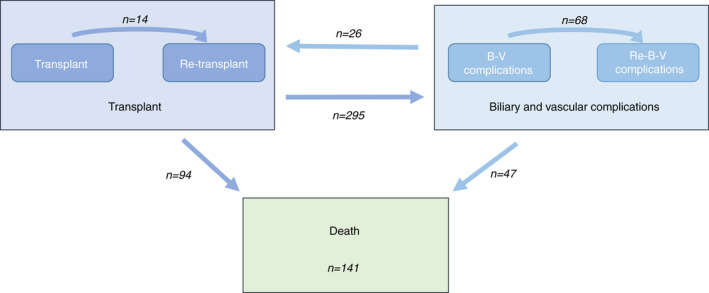
We included adult LT recipients with deceased donors in a nationwide prospective database study. Using a multistate modelling approach, we examined the effect of statins on the transition hazard between LT, biliary and vascular complications and death, allowing for recurring events. The observation time was 3 years.
We included 998 (696 male, 70%, mean age 54.46 ± 11.14 years) LT recipients. 14% of donors and 19% of recipients were exposed to statins during the study period. During follow-up, 141 patients died; there were 40 re-LT and 363 complications, with 66 patients having two or more complications. Treatment with statins in the recipient was modelled as a concurrent covariate and associated with lower mortality after LT (HR = 0.35; 95% CI 0.12-0.98; p = 0.047), as well as a significant reduction of re-LT (p = 0.004). However, it was not associated with lower incidence of complications (HR = 1.25; 95% CI = 0.85-1.83; p = 0.266). Moreover, in patients developing complications, statin use was significantly associated with decreased mortality (HR = 0.10; 95% CI = 0.01-0.81; p = 0.030), and reduced recurrence of complications (HR = 0.43; 95% CI = 0.20-0.93; p = 0.032).
Statin use by LT recipients may confer a survival advantage. Statin administration should be encouraged in LT recipients when clinically indicated.
关于他汀类药物对肝移植(LT)结局的影响,无论是受体还是供体使用,相关信息都很有限。
分析他汀类药物暴露与受体和移植物存活率之间的关系。
我们纳入了一项全国性前瞻性数据库研究中接受已故供体 LT 的成年受体。使用多状态建模方法,我们检查了他汀类药物对 LT、胆道和血管并发症以及死亡之间转移风险的影响,允许出现重复事件。观察时间为 3 年。
我们纳入了 998 名(696 名男性,70%,平均年龄 54.46±11.14 岁)LT 受体。研究期间,14%的供体和 19%的受体接受了他汀类药物治疗。在随访期间,有 141 名患者死亡;40 名患者再次接受 LT,363 名患者出现并发症,66 名患者出现两种或更多并发症。将受体中的他汀类药物治疗建模为同时存在的协变量,并与 LT 后死亡率降低相关(HR=0.35;95%CI 0.12-0.98;p=0.047),以及显著降低再次 LT 的发生率(p=0.004)。然而,它与并发症发生率降低无关(HR=1.25;95%CI=0.85-1.83;p=0.266)。此外,在出现并发症的患者中,他汀类药物的使用与降低死亡率显著相关(HR=0.10;95%CI=0.01-0.81;p=0.030),并降低了并发症的复发率(HR=0.43;95%CI=0.20-0.93;p=0.032)。
LT 受体使用他汀类药物可能带来生存优势。在临床需要时,应鼓励 LT 受体使用他汀类药物。