Division of Gynecology and Human Reproduction Physiopathology, IRCCS Azienda Ospedaliero-Universitaria di Bologna, Bologna, Italy.
Department of Medical and Surgical Sciences (DIMEC), University of Bologna, Bologna, Italy.
Int J Gynaecol Obstet. 2023 Mar;160(3):742-750. doi: 10.1002/ijgo.14412. Epub 2022 Sep 1.
Despite a debate spanning two decades, no consensus has been achieved about the safest laparoscopic entry technique.
To update the evidence about the safety of the main different laparoscopic entry techniques.
Six electronic databases were searched from inception to February 2021.
All randomized controlled trials (RCTs) comparing different laparoscopic entry techniques were included.
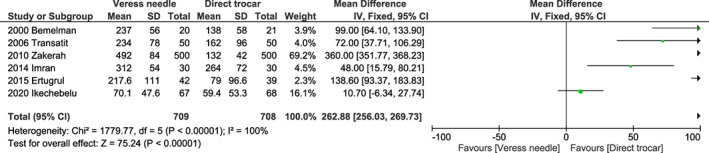
Entry-related complications and total time for entry were compared among the different methods of entry calculating pooled odds ratios (ORs) and mean differences, with 95% confidence intervals (CIs); P < 0.05 was considered significant.
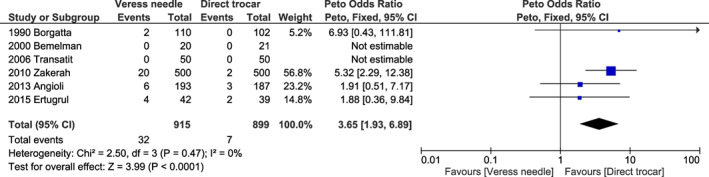
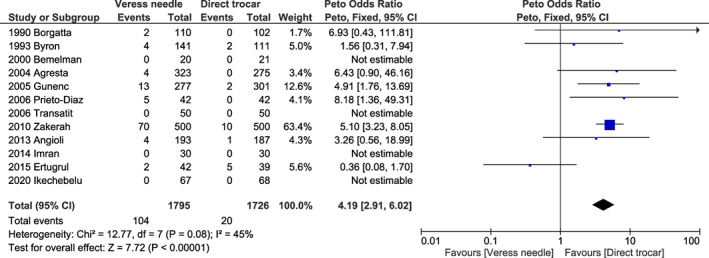
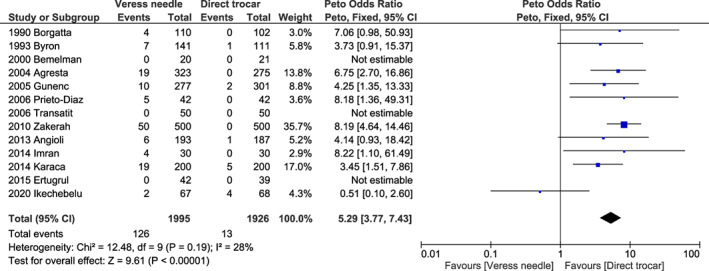
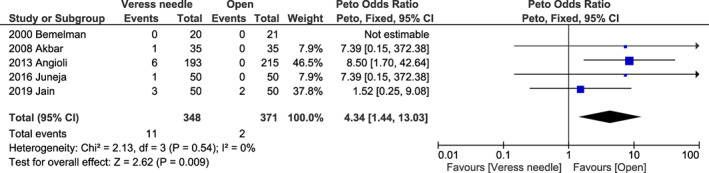
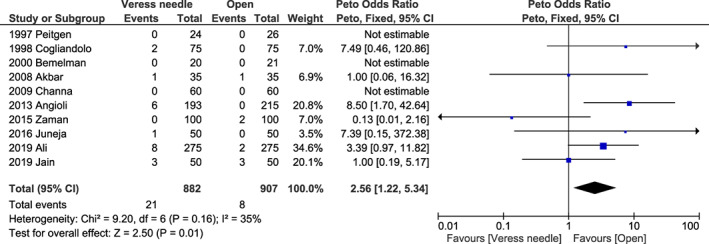
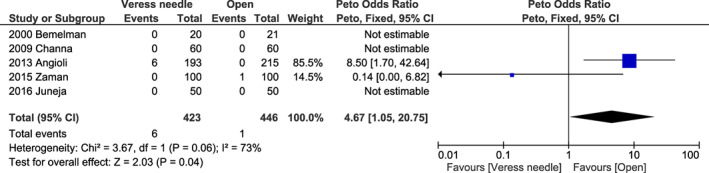
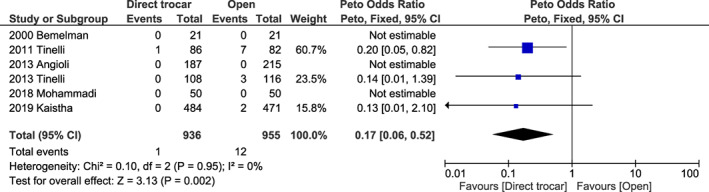
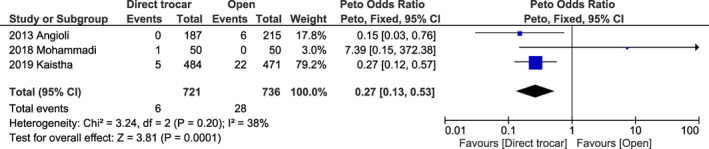
In total, 25 RCTs (6950 patients) were included. Complications considered were vascular, visceral and omental injury, failed entry, extraperitoneal insufflation, bleeding and infection at the trocar site bleeding, and incisional hernia. Compared to direct trocar, the OR for Veress needle was significantly higher for omental injury (OR 3.65, P < 0.001), for failed entry (OR 4.19, P < 0.001), and for extraperitoneal insufflation (OR 5.29, P < 0.001). Compared to the open method, the OR for Veress needle was significantly higher for omental injury (OR 4.93, P = 0.001), for failed entry (OR 2.99, P < 0.001), for extraperitoneal insufflation (OR 4.77; P = 0.04), and for incisional hernia. Compared to the open method, the OR for direct trocar was significantly lower for visceral injury (OR 0.17, P = 0.002) and for trocar site infection (OR 0.27, P = 0.001).
The direct trocar method may be preferred over Veress needle and open methods as a laparoscopic entry technique since it appears associated to a lower risk of complications.
尽管已经争论了二十年,但对于最安全的腹腔镜入路技术仍未达成共识。
更新关于主要不同腹腔镜入路技术安全性的证据。
从成立到 2021 年 2 月,对六个电子数据库进行了搜索。
所有比较不同腹腔镜入路技术的随机对照试验(RCT)均包括在内。
比较不同入路方法的入路相关并发症和入路总时间,计算汇总优势比(OR)和均数差,置信区间(CI)为 95%;P<0.05 被认为具有统计学意义。
共纳入 25 项 RCT(6950 例患者)。考虑的并发症包括血管、内脏和网膜损伤、入路失败、腹膜外充气、套管部位出血和感染、切口疝。与直接套管相比,Veress 针的网膜损伤(OR 3.65,P<0.001)、入路失败(OR 4.19,P<0.001)和腹膜外充气(OR 5.29,P<0.001)的 OR 显著更高。与开放方法相比,Veress 针的网膜损伤(OR 4.93,P=0.001)、入路失败(OR 2.99,P<0.001)、腹膜外充气(OR 4.77;P=0.04)和切口疝的 OR 显著更高。与开放方法相比,直接套管的内脏损伤(OR 0.17,P=0.002)和套管部位感染(OR 0.27,P=0.001)的 OR 显著更低。
与 Veress 针和开放方法相比,直接套管方法作为腹腔镜入路技术可能更具优势,因为它似乎与并发症风险较低相关。