Department of Medicine, Department of Pediatrics, Indiana University School of Medicine, Indianapolis, IN 46202, USA.
J Clin Endocrinol Metab. 2022 Dec 17;108(1):209-220. doi: 10.1210/clinem/dgac488.
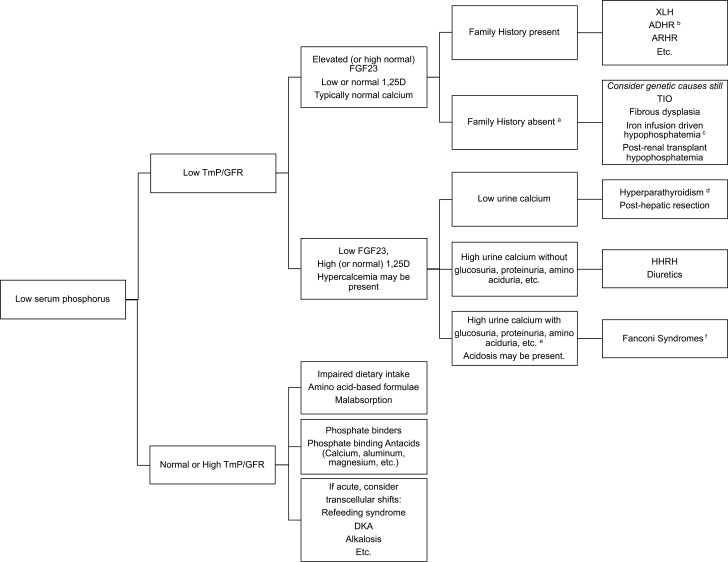
Hypophosphatemic rickets typically presents in infancy or early childhood with skeletal deformities and growth plate abnormalities. The most common causes are genetic (such as X-linked hypophosphatemia), and these typically will result in lifelong hypophosphatemia and osteomalacia. Knowledge of phosphate metabolism, including the effects of fibroblast growth factor 23 (FGF23) (an osteocyte produced hormone that downregulates renal phosphate reabsorption and 1,25-dihydroxyvitamin-D (1,25(OH)2D) production), is critical to determining the underlying genetic or acquired causes of hypophosphatemia and to facilitate appropriate treatment. Serum phosphorus should be measured in any child or adult with musculoskeletal complaints suggesting rickets or osteomalacia. Clinical evaluation incudes thorough history, physical examination, laboratory investigations, genetic analysis (especially in the absence of a guiding family history), and imaging to establish etiology and to monitor severity and treatment course. The treatment depends on the underlying cause, but often includes active forms of vitamin D combined with phosphate salts, or anti-FGF23 antibody treatment (burosumab) for X-linked hypophosphatemia. The purpose of this article is to explore the approach to evaluating hypophosphatemic rickets and its treatment options.
低磷性佝偻病通常在婴儿期或幼儿期出现骨骼畸形和生长板异常。最常见的原因是遗传性的(如 X 连锁低磷血症),这些通常会导致终身低磷血症和骨软化症。了解磷酸盐代谢,包括成纤维细胞生长因子 23(FGF23)的作用(一种成骨细胞产生的激素,可下调肾脏磷酸盐重吸收和 1,25-二羟维生素 D(1,25(OH)2D)的产生),对于确定低磷血症的潜在遗传或获得性原因以及促进适当的治疗至关重要。任何有骨骼肌肉投诉的儿童或成人,若提示佝偻病或骨软化症,都应测量血清磷。临床评估包括详细的病史、体格检查、实验室检查、基因分析(尤其是在缺乏指导家族史的情况下)以及影像学检查,以确定病因并监测严重程度和治疗过程。治疗取决于潜在的病因,但通常包括活性维生素 D 与磷酸盐盐联合治疗,或针对 X 连锁低磷血症的抗 FGF23 抗体治疗(布罗索尤单抗)。本文旨在探讨评估低磷性佝偻病及其治疗选择的方法。