Department of Clinical Medicine, Aarhus University, Palle Juul-Jensens Boulevard 99, 8200, Aarhus N, Denmark.
Natural History Museum of Denmark, University of Copenhagen, Copenhagen, Denmark.
BMC Biol. 2022 Aug 19;20(1):180. doi: 10.1186/s12915-022-01354-8.
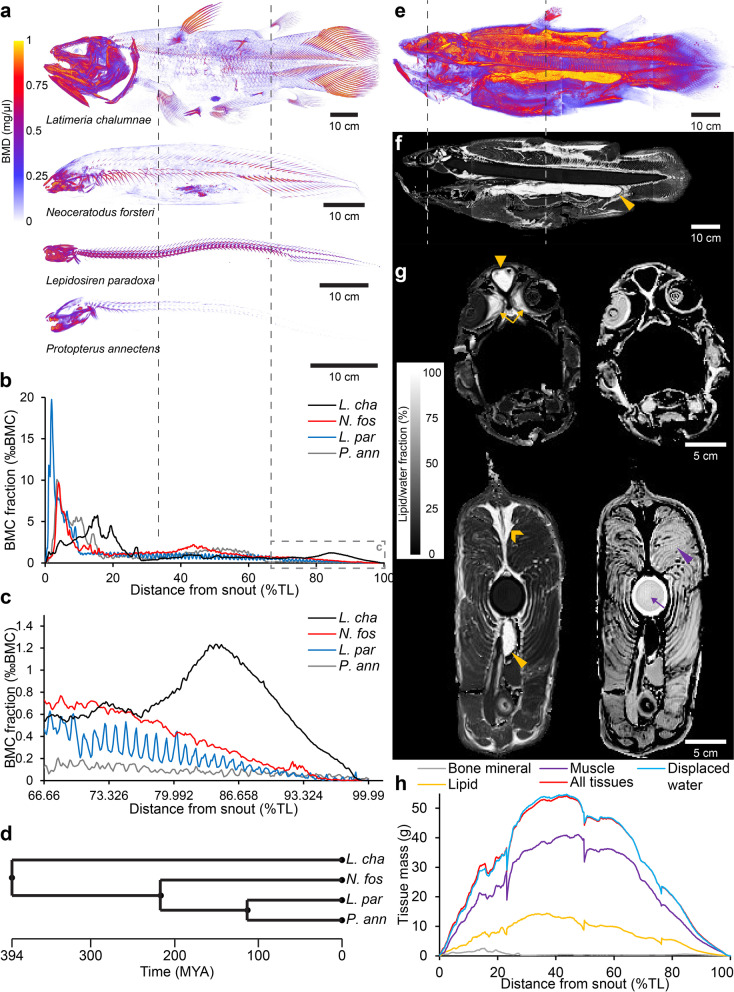
Buoyancy and balance are important parameters for slow-moving, low-metabolic, aquatic organisms. The extant coelacanths have among the lowest metabolic rates of any living vertebrate and can afford little energy to keep station. Previous observations on living coelacanths support the hypothesis that the coelacanth is neutrally buoyant and in close-to-perfect hydrostatic balance. However, precise measurements of buoyancy and balance at different depths have never been made. RESULTS: Here we show, using non-invasive imaging, that buoyancy of the coelacanth closely matches its depth distribution. We found that the lipid-filled fatty organ is well suited to support neutral buoyancy, and due to a close-to-perfect hydrostatic balance, simple maneuvers of fins can cause a considerable shift in torque around the pitch axis allowing the coelacanth to assume different body orientations with little physical effort.
Our results demonstrate a close match between tissue composition, depth range and behavior, and our collection-based approach could be used to predict depth range of less well-studied coelacanth life stages as well as of deep sea fishes in general.
浮力和平衡对于行动缓慢、新陈代谢率低的水生生物非常重要。现存的腔棘鱼是所有活体脊椎动物中新陈代谢率最低的物种之一,它们几乎没有能量来保持静止状态。对活体腔棘鱼的先前观察支持了腔棘鱼是中性浮力且接近完全静水力学平衡的假说。然而,对于不同深度下的浮力和平衡的精确测量从未进行过。
在这里,我们使用非侵入性成像技术表明,腔棘鱼的浮力与其深度分布密切匹配。我们发现,充满脂肪的脂肪器官非常适合支持中性浮力,并且由于接近完全的静水力学平衡,鳍的简单动作可以导致围绕俯仰轴的扭矩发生相当大的变化,从而使腔棘鱼能够以较小的体力呈现出不同的身体姿态。
我们的结果表明组织组成、深度范围和行为之间非常匹配,我们基于样本的方法可以用来预测研究较少的腔棘鱼生活阶段以及一般深海鱼类的深度范围。