Clinical Department of Infectious Diseases and Research, HIV/AIDS Unit, National Institute for Infectious Diseases Lazzaro Spallanzani Istituto di Ricovero e Cura a Carattere Scientifico, Rome, Italy.
Clinical Department of Infectious Diseases and Research, Psychology Service, National Institute for Infectious Diseases Lazzaro Spallanzani Istituto di Ricovero e Cura a Carattere Scientifico, Rome, Italy.
Clin Infect Dis. 2023 Feb 8;76(3):e629-e637. doi: 10.1093/cid/ciac658.
HIV-associated neurocognitive disorders (HAND) have been suggested as persistent even with effective antiretroviral therapy (ART). Aims were to evaluate HAND prevalence and associated factors, in a large cohort of people-with-HIV (PWH).
ART-treated PWH, underwent a neuropsychological examination through a battery of 12 tests exploring 5 different domains, between 2009 and 2020, were included in this cross-sectional analysis. HAND were classified according to Frascati's criteria. Participants were defined as complaining or not-complaining if a cognitive complaint was reported or not. Chi-square for trend and multivariable logistic regression were fitted.
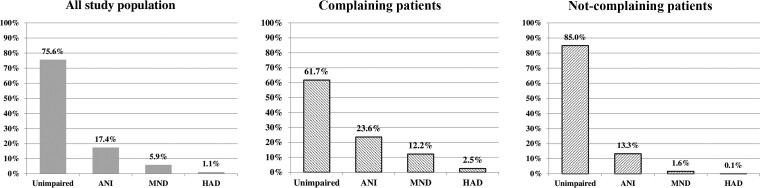
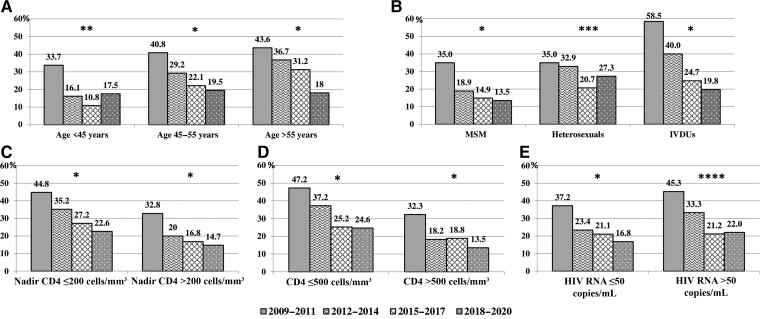
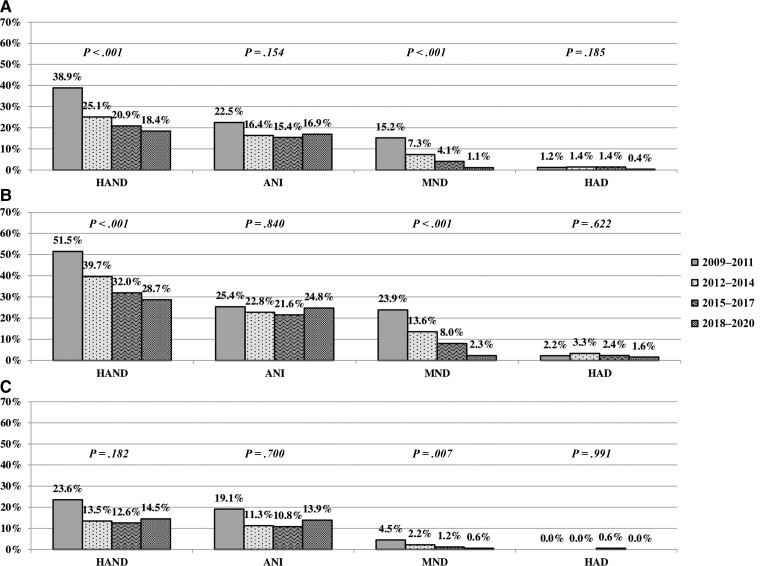
Overall, 1424 PWH were enrolled during four three-years periods. HAND prevalence was 24%; among complainers (572/1424), it was 38%, higher than among not-complainers (15%). Over the study period, a decreasing HAND prevalence was found in the entire population (P < 0.001) and in complaining (P < 0.001); in not-complaining it remained stable (P = 0.182). Factors associated with HAND were older age, lower educational level, lower current CD4+ T-cell count and HCV co-infection. Compared to nonnucleoside reverse transcriptase inhibitors, receiving dual and integrase strand transfer inhibitor (INSTI)-based therapies was associated with a decreased risk of HAND, as well as being tested in more recent years.
In this large cohort of ART-treated PWH, mostly virologically suppressed, a remarkable decreasing HAND prevalence was observed. Besides HIV- and patient-related factors, the reduced risk of HAND found with dual and INSTI-based regimens along with a more recent ART initiation, could suggest a potential role of new treatment strategies in this decline, due to their greater virologic efficacy and better tolerability.
HIV 相关神经认知障碍(HAND)在接受有效的抗逆转录病毒治疗(ART)后仍被认为持续存在。目的是评估大量 HIV 感染者(PWH)中 HAND 的流行率及其相关因素。
2009 年至 2020 年期间,对接受 ART 治疗的 PWH 进行了一项神经心理测试,使用 12 项测试的测试组评估了 5 个不同的领域,在此横断面分析中纳入了这些 PWH。根据 Frascati 标准对 HAND 进行分类。如果报告了认知主诉,则将参与者定义为主诉者或非主诉者。拟合了卡方趋势检验和多变量逻辑回归。
总体而言,在四个三年期间共纳入了 1424 名 PWH。HAND 的患病率为 24%;在主诉者(572/1424)中,患病率为 38%,高于非主诉者(15%)。在研究期间,整个人群(P < 0.001)和主诉者(P < 0.001)的 HAND 患病率均呈下降趋势;而非主诉者的患病率则保持稳定(P = 0.182)。与 HAND 相关的因素包括年龄较大、受教育程度较低、当前 CD4+ T 细胞计数较低和 HCV 合并感染。与非核苷类逆转录酶抑制剂相比,接受双重和整合酶抑制剂(INSTI)为基础的治疗与 HAND 风险降低相关,以及在更近的年份进行检测也与 HAND 风险降低相关。
在这项针对接受 ART 治疗的、大多数病毒学上得到抑制的 PWH 的大型队列研究中,HAND 的患病率显著下降。除了 HIV 和患者相关因素外,发现双重和 INSTI 为基础的方案以及更近期开始 ART 治疗的 HAND 风险降低,可能表明新的治疗策略在这一下降中发挥了潜在作用,因为它们具有更高的病毒学疗效和更好的耐受性。