Forma Felicia, Knight Tyler G, Thorndike Frances P, Xiong Xiaorui, Baik Rebecca, Velez Fulton F, Maricich Yuri A, Malone Daniel C
Pear Therapeutics, Inc., Medical Affairs Department, Boston, MA, USA.
Labcorp Drug Development, Market Access Consulting Department, Gaithersburg, MD, USA.
Clinicoecon Outcomes Res. 2022 Aug 10;14:537-546. doi: 10.2147/CEOR.S368780. eCollection 2022.
This analysis evaluated insomnia severity and long-term impact on healthcare resource utilization (HCRU) and costs after treatment with Somryst (previously called SHUTi), a digital therapeutic delivering cognitive behavioral therapy for insomnia (CBT-I).
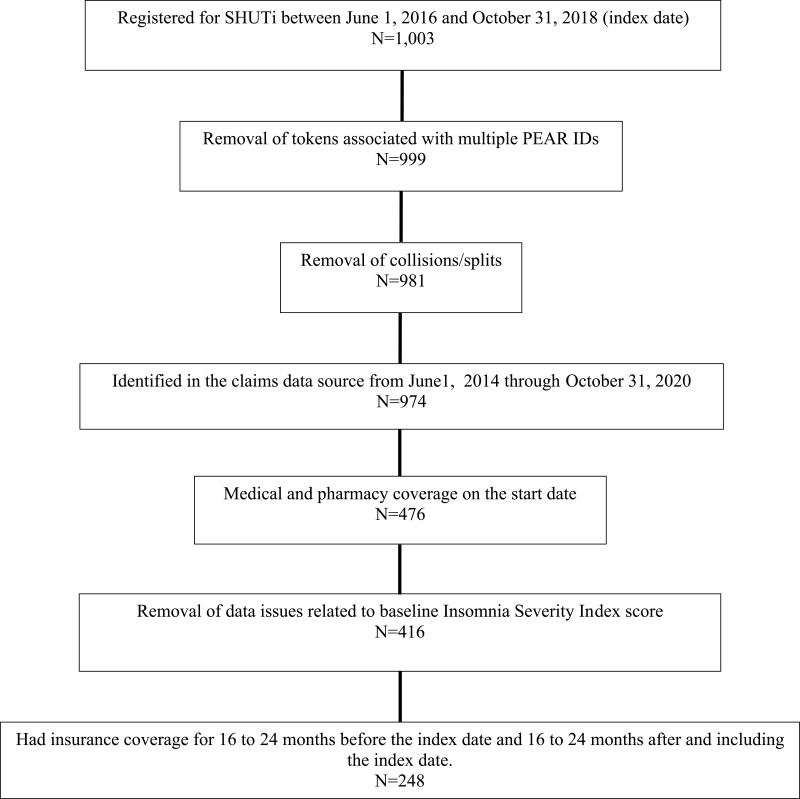
Change from baseline in insomnia severity index (ISI) score was assessed using last observed ISI score. A pre/post analysis of claims data was conducted, comparing HCRU in patients with self-identified sleep problems who successfully initiated the therapeutic (index date) between June 1, 2016 and December 31, 2018.
A total of 248 patients were analyzed (median age 56.5 years, 57.3% female, mean ISI score 19.13, 52.4% treated with sleep aid medications pre-index). After 9 weeks, mean ISI score declined by 37.2% from baseline (19.1 vs 12.0), 58.8% of patients achieved ISI responder status (ISI score improved by =>7; NNT: 1.7), and 26.6% of patients achieved insomnia remission (ISI score <8; NNT for remission: 3.8). After two-year follow-up, post-index events were reduced (compared to 2 years pre-index) for emergency department visits (-53%; IRR: 0.47; 95% CI 0.27, 0.82; =0.008), hospiatizations (-21%; IRR: 0.79; 95% CI 0.46, 1.35; =0.389) and hospital outpatient visits (-13%; IRR: 0.87; 95% CI 0.66, 1.14; =0.315). Slightly increased rates were observed for ambulatory surgical center visits (2%; IRR: 1.02; 95% CI 0.73, 1.44; =0.903) and office visits (2%; IRR: 1.02; 95% CI 0.92, 1.14; =0.672). The number of patients treated with sleep aid medications dropped 18.5% (52.4% pre-index vs 42.7% post-index). Average number of prescriptions decreased from 3.98 pre-index to 3.73 post-index (= 0.552). Total two-year cost reduction post-index vs pre-index was $510,678, or -$2059 per patient.
In a real-world cohort of patients with chronic insomnia, treatment with a digital therapeutic delivering CBT-I was associated with reductions in insomnia severity, emergency department visits, and net costs.
本分析评估了使用Somryst(以前称为SHUTi)治疗后失眠的严重程度及其对医疗资源利用(HCRU)和成本的长期影响。Somryst是一种提供失眠认知行为疗法(CBT-I)的数字疗法。
使用最后观察到的失眠严重程度指数(ISI)评分评估其相对于基线的变化。对索赔数据进行前后分析,比较2016年6月1日至2018年12月31日期间成功启动该疗法(索引日期)的自我认定有睡眠问题的患者的医疗资源利用情况。
共分析了248例患者(中位年龄56.5岁,57.3%为女性,平均ISI评分为19.13,52.4%在索引前使用助眠药物治疗)。9周后,平均ISI评分较基线下降了37.2%(从19.1降至12.0),58.8%的患者达到ISI缓解状态(ISI评分改善≥7;治疗需人数:1.7),26.6%的患者实现失眠缓解(ISI评分<8;缓解治疗需人数:3.8)。经过两年的随访,索引后急诊就诊次数(与索引前两年相比)减少了53%(发生率比:0.47;95%置信区间0.27,0.82;P = 0.008),住院次数减少了21%(发生率比:0.79;95%置信区间0.46,1.35;P = 0.389),医院门诊就诊次数减少了13%(发生率比:0.87;95%置信区间0.66,1.14;P = 0.315)。门诊手术中心就诊次数(2%)和门诊就诊次数(2%)略有增加(发生率比:1.02;95%置信区间0.73,1.44;P = 0.903;发生率比:1.02;95%置信区间0.92,1.14;P = 0.672)。使用助眠药物治疗的患者人数下降了18.5%(索引前为52.4%,索引后为42.7%)。平均处方数量从索引前的3.98降至索引后的3.73(P = 0.552)。索引后与索引前相比,两年总成本降低了510,678美元,即每位患者降低2059美元。
在一个慢性失眠患者的真实队列中,使用提供CBT-I的数字疗法进行治疗与失眠严重程度降低、急诊就诊次数减少和净成本降低相关。