Department of Medicine, School of Medicine, College of Health Sciences, Makerere University, Kampala, Uganda.
Ifakara Health Institute, Ifakara, Tanzania.
PLoS One. 2022 Aug 19;17(8):e0268122. doi: 10.1371/journal.pone.0268122. eCollection 2022.
Uganda adopted the HIV Test and Treat in 2016. There is paucity of data about its implementation among hospitalized patients. We aimed to determine the proportion of patients initiating anti-retroviral therapy (ART) during hospitalization, barriers and mortality outcome.
In this mixed methods cohort study, we enrolled hospitalized patients with a recent HIV diagnosis from three public hospitals in Uganda. We collected data on clinical characteristics, ART initiation and reasons for failure to initiate ART, as well as 30 day outcomes. Healthcare workers in-depth interviews were also conducted and data analyzed by sub-themes.
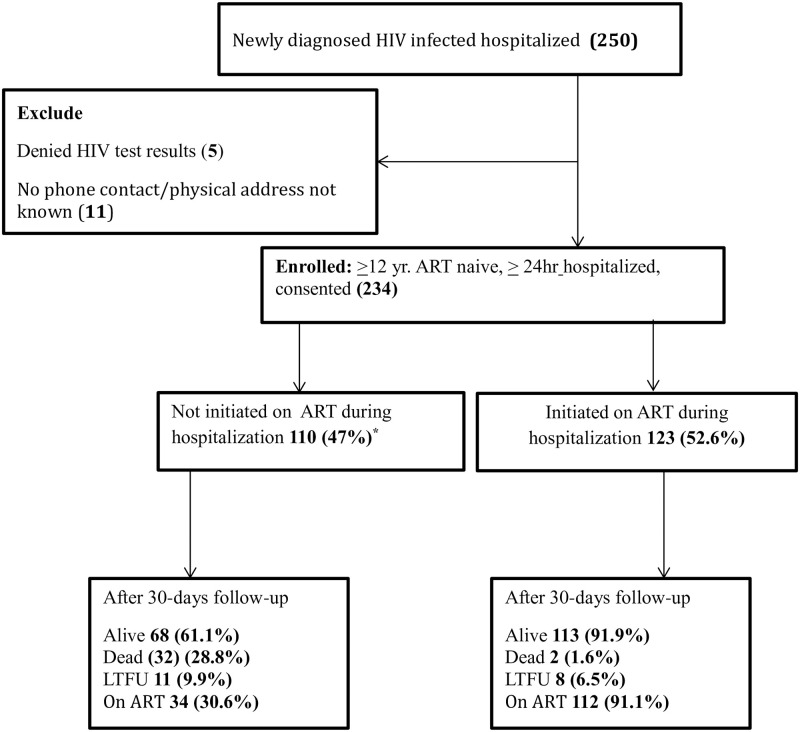
We enrolled 234 patients; females 140/234 (59.8%), median age 34.5 years (IQR 29-42), 195/234 (83.7%) had WHO HIV stage 3 or 4, and 74/116 (63.8%) had CD4 ≤ 200 cell/μL. The proportion who initiated ART during hospitalization was 123/234 (52.6%) (95% CI 46.0-59.1), of these 35/123 (28.5%) initiated ART on the same day of hospitalization, while 99/123 (80.5%) within a week of hospitalization. By 30 days 34/234 (14.5%) (95% CI 10.3-19.7) died. Patients residing ≥ 35 kilometers from the hospital were more likely not to initiate ART during hospitalization, [aRR = 1.39, (95% CI 1.22-1.59). Inadequate patient preparation for ART initiation and advanced HIV disease were highlighted as barriers of ART initiation during hospitalization.
In this high HIV prevalence setting, only half of newly diagnosed HIV patients are initiated on ART during hospitalization. Inadequate pre-ART patient preparation and advanced HIV are barriers to rapid ART initiation among hospitalized patients in public hospitals.
乌干达于 2016 年采用了 HIV 检测和治疗方法。关于该方法在住院患者中的实施情况,数据匮乏。我们旨在确定在住院期间开始抗逆转录病毒治疗 (ART) 的患者比例、障碍和死亡率结果。
在这项混合方法队列研究中,我们招募了来自乌干达三家公立医院的最近诊断出 HIV 的住院患者。我们收集了临床特征、ART 启动以及未能启动 ART 的原因以及 30 天结局的数据。我们还对医护人员进行了深入访谈,并按子主题对数据进行了分析。
我们共招募了 234 名患者;女性 140/234(59.8%),中位年龄 34.5 岁(IQR 29-42),195/234(83.7%)患有世界卫生组织(WHO)HIV 第 3 或 4 期疾病,74/116(63.8%)CD4 细胞数≤200 个/μL。在住院期间开始 ART 的比例为 123/234(52.6%)(95%CI 46.0-59.1),其中 35/123(28.5%)在住院当天开始 ART,而 99/123(80.5%)在住院后一周内开始 ART。在 30 天内,有 34/234(14.5%)(95%CI 10.3-19.7)死亡。与居住在距离医院≥35 公里的患者相比,他们更不可能在住院期间开始 ART,[调整后的风险比(aRR)=1.39,(95%CI 1.22-1.59)]。研究强调,对 ART 启动的患者准备不足和 HIV 疾病的进展是在住院期间启动 ART 的障碍。
在 HIV 流行率较高的环境中,只有一半新诊断的 HIV 患者在住院期间开始接受 ART。在公立医院中,对接受 ART 治疗的患者准备不足和 HIV 疾病的进展是阻碍住院患者快速开始 ART 的障碍。