Kamel Alshaimaa Abdel Fattah, Medhat Marwa Mohamed, Salem Dina Abdelhameed Elsadek, Naby Sara Mohamed Abdel
Anesthesia, Intensive Care and Pain Management Department, Faculty of Human Medicine, Zagazig University, Alsharkia, Egypt.
Patient Saf Surg. 2022 Aug 19;16(1):27. doi: 10.1186/s13037-022-00336-7.
Maintenance of adequate peripheral perfusion during controlled hypotension is necessary for patient safety and improved surgical outcomes during controlled hypotension in nasal surgery. The hypothesis of this study was to investigate the effect of perioperative magnesium sulfate and labetalol infusion on peripheral perfusion and postoperative pain in patients undergoing nasal surgery.
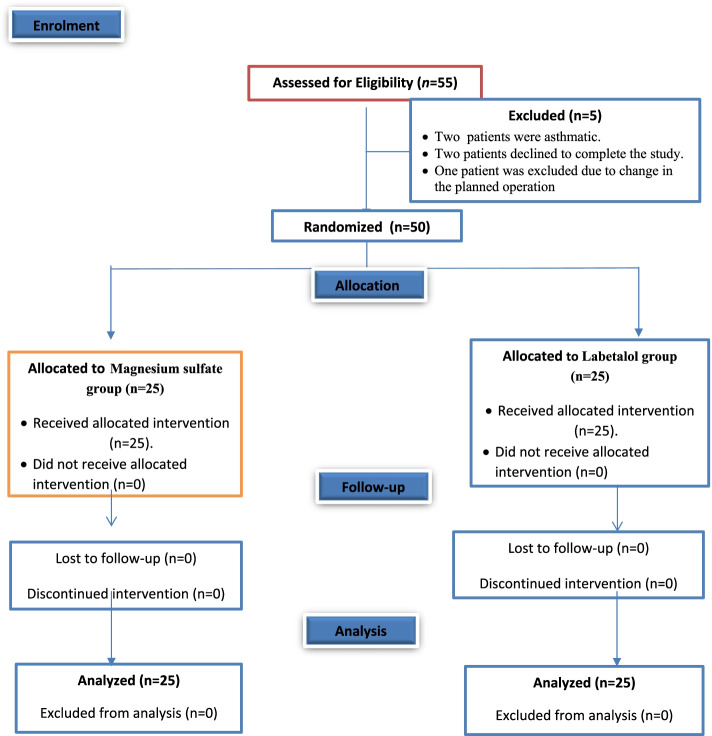
A total of 50 patients were randomly assigned into two equal groups in this double-blind clinical study: the magnesium sulfate group; received 40 mg/kg loading dose of intravenous (IV) magnesium sulfate followed by 10-15 mg/kg/h continuous IV infusion and the labetalol group; received 0.25 mg/kg loading dose of IV labetalol followed by 0.5-1 mg/kg/h continuous IV infusion to achieve a mean arterial blood pressure (MABP) of = 55-65 mmHg. The primary outcome was to compare the effect of perioperative magnesium sulfate and labetalol infusion on peripheral perfusion during nasal surgery. The secondary outcomes were the assessment of serum lactate, postoperative pain, time to the first call for pethidine (rescue analgesic) and total pethidine consumption.
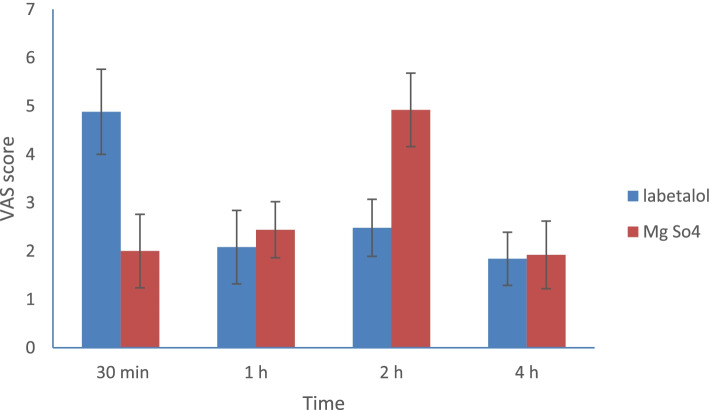
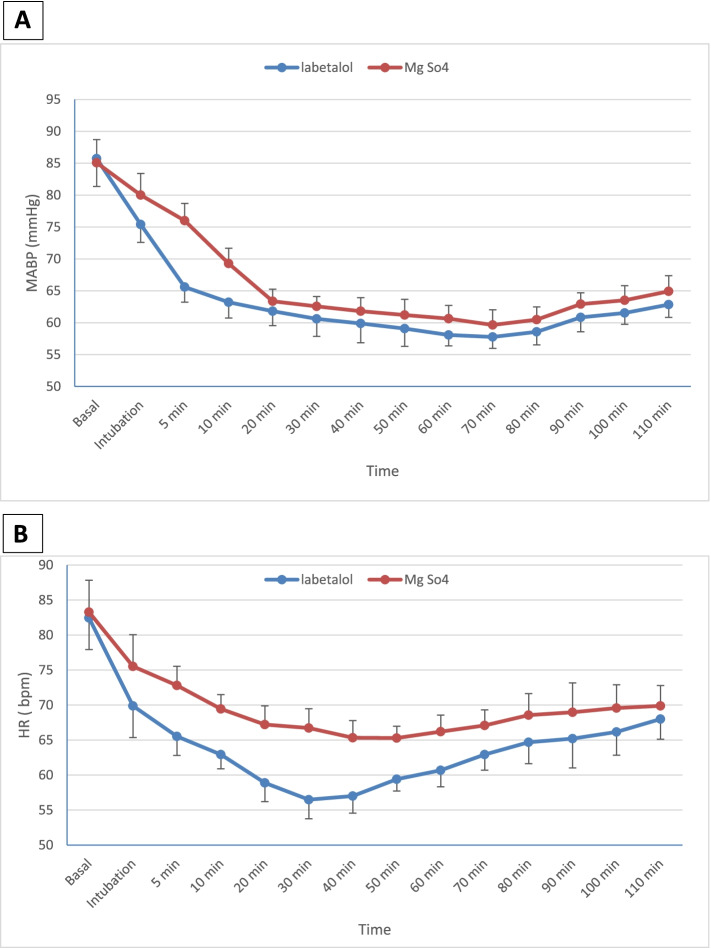
PPI was comparable between the groups at baseline, intubation, and 5 min. In contrast, magnesium sulfate group had a significantly higher PPI than the labetalol group. The magnesium sulfate group had a significantly higher MABP and heart rate compared to labetalol group. The time to reach the target MABP was significantly prolonged in magnesium sulfate than the labetalol group [21.6 ± 1.7 vs 6.9 ± 1.5] min. VAS scores were significantly lower for 2 hs postoperatively in the magnesium sulfate group than the labetalol group. The time to first call of pethidine was significantly prolonged in the magnesium sulfate group compared to the labetalol group [113.1 ± 5.2 vs 28.2 ± 1.5] min.
Magnesium sulfate maintains wider PPI and offers better postoperative pain relief compared to labetalol during induced hypotension in nasal surgery.
Institutional review board approval (ref: 6601/20-12-2020).
gov (ref: NCT04688203 , date of registration: 29 -12-2020).
在鼻腔手术控制性低血压期间,维持充足的外周灌注对于患者安全及改善手术结局是必要的。本研究的假设是探讨围手术期静脉输注硫酸镁和拉贝洛尔对鼻腔手术患者外周灌注及术后疼痛的影响。
在这项双盲临床研究中,共50例患者被随机分为两组,每组人数相等:硫酸镁组,静脉注射40mg/kg负荷剂量的硫酸镁,随后以10 - 15mg/kg/h持续静脉输注;拉贝洛尔组,静脉注射0.25mg/kg负荷剂量的拉贝洛尔,随后以0.5 - 1mg/kg/h持续静脉输注,以使平均动脉血压(MABP)维持在55 - 65mmHg。主要结局是比较围手术期静脉输注硫酸镁和拉贝洛尔对鼻腔手术期间外周灌注的影响。次要结局包括血清乳酸评估、术后疼痛、首次呼叫哌替啶(解救镇痛药)的时间及哌替啶总消耗量。
两组在基线、插管时及5分钟时的外周灌注指数(PPI)相当。相比之下,硫酸镁组的PPI显著高于拉贝洛尔组。硫酸镁组的MABP和心率显著高于拉贝洛尔组。与拉贝洛尔组相比,硫酸镁组达到目标MABP的时间显著延长[21.6±1.7 vs 6.9±1.5]分钟。术后2小时,硫酸镁组的视觉模拟评分(VAS)显著低于拉贝洛尔组。与拉贝洛尔组相比,硫酸镁组首次呼叫哌替啶的时间显著延长[113.1±5.2 vs 28.2±1.5]分钟。
在鼻腔手术诱导性低血压期间,与拉贝洛尔相比,硫酸镁可维持更宽的外周灌注指数,并提供更好的术后疼痛缓解。
机构审查委员会批准(编号:6601/20 - 12 - 2020)。
美国国立医学图书馆临床试验注册库(编号:NCT04688203,注册日期:2020年12月29日)