Head of School, School of Health Professions, University of Plymouth, Drake Circus, Plymouth, PL4 8AA, Devon, UK.
Research Fellow, School of Health Professions, University of Plymouth, Drake Circus, Plymouth, PL4 8AA, Devon, UK.
J Foot Ankle Res. 2022 Aug 19;15(1):63. doi: 10.1186/s13047-022-00566-z.
The concept of person-centred care is embedded within healthcare policy, focusing on long-term conditions and multimorbidity. The evidence that person-centred care is being operationalised effectively across all areas of healthcare is limited. The aim of this scoping review was to explore the application, features, and effectiveness of person-centred care with service-users, carers, and the community within podiatry.
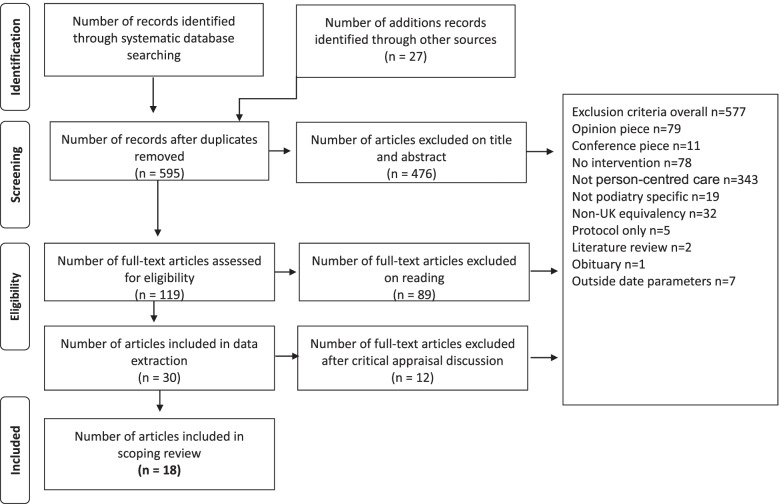
The scoping review was based upon Arksey and Malley's five stage framework. The following databases were searched between January 2010 and March 2021: AMED, CINAHL, Embase, Cochrane library, SocINDEX, British Education Index, Business Source Complete, MEDLINE (EBSCO), and the EThOS 'Global electronic thesis and dissertation' repository, Prospero, and reference lists of included papers. Primary research articles were included if they reported on a person-centred care focused intervention with podiatry. Research terms were developed, appropriate databases identified, and an initial search resulted in 622 papers which, following removal of duplicates and critical appraisal, resulted in 18 eligible papers. Data extracted involved the types of person-centred care utilised, intervention details, motivations for engaging in person-centred care interventions, and intervention barriers and challenges.
Eighteen articles were included in the review. The main type of person-centred care utilised was patient/carer activities around self-management. None of the studies considered the role of the podiatrist as a person-centred care agent. The data on interventions generated the following themes 'service facilitated person-centred care' where a change has been made to service delivery, 'direct clinician delivery' where the intervention is delivered by the clinician with the patient present and 'patient instigated participation' where patient motivation is required to engage with an activity beyond the consultation. Outcome measures associated with quality of care and effectiveness were absent.
There is a lack of congruency between the concept of person-centred care and how it is operationalised. A whole system approach that considers commissioning, organisational leadership, the role of the practitioners and patients has not been considered. There is immense scope for the podiatrist to play an important part in the personalised-care agenda, but currently research that can evidence the effectiveness of person-centred care in podiatry is absent.
Open Science Framework ( osf.io/egjsd ).
以人为本的护理理念嵌入医疗保健政策中,注重慢性病和多种疾病。证据表明,以人为本的护理在医疗保健的各个领域都得到了有效实施,但这方面的证据有限。本综述的目的是探讨足病学中患者、护理人员和社区中以人为本的护理的应用、特点和效果。
本综述基于 Arksey 和 Malley 的五阶段框架进行。在 2010 年 1 月至 2021 年 3 月期间,对以下数据库进行了搜索:AMED、CINAHL、Embase、Cochrane 图书馆、SocINDEX、英国教育索引、商业资源全文数据库、MEDLINE(EBSCO)和 EThOS“全球电子论文和论文”知识库、Prospéro 和纳入论文的参考文献列表。如果研究报告的是以人为中心的护理为重点的足病学干预措施,则纳入初步研究文章。制定了研究术语,确定了合适的数据库,并进行了初步搜索,得到了 622 篇论文,经过重复项删除和批判性评价,最终纳入了 18 篇符合条件的论文。提取的数据涉及所使用的以人为本的护理类型、干预措施细节、参与以人为本的护理干预的动机以及干预的障碍和挑战。
综述共纳入 18 篇文章。使用的主要以人为本的护理类型是患者/护理人员围绕自我管理的活动。没有研究考虑足病医生作为以人为本的护理代理人的角色。干预措施的数据生成了以下主题:“服务促进以人为本的护理”,其中服务提供方式发生了变化;“直接临床医生提供”,其中干预措施由临床医生在患者在场的情况下提供;“患者主动参与”,患者需要参与咨询之外的活动。与护理质量和效果相关的结果衡量指标缺失。
以人为本的护理理念与其实施方式之间存在不一致。尚未考虑整个系统方法,包括委托、组织领导力、从业者的角色以及患者的角色。足病医生在个性化护理议程中发挥重要作用的空间很大,但目前缺乏证明足病学中以人为本的护理有效性的研究。
开放科学框架(osf.io/egjsd)。