Interdisciplinary Department of Social Sciences, Bar-Ilan University, Ramat Gan, Israel.
Department of Family Medicine, USC Keck School of Medicine, 1000 S. Fremont Avenue, Unit 22, HSA Building A-6, Alhambra, CA, 91803, USA.
BMC Geriatr. 2022 Aug 20;22(1):689. doi: 10.1186/s12877-022-03385-w.
The COVID-19 pandemic has exacerbated circumstances that place older adults at higher risk for abuse, neglect, and exploitation. Identifying characteristics of elder abuse during COVID-19 is critically important. This study characterized and compared elder abuse patterns across two time periods, a one-year period during the pandemic, and a corresponding one-year period prior to the start of the pandemic.
Contacts (including social media contacts, and email; all referred to as "calls" for expediency) made to the National Center on Elder Abuse (NCEA) resource line were examined for differences in types of reported elder abuse and characteristics of alleged perpetrators prior to the pandemic (Time 1; March 16, 2018 to March 15, 2019) and during the pandemic (Time 2; March 16, 2020 to March 15, 2021). Calls were examined for whether or not abuse was reported, the types of reported elder abuse, including financial, physical, sexual, emotional, and neglect, and characteristics of callers, victims, and alleged perpetrators. Chi-square tests of independence compared frequencies of elder abuse characteristics between time periods.
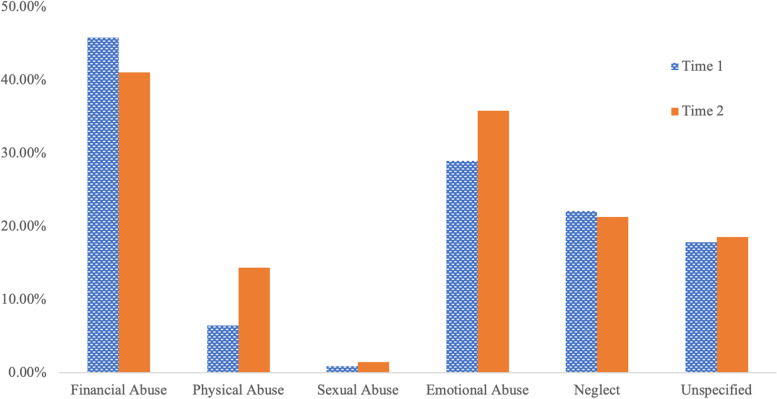
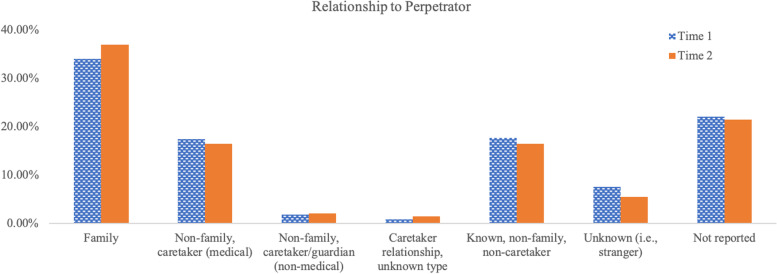
In Time 1, 1401 calls were received, of which 795 calls (56.7%) described abuse. In Time 2, 1009 calls were received, of which 550 calls (54.5%) described abuse. The difference between time periods in frequency of abuse to non-abuse calls was not significant ([Formula: see text]). Time periods also did not significantly differ with regard to caller, victim, and perpetrator characteristics. Greater rates of physical abuse ([Formula: see text] and emotional abuse ([Formula: see text] were reported during Time 2 after adjustment for multiple comparisons. An increased frequency of multiple forms of abuse was also found in Time 2 compared to Time 1 ([Formula: see text].
Findings suggest differences in specific elder abuse subtypes and frequency of co-occurrence between subtypes between time periods, pointing to a potential increase in the severity of elder abuse during COVID-19.
COVID-19 大流行加剧了使老年人面临更高虐待、忽视和剥削风险的情况。确定 COVID-19 期间虐待老人的特征至关重要。本研究对大流行期间和大流行前一年两个时间段的虐待老人模式进行了特征描述和比较。
为了便于说明,将国家老年人虐待问题中心(NCEA)资源热线接到的电话(包括社交媒体和电子邮件)分为两类:大流行前(时间 1:2018 年 3 月 16 日至 2019 年 3 月 15 日)和大流行期间(时间 2:2020 年 3 月 16 日至 2021 年 3 月 15 日)接到的报告虐待老人的电话。这些电话检查了是否报告了虐待行为、报告的虐待老人类型,包括财务、身体、性、情感和忽视,以及来电者、受害者和被指控的施虐者的特征。独立卡方检验比较了两个时间段的虐待老人特征的频率。
在时间 1 中,共收到 1401 个电话,其中 795 个电话(56.7%)描述了虐待行为。在时间 2 中,共收到 1009 个电话,其中 550 个电话(54.5%)描述了虐待行为。在频率上,虐待电话和非虐待电话在两个时间段之间没有显著差异([公式:见正文])。两个时间段在来电者、受害者和施虐者特征方面也没有显著差异。在调整了多次比较后,时间 2 中报告的身体虐待([公式:见正文])和情感虐待([公式:见正文])的比率更高。与时间 1 相比,时间 2 中还发现多种形式虐待的频率增加([公式:见正文])。
研究结果表明,在特定的虐待老人亚型和亚型之间同时发生的频率方面,两个时间段之间存在差异,这表明 COVID-19 期间虐待老人的严重程度可能有所增加。