La Fountaine Michael F, Hohn Asante N, Leahy Caroline L, Weir Joseph P, Testa Anthony J
Department of Physical Therapy, School of Health and Medical Sciences, Seton Hall University, Nutley, NJ, United States.
Departments of Medical Sciences and Neurology, Hackensack Meridian School of Medicine, Nutley, NJ, United States.
Front Neurol. 2022 Aug 5;13:947524. doi: 10.3389/fneur.2022.947524. eCollection 2022.
Post-traumatic headache (PTH) is commonly reported after concussion. Calcitonin gene-related peptide (CGRP) is implicated in the pathogenesis of migraine. We explored how single nucleotide polymorphisms (SNPs) from CGRP-alpha (CALCA) and the receptor activity modifying protein-1 (RAMP1) related to headache burden during the first week after concussion.
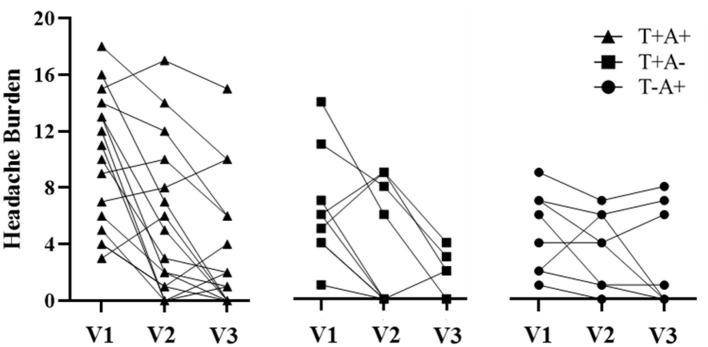
A prospective study was performed in 34 collegiate athletes who sustained a concussion. Participants completed the symptom evaluation checklist from the SCAT3 within 48 h of injury (V1), and again 4 (V2) and 7 (V3) days after injury. For each visit, the self-reported score (0-6) for headache, pressure in head, blurred vision, and sensitivity to light/noise were reported and summed to calculate the headache burden. A saliva sample was obtained and genotyped for CALCA (rs3781719) and RAMP1 (rs10185142). RAMP1 (TT, TC, CC) and CALCA (AA, AG, GG) were dichotomized (A+, A- and T+, T-, respectively), and concatenated (T+A+, T+A-, T-A+, T-A-) for analyses.
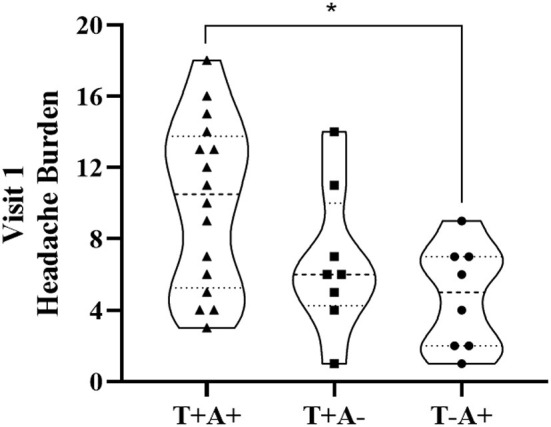
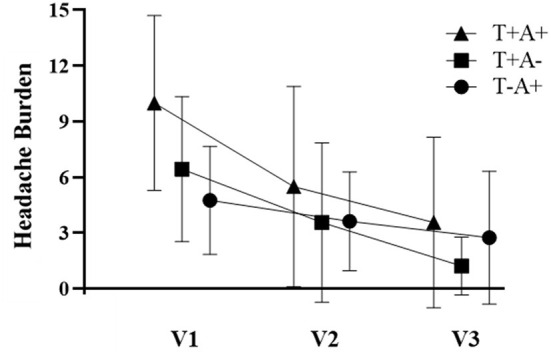
Headache Burden at Visit 1 was greatest in T+A+ compared to T-A+, and trended toward a significant difference with T+A-. Repeated-measures ANOVA revealed the presence of significant visit main effects ( < 0.001, η = 0.404), but the group ( = 0.055) and interaction effects only trended ( = 0.094). Pearson's χ-tests revealed that 88% of those with return-to play (RTP) exclusions ≥15 days had PTH with multi-sensory symptoms (PTH+SENS) as compared to 35% in those with RTP < 14 day.
Knowledge of RAMP1 and CALCA genotypes appear to improve an understanding the presenting features and magnitude of headache burden after concussion injury.
创伤后头痛(PTH)在脑震荡后很常见。降钙素基因相关肽(CGRP)与偏头痛的发病机制有关。我们探讨了CGRP-α(CALCA)和受体活性修饰蛋白-1(RAMP1)的单核苷酸多态性(SNP)与脑震荡后第一周头痛负担的关系。
对34名遭受脑震荡的大学运动员进行了一项前瞻性研究。参与者在受伤后48小时内(V1)、受伤后4天(V2)和7天(V3)再次完成了SCAT3的症状评估清单。每次就诊时,报告头痛、头部压力、视力模糊和对光/噪音敏感的自我报告分数(0-6),并将其相加计算头痛负担。采集唾液样本,对CALCA(rs3781719)和RAMP1(rs10185142)进行基因分型。RAMP1(TT、TC、CC)和CALCA(AA、AG、GG)被二分法分类(分别为A+、A-和T+、T-),并连接起来(T+A+、T+A-、T-A+、T-A-)进行分析。
与T-A+相比,T+A+在第1次就诊时的头痛负担最大,与T+A-相比有显著差异的趋势。重复测量方差分析显示存在显著的就诊主效应(<0.001,η=0.4),但组间效应(=0.055)和交互效应仅呈趋势(=0.094)。Pearson卡方检验显示,与恢复比赛(RTP)<14天的患者相比,RTP排除≥15天的患者中有88%患有伴有多感官症状的PTH(PTH+SENS),而后者为35%。
了解RAMP1和CALCA基因型似乎有助于更好地理解脑震荡损伤后头痛负担的表现特征和严重程度。