
远程重症监护服务的运营分析显示了价值传递、服务随时间的适应性以及远程医疗服务提供者的困扰。
Operation analysis of the tele-critical care service demonstrates value delivery, service adaptation over time, and distress among tele-providers.
作者信息
Laudanski Krzysztof, Huffenberger Ann Marie, Scott Michael J, Williams Maria, Wain Justin, Jablonski Juliane, Hanson C William
机构信息
Department of Anesthesiology and Critical Care, Hospital of the University of Pennsylvania, Philadelphia, PA, United States.
Leonard Davis Institute for Healthcare Economics, Philadelphia, PA, United States.
出版信息
Front Med (Lausanne). 2022 Aug 5;9:883126. doi: 10.3389/fmed.2022.883126. eCollection 2022.
BACKGROUND
Our study addresses the gaps in knowledge of the characterizations of operations by remote tele-critical care medicine (tele-CCM) service providers interacting with the bedside team. The duration of engagements, the evolution of the tele-CCM service over time, and the distress during interactions with the bedside team have not been characterized systematically. These characteristics are critical for planning the deployment of teleICU services and preventing burnout among remote teleICU providers.
METHODS
REDCap self-reported activity logs collected engagement duration, triggers (), expediency, nature (, communication modes, and acceptance. Seven hospitals with 16 ICUs were overseen between 9/2020 and 9/2021 by teams consisting of telemedicine medical doctors (eMD), telemedicine registered nurses (eRN), and telemedicine respiratory therapists (eRT).
RESULTS
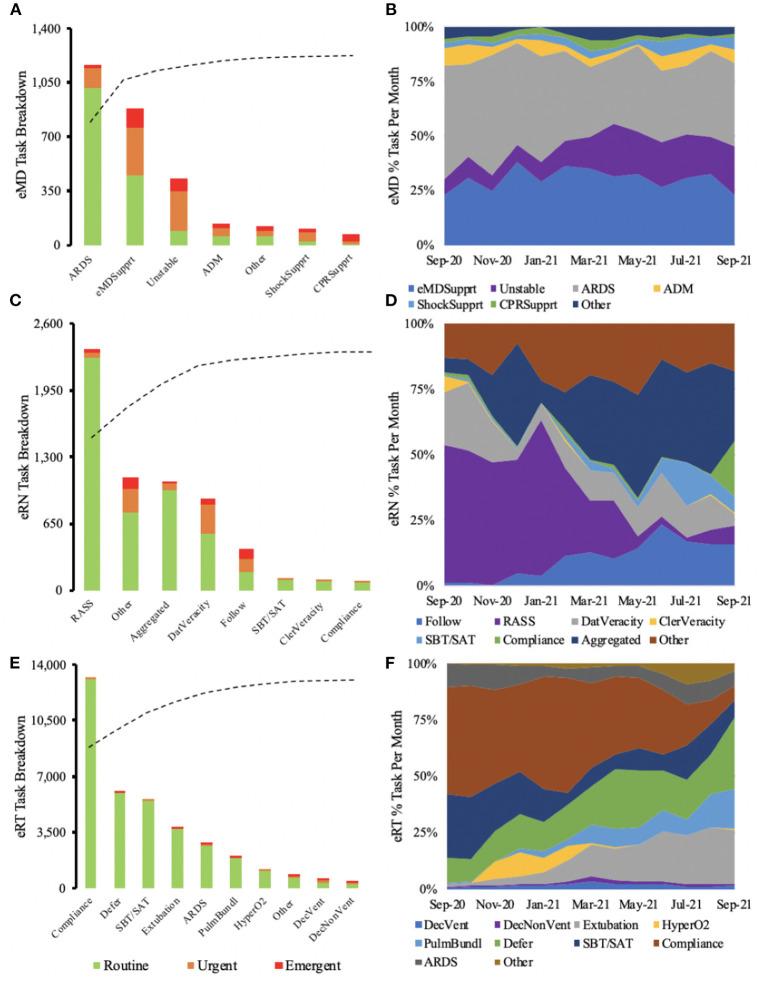
39,915 total engagements were registered. eMDs had a significantly higher percentage of and engagements (31.9%) vs. eRN (9.8%) or eRT (1.7%). The average intervention took 16.1 ± 10.39 min for eMD, 18.1 ± 16.23 for eRN, and 8.2 ± 4.98 min for eRT, significantly varied between engagement, and expediency, hospitals, and ICUs types. During the observation period, there was a shift in intervention triggers with an increase in concomitant with predominant utilization of engagements, and the of electronic medical records at the expense of the share of . eRT communicated more frequently with bedside staff (% MD = 37.8%; % RN = 36.8, % RT = 49.0%) but mostly with other eRTs. In contrast, the eMD communicated with all ICU stakeholders while the eRN communicated chiefly with other RN and house staff at the patient's bedside. The rate of distress reported by tele-CCM staff was 2% among all interactions, with the entity hospital being the dominant factor.
CONCLUSIONS
Delivery of tele-CCM services has to be tailored to the specific beneficiary of tele-CCM services to optimize care delivery and minimize distress. In addition, the duration of the average intervention must be considered while creating an efficient workflow.
背景
我们的研究旨在填补远程重症监护医学(远程CCM)服务提供者与床边团队互动时操作特征方面的知识空白。参与时长、远程CCM服务随时间的演变以及与床边团队互动期间的困扰尚未得到系统描述。这些特征对于规划远程重症监护病房(teleICU)服务的部署以及预防远程teleICU提供者的倦怠至关重要。
方法
通过REDCap自我报告的活动日志收集参与时长、触发因素()、及时性、性质(,沟通方式和接受情况。在2020年9月至2021年9月期间,由远程医疗医生(eMD)、远程医疗注册护士(eRN)和远程医疗呼吸治疗师(eRT)组成的团队对7家医院的16个重症监护病房进行了监督。
结果
共记录了39915次参与。eMD的紧急和非紧急参与百分比(31.9%)显著高于eRN(9.8%)或eRT(1.7%)。eMD的平均紧急干预时间为16.1±10.39分钟,eRN为18.1±16.23分钟,eRT为8.2±4.98分钟,在参与、及时性、医院和重症监护病房类型之间存在显著差异。在观察期内,干预触发因素发生了变化,紧急情况增加,同时非紧急参与的使用占主导地位,电子病历的使用以牺牲床边记录的份额为代价。eRT与床边工作人员的沟通更频繁(MD占比=37.8%;RN占比=36.8%,RT占比=49.0%),但主要是与其他eRT沟通。相比之下,eMD与所有重症监护病房利益相关者沟通,而eRN主要与其他RN和患者床边的住院医生沟通。远程CCM工作人员报告的困扰率在所有互动中为2%,实体医院是主要因素。
结论
远程CCM服务的提供必须针对远程CCM服务的特定受益者进行定制,以优化护理提供并减少困扰。此外,在创建高效工作流程时必须考虑平均干预时长。



 Zotero 插件