Department of Aquatic Ecology, EAWAG (Swiss Federal Institute of Aquatic Science and Technology), 8600 Dübendorf, ZH, Switzerland.
Department of Surface Waters - Research and Management, EAWAG (Swiss Federal Institute of Aquatic Science and Technology), 8600 Dübendorf, ZH, Switzerland.
Proc Natl Acad Sci U S A. 2022 Aug 30;119(35):e2116413119. doi: 10.1073/pnas.2116413119. Epub 2022 Aug 22.
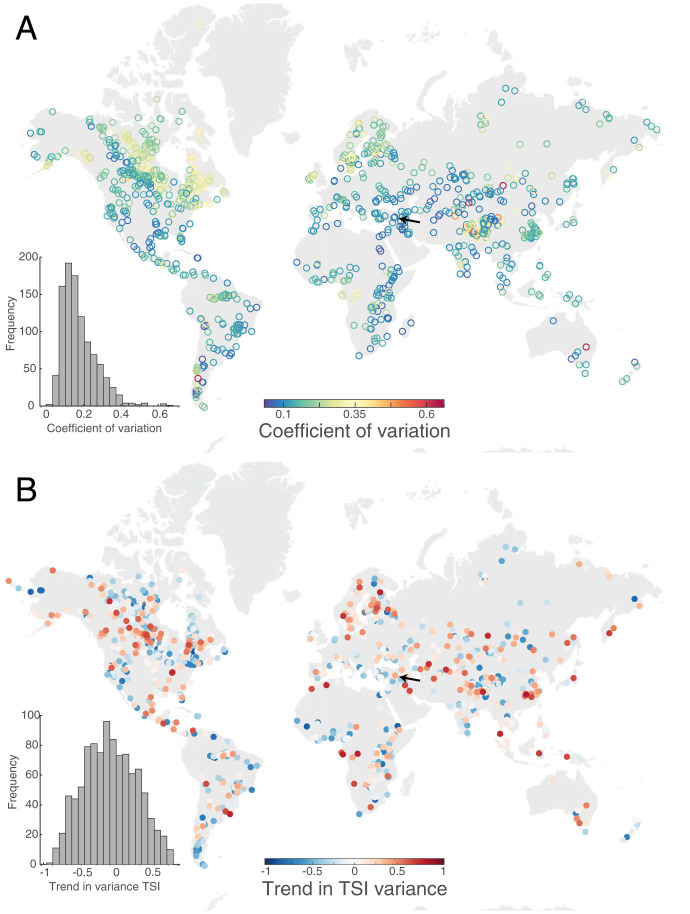
Lakes are often described as sentinels of global change. Phenomena like lake eutrophication, algal blooms, or reorganization in community composition belong to the most studied ecosystem regime shifts. However, although regime shifts have been well documented in several lakes, a global assessment of the prevalence of regime shifts is still missing, and, more in general, of the factors altering stability in lake status, is missing. Here, we provide a first global assessment of regime shifts and stability in the productivity of 1,015 lakes worldwide using trophic state index (TSI) time series derived from satellite imagery. We find that 12.8% of the lakes studied show regime shifts whose signatures are compatible with tipping points, while the number of detected regime shifts from low to high TSI has increased over time. Although our results suggest an overall stable picture for global lake dynamics, the limited instability signatures do not mean that lakes are insensitive to global change. Modeling the interaction between lake climatic, geophysical, and socioeconomic features and their stability properties, we find that the probability of a lake experiencing a tipping point increases with human population density in its catchment, while it decreases as the gross domestic product of that population increases. Our results show how quantifying lake productivity dynamics at a global scale highlights socioeconomic inequalities in conserving natural environments.
湖泊常被描述为全球变化的“哨兵”。湖泊富营养化、藻类大量繁殖或群落组成重组等现象属于研究最多的生态系统状态转变。然而,尽管已经有大量关于几个湖泊的状态转变的记录,但全球范围内对状态转变的普遍性以及改变湖泊状态稳定性的因素的评估仍存在空白。在这里,我们使用卫星图像衍生的营养状态指数 (TSI) 时间序列,对全球 1015 个湖泊的生产力进行了首次全球评估。我们发现,研究中 12.8%的湖泊显示出与临界点兼容的状态转变特征,而从低 TSI 到高 TSI 的检测到的状态转变数量随着时间的推移而增加。尽管我们的结果表明全球湖泊动态总体上是稳定的,但有限的不稳定特征并不意味着湖泊对全球变化不敏感。通过对湖泊气候、地球物理和社会经济特征及其稳定性特性之间的相互作用进行建模,我们发现,湖泊发生临界点的概率随着其集水区内的人口密度增加而增加,而随着该人口的国内生产总值增加而降低。我们的研究结果表明,在全球范围内量化湖泊生产力动态如何突出了保护自然环境方面的社会经济不平等。