Pun Teha B, Phillips Craig L, Marshall Nathaniel S, Comas Maria, Hoyos Camilla M, D'Rozario Angela L, Bartlett Delwyn J, Davis Wendy, Hu Wenye, Naismith Sharon L, Cain Sean, Postnova Svetlana, Grunstein Ron R, Gordon Christopher J
Faculty of Medicine and Health, The University of Sydney, Sydney, NSW 2050, Australia.
CIRUS, Centre for Sleep and Chronobiology, Woolcock Institute of Medical Research, Sydney, NSW 2037, Australia.
Clocks Sleep. 2022 Aug 9;4(3):358-373. doi: 10.3390/clockssleep4030030.
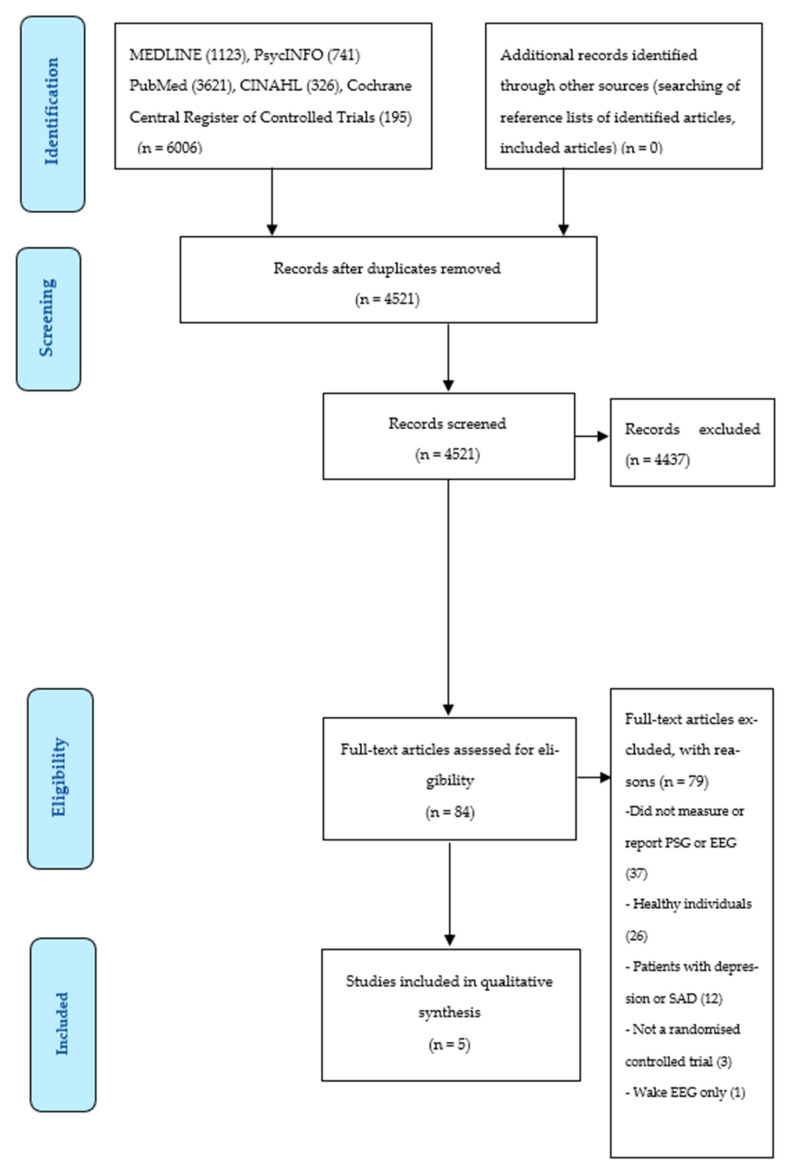
Light therapy is used to treat sleep and circadian rhythm disorders, yet there are limited studies on whether light therapy impacts electroencephalographic (EEG) activity during sleep. Therefore, we aimed to provide an overview of research studies that examined the effects of light therapy on sleep macro- and micro-architecture in populations with sleep and circadian rhythm disorders. We searched for randomized controlled trials that used light therapy and included EEG sleep measures using MEDLINE, PubMed, CINAHL, PsycINFO and Cochrane Central Register of Controlled Trials databases. Five articles met the inclusion criteria of patients with either insomnia or delayed sleep−wake phase disorder (DSWPD). These trials reported sleep macro-architecture outcomes using EEG or polysomnography. Three insomnia trials showed no effect of the timing or intensity of light therapy on total sleep time, wake after sleep onset, sleep efficiency and sleep stage duration compared to controls. Only one insomnia trial reported significantly higher sleep efficiency after evening light therapy (>4000 lx between 21:00−23:00 h) compared with afternoon light therapy (>4000 lx between 15:00−17:00 h). In the only DSWPD trial, six multiple sleep latency tests were conducted across the day (09:00 and 19:00 h) and bright light (2500 lx) significantly lengthened sleep latency in the morning (09:00 and 11:00 h) compared to control light (300 lx). None of the five trials reported any sleep micro-architecture measures. Overall, there was limited research about the effect of light therapy on EEG sleep measures, and studies were confined to patients with insomnia and DSWPD only. More research is needed to better understand whether lighting interventions in clinical populations affect sleep macro- and micro-architecture and objective sleep timing and quality.
光疗法用于治疗睡眠和昼夜节律紊乱,但关于光疗法是否会影响睡眠期间的脑电图(EEG)活动的研究有限。因此,我们旨在概述那些研究光疗法对患有睡眠和昼夜节律紊乱人群的睡眠宏观和微观结构影响的研究。我们通过MEDLINE、PubMed、CINAHL、PsycINFO和Cochrane对照试验中央注册库数据库搜索了使用光疗法并纳入EEG睡眠测量的随机对照试验。五篇文章符合失眠或睡眠-觉醒相位延迟障碍(DSWPD)患者的纳入标准。这些试验使用EEG或多导睡眠图报告了睡眠宏观结构结果。三项失眠试验表明,与对照组相比,光疗法的时间或强度对总睡眠时间、睡眠开始后的觉醒时间、睡眠效率和睡眠阶段持续时间没有影响。只有一项失眠试验报告称,与下午光疗法(15:00至17:00之间>4000勒克斯)相比,晚上光疗法(21:00至23:00之间>4000勒克斯)后睡眠效率显著更高。在唯一一项DSWPD试验中,全天(09:00和19:00)进行了六次多次睡眠潜伏期测试,与对照光(300勒克斯)相比,强光(2500勒克斯)显著延长了早晨(09:00和11:00)的睡眠潜伏期。五项试验均未报告任何睡眠微观结构测量结果。总体而言,关于光疗法对EEG睡眠测量影响的研究有限,且研究仅局限于失眠和DSWPD患者。需要更多研究来更好地了解临床人群中的光照干预是否会影响睡眠宏观和微观结构以及客观的睡眠时间和质量。