Heczko Michał, Sumińska Ewa, Pinkowicz Dawid, Nowicka Beata
Faculty of Chemistry, Jagiellonian University, Gronostajowa 2, 30-387 Kraków, Poland.
Inorg Chem. 2022 Sep 5;61(35):13817-13828. doi: 10.1021/acs.inorgchem.2c01629. Epub 2022 Aug 23.
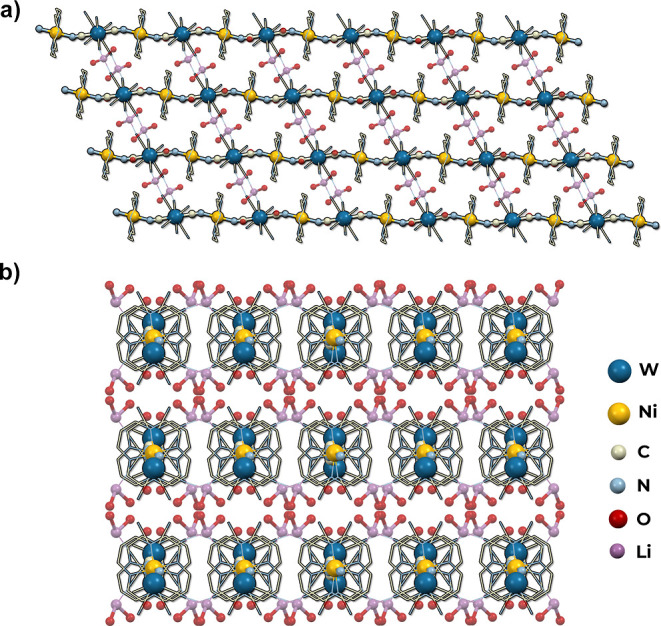
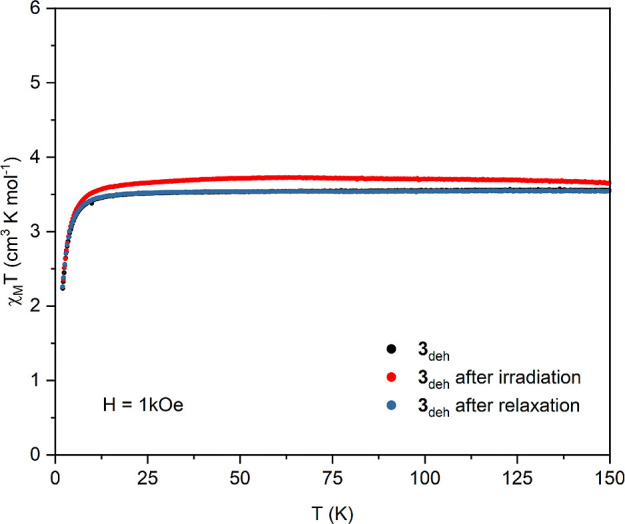
A series of new CN-bridged coordination networks of different dimensionality and topology was obtained through the modification of reaction conditions between [Ni(cyclam)] (cyclam = 1,4,8,11-tetraazacyclotetradecane) and [W(CN)]. The factors determining the reaction pathway are temperature and addition of the LiCl electrolyte. The products include three negatively charged frameworks incorporating Li guests: the 1D Li[Ni(cyclam)][W(CN)]·6HO () straight chain, the 1D Li[Ni(cyclam)][W(CN)]·2HO () zigzag chain, and the 2D Li[Ni(cyclam)][W(CN)]·24HO () honeycomb-like network, as well as the 3D two-fold interpenetrating [Ni(cyclam)][Ni(CN)][W(CN)]·11HO () network and the 1D [Ni(cyclam)][Ni(CN)]·2HO () chain, which result from partial decomposition of the starting complexes. Together with the previously characterized 3D [Ni(cyclam)][W(CN)]·16HO () network, they constitute the largest family of CN-bridged coordination polymers obtained from the same pair of building blocks. All compounds exhibit paramagnetic behavior because of the separation of paramagnetic nickel(II) centers through the diamagnetic polycyanidometallates. However, the presence of the photomagnetically active octacyanidotungstate(IV) ions allowed observation of the magnetic superexchange after the violet light excitation (405 nm) for compound , which constitutes the first example of the photomagnetic effect in a Ni-[W(CN)] system. The photomagnetic investigations for fully hydrated and dehydrated sample of , as well as for the isostructural octacyanidomolybdate(IV)-based network are discussed.
通过改变[Ni(环胺)](环胺=1,4,8,11-四氮杂环十四烷)与[W(CN)]之间的反应条件,得到了一系列不同维度和拓扑结构的新型CN桥连配位网络。决定反应途径的因素是温度和LiCl电解质的添加。产物包括三种包含Li客体的带负电荷框架:一维的Li[Ni(环胺)][W(CN)]·6H₂O(直链)、一维的Li[Ni(环胺)][W(CN)]·2H₂O(之字形链)和二维的Li[Ni(环胺)][W(CN)]·24H₂O(蜂窝状网络),以及三维的双贯穿[Ni(环胺)][Ni(CN)][W(CN)]·11H₂O(网络)和一维的[Ni(环胺)][Ni(CN)]·2H₂O(链),它们是起始配合物部分分解的产物。与先前表征的三维[Ni(环胺)][W(CN)]·16H₂O(网络)一起,它们构成了由同一对结构单元获得的最大的CN桥连配位聚合物家族。由于顺磁性镍(II)中心通过抗磁性多氰基金属酸盐分离,所有化合物都表现出顺磁性行为。然而,光磁活性的八氰基钨(IV)离子的存在使得在紫光激发(405 nm)后,化合物能够观察到磁超交换,这构成了Ni-[W(CN)]体系中光磁效应的第一个例子。讨论了化合物完全水合和脱水样品以及同构的基于八氰基钼(IV)的网络的光磁研究。