Gao Ya, Li Haipu, Song Yang, Zhang Fenglin, Yang Zhaoguang
Center for Environment and Water Resources, College of Chemistry and Chemical Engineering, Central South University, Changsha 410083, China.
Key Laboratory of Hunan Province for Water Environment and Agriculture Product Safety, Changsha 410083, China.
Toxics. 2022 Jul 28;10(8):429. doi: 10.3390/toxics10080429.
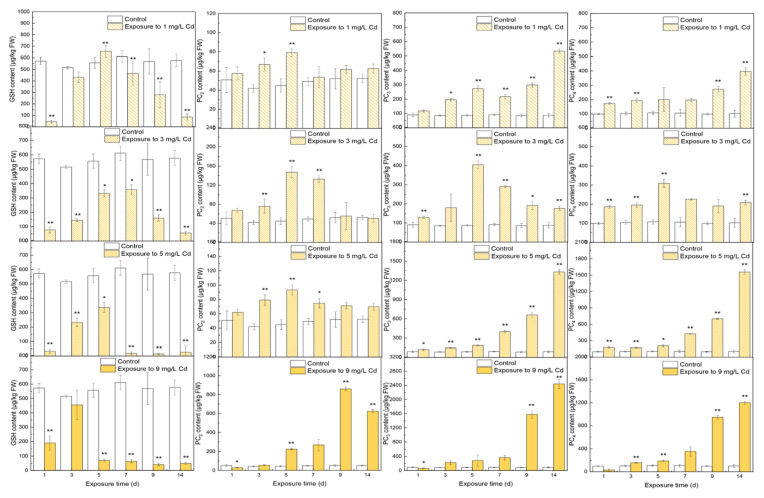
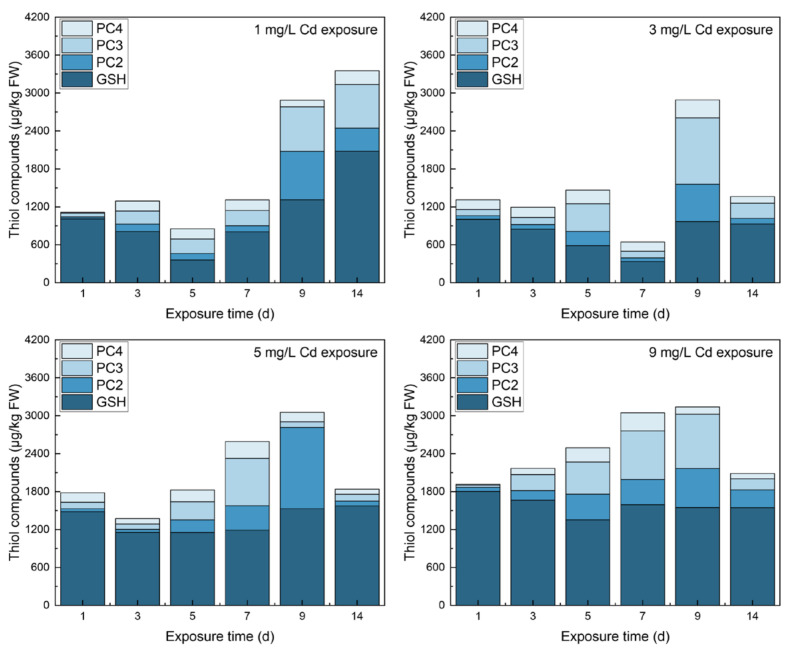
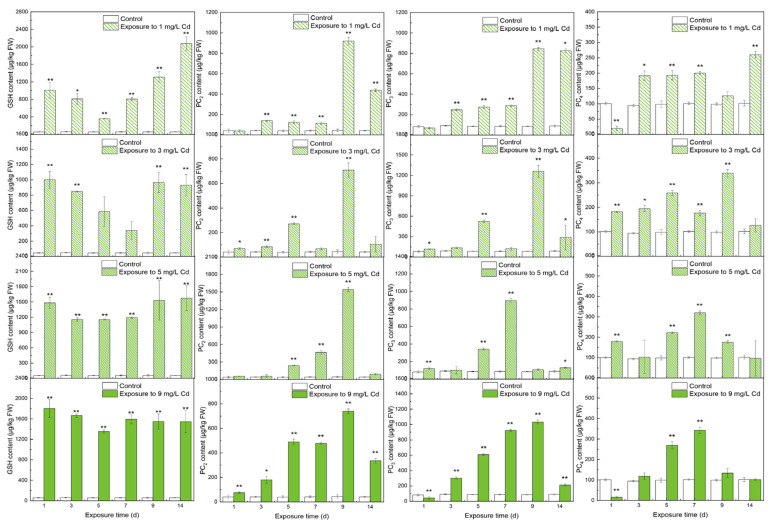
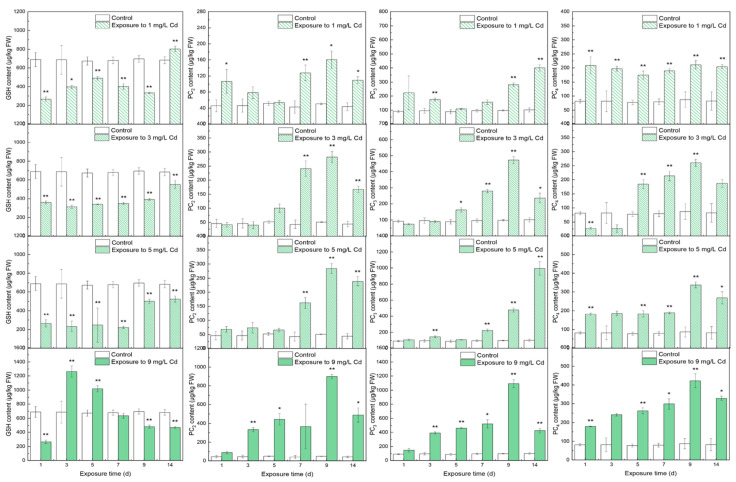
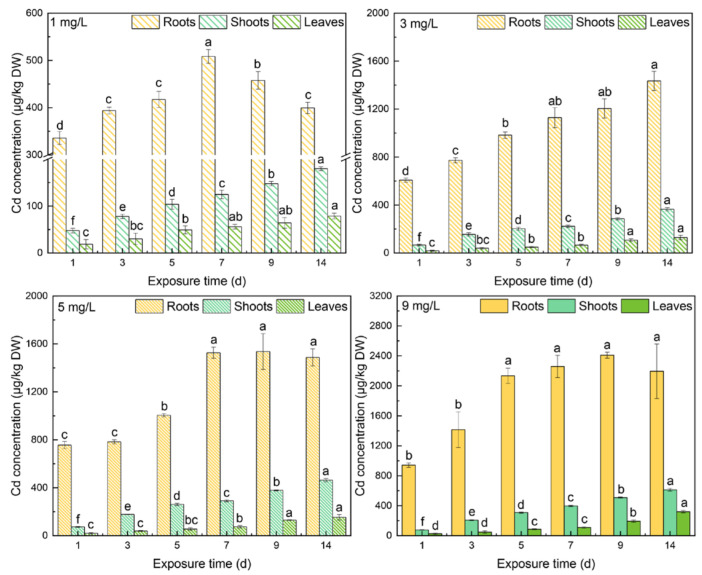
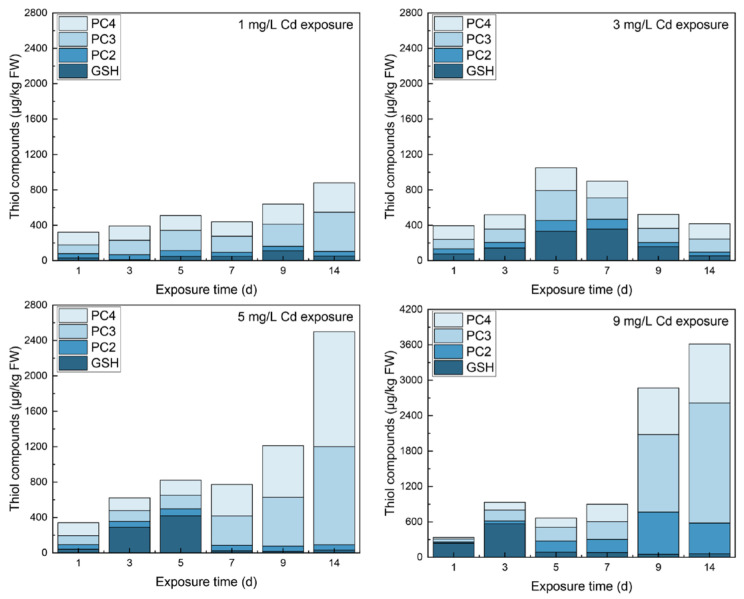
The aim of this study is to examine the thiol species for the high cadmium (Cd) tolerance of spinach and provide information for the improvement of soil utilization. The spinach was cultured in aqueous solution with concentrations of Cd ranging from 1 to 9 mg/L. The time responses of glutathione (GSH) and phytochelatins (PCs, PC2-PC4) in the tissues of spinach were monitored via HPLC−MS/MS, and the concentrations of Cd in the roots, shoots and leaves were detected by ICP−OES. Data were analyzed via one-way ANOVA and Spearman correlation to assess the relationships among the types of thiols and the changes between types of thiols and Cd. As Cd stress increased, Cd concentrations in tissues also increased. The total thiol contents responded to Cd stresses with correlations r ranging from 0.394 (root), 0.520 (shoot) to 0.771 (leaf) (p < 0.01). GSH and PC3 were dominant on most of the days under Cd stress. The correlation r between improvements in GSH and increments of Cd concentration in roots was −0.808 (p < 0.01), and r between changes in PC3 and changes in Cd concentrations in leaves was −0.503 (p < 0.01). No correlation can be found between GSH and the subtypes of PCs in shoots, but strong positive correlations within the subtypes of PCs. Thiols can be produced in different tissues of spinach, while the shoots are only a transport tissue for GSH.
本研究旨在检测菠菜对高镉(Cd)耐受性的硫醇种类,并为提高土壤利用率提供信息。将菠菜培养在镉浓度为1至9 mg/L的水溶液中。通过高效液相色谱-串联质谱法(HPLC−MS/MS)监测菠菜组织中谷胱甘肽(GSH)和植物螯合肽(PCs,PC2 - PC4)的时间响应,并通过电感耦合等离子体发射光谱法(ICP−OES)检测根、茎和叶中的镉浓度。通过单因素方差分析和Spearman相关性分析数据,以评估硫醇类型之间以及硫醇类型与镉之间变化的关系。随着镉胁迫增加,组织中的镉浓度也增加。总硫醇含量对镉胁迫的响应相关性r范围从0.394(根)、0.520(茎)到0.771(叶)(p < 0.01)。在镉胁迫下的大多数日子里,GSH和PC3占主导地位。根中GSH的增加与镉浓度增加之间的相关性r为−0.808(p < 0.01),叶中PC3的变化与镉浓度变化之间的相关性r为−0.503(p < 0.01)。茎中GSH与PCs亚型之间未发现相关性,但PCs亚型之间存在强正相关。菠菜的不同组织均可产生硫醇,而茎只是GSH的运输组织。