Department of Obstetrics and Gynecology, University of Michigan, Ann Arbor, Michigan, United States of America.
Department of Obstetrics and Gynecology, Washington University in St. Louis, St. Louis, Missouri, United States of America.
PLoS One. 2022 Aug 25;17(8):e0272155. doi: 10.1371/journal.pone.0272155. eCollection 2022.
Worldwide, 10% of babies are born preterm, defined as a live birth before 37 weeks of gestation. Preterm birth is the leading cause of neonatal death, and survivors face lifelong risks of adverse outcomes. New approaches with large sample sizes are needed to identify strategies to predict and prevent preterm birth. The primary aims of the Washington University Prematurity Research Cohort Study were to conduct three prospective projects addressing possible causes of preterm birth and provide data and samples for future research.
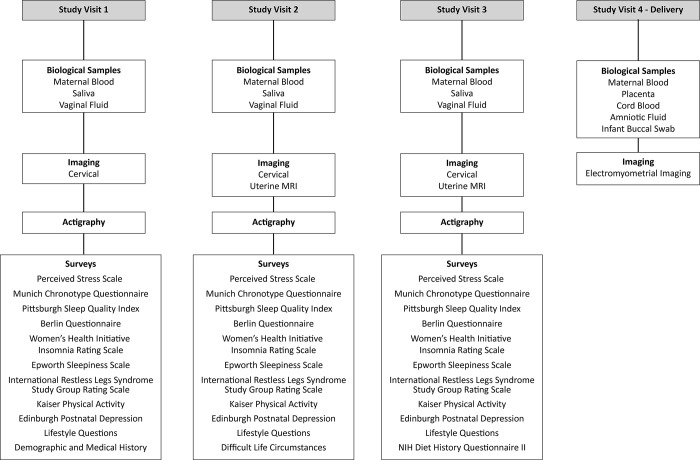
Pregnant patients were recruited into the cohort between January 2017 and January 2020. Consenting patients were enrolled into the study before 20 weeks' gestation and followed through delivery. Participants completed demographic and lifestyle surveys; provided maternal blood, placenta samples, and cord blood; and participated in up to three projects focused on underlying physiology of preterm birth: cervical imaging (Project 1), circadian rhythms (Project 2), and uterine magnetic resonance imaging and electromyometrial imaging (Project 3).
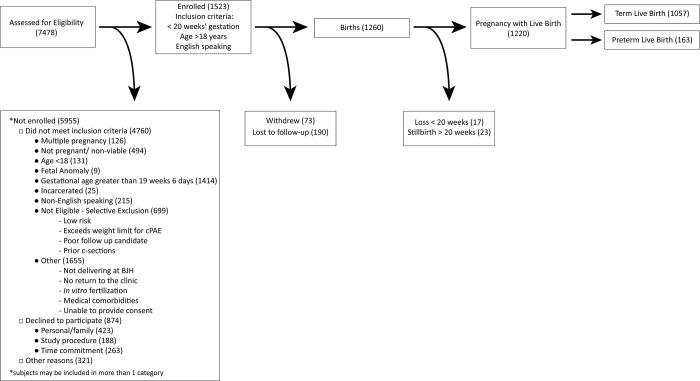
A total of 1260 participants were enrolled and delivered during the study period. Of the participants, 706 (56%) were Black/African American, 494 (39%) were nulliparous, and 185 (15%) had a previous preterm birth. Of the 1260 participants, 1220 (97%) delivered a live infant. Of the 1220 with a live birth, 163 (14.1%) had preterm birth, of which 74 (6.1%) were spontaneous preterm birth. Of the 1220 participants with a live birth, 841 participated in cervical imaging, 1047 contributed data and/or samples on circadian rhythms, and 39 underwent uterine magnetic resonance imaging. Of the 39, 25 underwent electromyometrial imaging.
We demonstrate feasibility of recruiting and retaining a diverse cohort in a complex prospective, longitudinal study throughout pregnancy. The extensive clinical, imaging, survey, and biologic data obtained will be used to explore cervical, uterine, and endocrine physiology of preterm birth and can be used to develop novel approaches to predict and prevent preterm birth.
全球有 10%的婴儿早产,即妊娠 37 周前出生的活产儿。早产是新生儿死亡的主要原因,幸存者面临终生不良结局的风险。需要采用具有大样本量的新方法来确定预测和预防早产的策略。华盛顿大学早产研究队列研究的主要目的是开展三项前瞻性项目,以研究早产的可能原因,并为未来的研究提供数据和样本。
2017 年 1 月至 2020 年 1 月期间,招募孕妇进入队列。同意参与的患者在 20 周妊娠前入组,并随访至分娩。参与者完成人口统计学和生活方式调查;提供母体血液、胎盘样本和脐带血;并参与三个专注于早产潜在生理的项目:宫颈成像(项目 1)、昼夜节律(项目 2)和子宫磁共振成像和肌电描记术成像(项目 3)。
在研究期间共招募了 1260 名参与者并分娩。其中,706 名(56%)为黑人/非裔美国人,494 名(39%)为初产妇,185 名(15%)有过早产史。1260 名参与者中,1220 名(97%)分娩了活婴。在 1220 名有活产的婴儿中,163 名(14.1%)早产,其中 74 名(6.1%)为自发性早产。在 1220 名有活产的参与者中,841 名参与了宫颈成像,1047 名提供了昼夜节律的数据和/或样本,39 名进行了子宫磁共振成像。其中,25 名进行了肌电描记术成像。
我们证明了在整个妊娠期间,在一项复杂的前瞻性、纵向研究中招募和保留多样化队列的可行性。获得的广泛临床、影像学、调查和生物学数据将用于探索早产的宫颈、子宫和内分泌生理学,并可用于开发预测和预防早产的新方法。