Kim Kyung-Hyun, Hong Geum-Lan, Kim Yae-Ji, Lee Hui-Ju, Jung Ju-Young
Department of Veterinary Medicine & Institute of Veterinary Science, Chungnam National University, 99, Daehak-ro, Yuseong-gu, Daejeon 34134, Korea.
Biomedicines. 2022 Aug 16;10(8):1981. doi: 10.3390/biomedicines10081981.
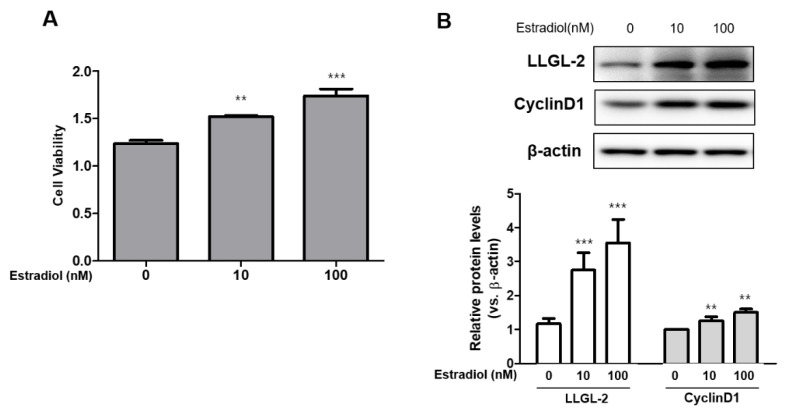
Lethal giant larvae (Lgl) is an apical-basal polarity gene first identified in . LLGL2 is one of the mammalian homologs of Lgl. However, little is known about its function in the prostate. In this study, to explore the new role of LLGL2 in the prostate, we examined the proliferative activity of a BPH-1 cell line, a well-established model for the human prostate biology of benign prostatic hyperplasia (BPH). The expression of LLGL2 was dose-dependently increased in BPH-1 cells after treatment with 17β-estradiol (E2). Additionally, E2 treatment increased the proliferation of the BPH-1 cells. However, the knockdown of LLGL2 with siRNA significantly suppressed the proliferation of the E2-treated BPH-1 cells. Moreover, si- treatment up-regulated the expression of LC-3B, ATG7, and p-beclin, which are known to play a pivotal role in autophagosome formation in E2-treated BPH-1 cells. Overexpression of LLGL2 was able to further prove these findings by showing the opposite results from the knockdown of LLGL2 in E2-treated BPH-1 cells. Collectively, our results suggest that LLGL2 is closely involved in the proliferation of prostate cells by regulating autophagosome formation. These results provide a better understanding of the mechanism involved in the effect of LLGL2 on prostate cell proliferation. LLGL2 might serve as a potential target in the diagnosis and/or treatment of human BPH.
致死性巨幼虫(Lgl)是一种首先在……中被鉴定出的顶-基极性基因。LLGL2是Lgl的哺乳动物同源物之一。然而,其在前列腺中的功能尚不清楚。在本研究中,为了探索LLGL2在前列腺中的新作用,我们检测了BPH-1细胞系的增殖活性,该细胞系是良性前列腺增生(BPH)人类前列腺生物学的成熟模型。用17β-雌二醇(E2)处理后,BPH-1细胞中LLGL2的表达呈剂量依赖性增加。此外,E2处理增加了BPH-1细胞的增殖。然而,用小干扰RNA(siRNA)敲低LLGL2显著抑制了E2处理的BPH-1细胞的增殖。此外,siRNA处理上调了LC-3B、ATG7和p-beclin的表达,已知这些蛋白在E2处理的BPH-1细胞自噬体形成中起关键作用。LLGL2的过表达能够通过显示与E2处理的BPH-1细胞中LLGL2敲低相反的结果进一步证实这些发现。总体而言,我们的结果表明LLGL2通过调节自噬体形成密切参与前列腺细胞的增殖。这些结果有助于更好地理解LLGL2对前列腺细胞增殖作用的机制。LLGL2可能成为人类BPH诊断和/或治疗的潜在靶点。