Kunz Viktor, Wichmann Gunnar, Wald Theresa, Pirlich Markus, Zebralla Veit, Dietz Andreas, Wiegand Susanne
Department of Otolaryngology, Head and Neck Surgery, University Hospital Leipzig, 04103 Leipzig, Germany.
J Clin Med. 2022 Aug 12;11(16):4714. doi: 10.3390/jcm11164714.
Frailty represents a complex geriatric syndrome associated with elevated rates of postoperative complications as shown for several malignant entities, including head and neck cancer. A specific screening instrument to assess frailty in head and neck patients does not exist. Both the FRAIL Scale and the G8 questionnaire are well-established and easy to use as screening tools. The present study's aim was to assess the potential of frailty screening to predict postoperative complications in head and neck patients prior to surgery.
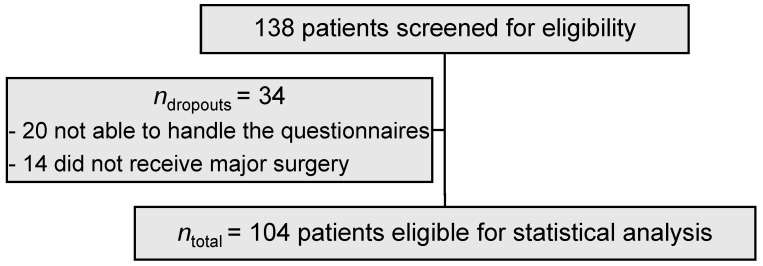
We recorded demographic data, pre-existing medical conditions and clinical characteristics in a prospective cohort of 104 head and neck cancer patients undergoing major head and neck surgery and assessed frailty prospectively on the day of admission utilizing the G8 questionnaire and the FRAIL Scale. We analyzed the link between occurrence of postoperative complications up to the twenty-first postoperative day and age, frailty and other covariates using χ tests and receiver operating characteristic (ROC) curves.
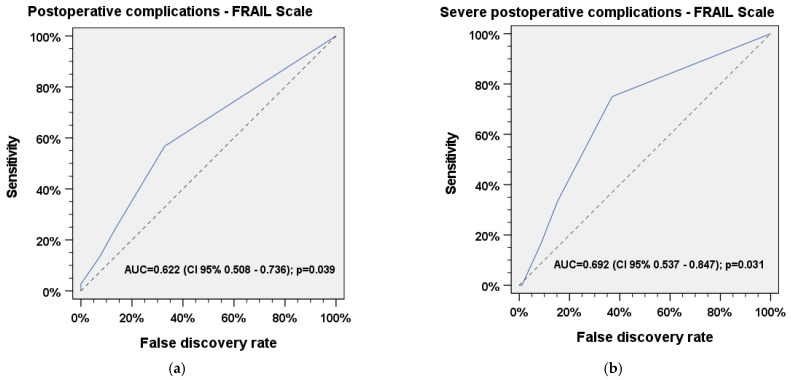
There was no significant correlation between patients' pre-existing medical conditions and postoperative complications. Whereas chronological age alone did not predict the occurrence of postoperative complications, frailty posed the highest risk for complications. Frailty according to either the G8 questionnaire or the FRAIL Scale predicted occurrence of complications with an area under the curve (AUC) of 0.64 ( = 0.018) and 0.62 ( = 0.039) and severe complications with an AUC of 0.72 ( = 0.014) and 0.69 (=0.031), respectively. Neither frailty score correlated with age or with each other.
Prospective screening using the FRAIL Scale or the G8 questionnaire reliably detected frailty in our sample group. Frailty is linked to increased risk of postoperative complications. The correct prediction of severe postoperative complications as shown identifies vulnerable cases and triggers awareness of potential complications. Anticipating risk allows for a more comprehensive view of the patient and triggers decision making towards risk adjustment, and therefore a selective view of alternative treatment modalities.
衰弱是一种复杂的老年综合征,与包括头颈癌在内的多种恶性肿瘤术后并发症发生率升高相关。目前尚无用于评估头颈患者衰弱情况的特定筛查工具。衰弱量表(FRAIL Scale)和G8问卷都是成熟且易于使用的筛查工具。本研究旨在评估衰弱筛查在术前预测头颈患者术后并发症的潜力。
我们记录了104例接受大型头颈手术的头颈癌患者的人口统计学数据、既往病史和临床特征,并在入院当天使用G8问卷和衰弱量表对衰弱情况进行前瞻性评估。我们使用χ检验和受试者工作特征(ROC)曲线分析了术后第21天内术后并发症的发生与年龄、衰弱及其他协变量之间的联系。
患者的既往病史与术后并发症之间无显著相关性。仅按实足年龄并不能预测术后并发症的发生,而衰弱是并发症的最高风险因素。根据G8问卷或衰弱量表评估的衰弱情况预测并发症发生的曲线下面积(AUC)分别为0.64(P = 0.018)和0.62(P = 0.039),预测严重并发症的AUC分别为0.72(P = 0.014)和0.69(P = 0.031)。两种衰弱评分均与年龄无关,且彼此之间也无相关性。
使用衰弱量表或G8问卷进行前瞻性筛查能可靠地检测出我们样本组中的衰弱情况。衰弱与术后并发症风险增加相关。如所示,对严重术后并发症的正确预测可识别出脆弱病例,并引发对潜在并发症的关注。预先评估风险有助于更全面地了解患者,并促使做出风险调整决策,从而有选择地考虑替代治疗方式。