Department of Pathology, Faculty of Medicine, Universiti Kebangsaan Malaysia, Hospital Canselor Tuanku Muhriz UKM, Jalan Yaacob Latif, Bandar Tun Razak, Cheras, Kuala Lumpur 56000, Malaysia.
Gastroenterology Unit, Department of Medicine, Faculty of Medicine, Universiti Kebangsaan Malaysia, Hospital Canselor Tuanku Muhriz UKM, Jalan Yaacob Latif, Bandar Tun Razak, Cheras, Kuala Lumpur 56000, Malaysia.
Medicina (Kaunas). 2022 Jul 28;58(8):1015. doi: 10.3390/medicina58081015.
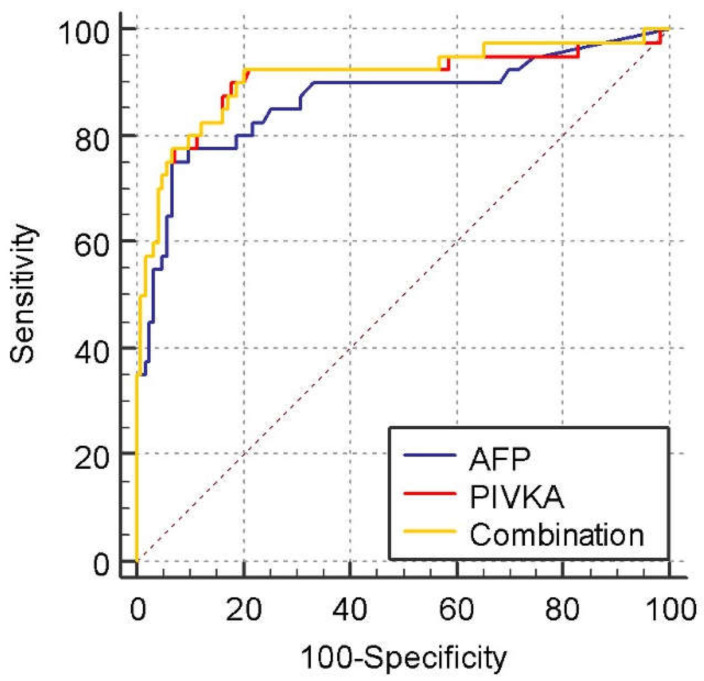
Background and Objectives: We aim to compare the diagnostic performance of Protein induced by vitamin K absence-II (PIVKA-II), a biomarker for hepatocellular carcinoma (HCC), and alpha-fetoprotein (AFP) in differentiating HCC and non-malignant high-risk (NMHR) groups and to determine their cut-off values. Materials and Methods: A total of 163 patients, including 40 with HCC and 123 with NMHR (100 with liver cirrhosis and 23 with non-cirrhotic high-risk patients) were prospectively enrolled. The levels of AFP and PIVKA-II were measured, and their cut-off values were determined. We calculated and compared the areas under the receiver operating characteristic (AUROC) curves of PIVKA-II, AFP, and their combination. Results: The levels of PIVKA-II and AFP were found to be significantly higher in the HCC compared to NMHR patients (p < 0.0001). For the differentiation of HCC from NMHR, the optimal cutoff values for PIVKA-II and AFP were 36.7 mAU/mL (90% sensitivity; 82.1% specificity) and 14.2 ng/mL (75% sensitivity; 93.5% specificity), respectively. The AUROC of PIVKA-II (0.905, p < 0.0001) was higher compared to AFP (0.869, p < 0.0001), but the combination of PIVKA−II and AFP gave the highest AUROC value (0.911, p < 0.0001). However, their differences were not statistically significant (AFP vs. PIVKA; p = 0.4775, AFP vs. Combination; p = 0.3808, PIVKA vs. Combination; p = 0.2268). Conclusions: PIVKA-II and AFP showed equal performance in detecting HCC in high-risk patients. AFP as a screening marker for HCC may be adequate, and replacing or adding the PIVKA-II test in current clinical practice may be of little value.
我们旨在比较维生素 K 缺乏诱导蛋白 II(PIVKA-II)和甲胎蛋白(AFP)作为肝细胞癌(HCC)诊断标志物在鉴别 HCC 和非恶性高危(NMHR)患者中的诊断性能,并确定其截断值。
前瞻性纳入 163 例患者,其中 40 例为 HCC 患者,123 例为 NMHR 患者(100 例为肝硬化患者,23 例为非肝硬化高危患者)。检测 AFP 和 PIVKA-II 水平,并确定其截断值。我们计算并比较了 PIVKA-II、AFP 及其联合的受试者工作特征(ROC)曲线下面积(AUROC)。
与 NMHR 患者相比,HCC 患者的 PIVKA-II 和 AFP 水平显著升高(p<0.0001)。对于 HCC 与 NMHR 的鉴别,PIVKA-II 和 AFP 的最佳截断值分别为 36.7 mAU/mL(90%敏感性;82.1%特异性)和 14.2 ng/mL(75%敏感性;93.5%特异性)。PIVKA-II 的 AUROC(0.905,p<0.0001)高于 AFP(0.869,p<0.0001),但 PIVKA-II 和 AFP 的联合检测具有最高的 AUROC 值(0.911,p<0.0001)。然而,它们之间的差异无统计学意义(AFP 与 PIVKA;p=0.4775,AFP 与联合检测;p=0.3808,PIVKA 与联合检测;p=0.2268)。
PIVKA-II 和 AFP 在检测高危患者中的 HCC 方面表现相当。AFP 作为 HCC 的筛查标志物可能已经足够,在当前临床实践中替代或增加 PIVKA-II 检测可能没有价值。