Public Health School Dr. Jorge David Nasser, Av. Sen. Filinto Müler, 1480 - Pioneiros, Campo Grande, MS, 79074-460, Brazil.
Federal University of Mato Grosso Do Sul, Campo Grande, MS, Brazil.
BMC Oral Health. 2022 Aug 26;22(1):364. doi: 10.1186/s12903-022-02402-z.
To identify the individual and contextual factors associated with the absence of Brazilians at a scheduled appointment in Dental Specialties Centers (DSC).
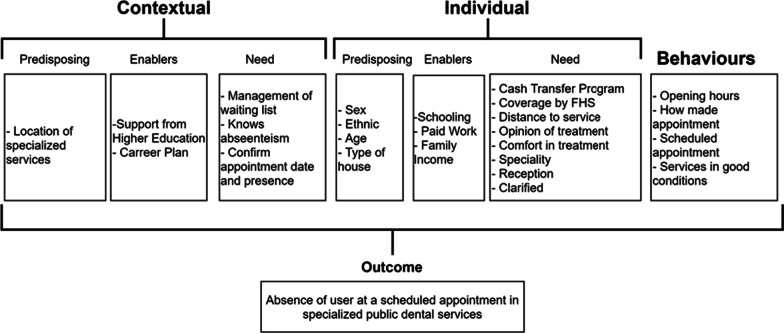
This cross-sectional design uses the National Program for Improving Access and Quality of Dental Specialties Centers database, 2018. The outcome was the users' lack of at least one of the scheduled appointments. Contextual and individual independent variables were used, considering Andersen's behavioural model. The analyses were performed with the R Core Team and SAS (Studio 3.8, Institute Inc, North Carolina, U.S, 2019) programs.
Of the 10,391 patients interviewed, 27.7% missed at least one of the consultations. In the adjusted multivariate model, the interpretation based on the effect size and 95% CI showed that the behaviour individual predisposing factors such as age ≤ 42 years (OR = 1.10; 95%CI:1.01-1.21), individual need factors such as participation in the "Bolsa Família" program (OR = 1,14; 95%CI:1.02-1.27), not being covered by the Family Health Strategy (OR = 1.15; 95% CI:1.02-1.30), and users of periodontics services (OR = 1.22;95%CI:1.05-1.40) were associated with absences. The behavioural factor associated with the outcome was that the DSC facilities were not in good condition (OR = 1.18; 95%CI:1.03-1.34). DSC located in the capital (OR = 1.12; 95% CI: 0.92-1.48) were 12% more likely to have dental absences than those in the interior region.
There are individual and contextual barriers associated with patients not attending specialised public dental consultations. DSC should offer adequate hours to patients, especially young adults and vulnerable people.
确定与在牙科专科中心(DSC)预约就诊时巴西人缺席相关的个体和背景因素。
本横断面设计使用了 2018 年国家改善牙科专科中心获得和质量方案数据库。结果是患者至少错过一次预约。使用了个体和背景的独立变量,考虑了安德森行为模型。分析使用了 R 核心团队和 SAS(Studio 3.8,美国北卡罗来纳州研究所,2019 年)程序。
在接受采访的 10391 名患者中,27.7%至少错过了一次就诊。在调整后的多变量模型中,根据效应大小和 95%CI 的解释表明,行为个体倾向因素,如年龄≤42 岁(OR=1.10;95%CI:1.01-1.21)、个体需求因素,如参与“Bolsa Família”计划(OR=1.14;95%CI:1.02-1.27)、未被家庭健康战略覆盖(OR=1.15;95%CI:1.02-1.30)和牙周病服务使用者(OR=1.22;95%CI:1.05-1.40)与缺勤有关。与结果相关的行为因素是 DSC 设施状况不佳(OR=1.18;95%CI:1.03-1.34)。位于首都的 DSC(OR=1.12;95%CI:0.92-1.48)比位于内陆地区的 DSC 缺勤的可能性高 12%。
存在与患者未参加公共牙科专科咨询相关的个体和背景障碍。DSC 应向患者,特别是年轻成年人和弱势群体提供足够的就诊时间。