Department of Pharmacology, Institute of Medical Sciences, Banaras Hindu University, Varanasi, UP, India.
Department of Kaumarbhritya/Balroga (Ayurveda-Paediatrics), Institute of Medical Sciences, Banaras Hindu University, Varanasi, UP, 221005, India.
Drug Saf. 2022 Oct;45(10):1099-1109. doi: 10.1007/s40264-022-01226-8. Epub 2022 Aug 27.
The BBV152 coronavirus disease 2019 (COVID-19) vaccine (COVAXIN) has recently been approved for adolescents.
We provide the first real-world safety data of COVAXIN use in adolescents and compare with adults.
A prospective observational study was initiated in January 2022. Enrolled adolescents and adults were contacted by telephone after 14 days of receiving the BBV152 vaccine. The primary outcome was vaccine safety assessed as rate of adverse events following immunization (AEFIs). Severity grading of AEFIs was done using the Food and Drug Administration (FDA) scale. Interim results are presented.
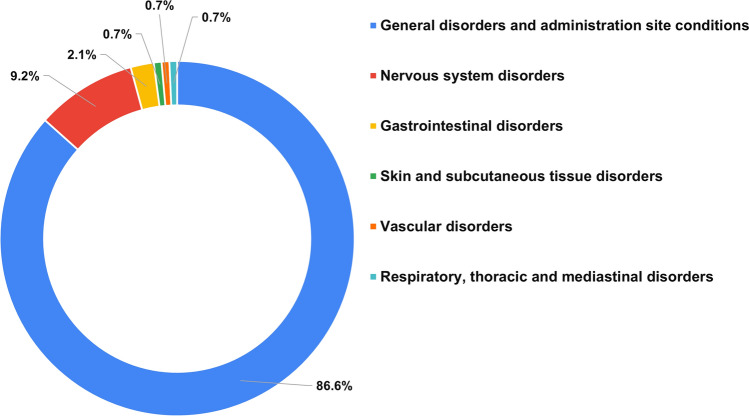
A total of 698 adolescents and 326 adults were enrolled. AEFIs after the first dose developed in 243 out of 670 adolescents (36.3%), with 21% reporting only local AEFIs and 15.2% reporting systemic AEFIs. Among 340 adolescents who had received the second dose of vaccine, 129 (37.9%) developed AEFIs, with only local involvement in 20.3% and systemic involvement in 17.6%. Injection site pain and fever were the common AEFIs. The majority of AEFIs were mild-moderate. Nearly 0.9% of adolescents receiving the first dose reported severe AEFIs. Atypical AEFIs were observed in 0.6-0.9% of adolescents. The majority of the AEFIs resolved in 1-2 days. AEFIs were persistent in > 2% of adolescents at day 14 after the second dose, and also in 3.7% of adults overall at follow-up. No difference was observed in AEFI incidence and patterns between adolescents and adults. Regression analysis showed females and those with a history of allergy to be, respectively, at 1.6 times and 3 times increased risk of AEFIs among adolescents.
COVAXIN carries an overall favorable short-term safety profile in adolescents. The observed AEFI rates in adolescents are much lower than that reported with mRNA vaccines, but head-head comparisons in the same population are required to generate relative vaccine safety data. Female adolescents and those with a history of allergy need watchfulness for severe and persistent AEFIs. With some AEFIs persisting at 14 days, a longer follow-up is recommended to strengthen the safety data of COVAXIN.
BBV152 冠状病毒病 2019(COVID-19)疫苗(COVAXIN)最近已获准用于青少年。
我们提供 COVAXIN 在青少年中使用的首个真实世界安全性数据,并与成年人进行比较。
2022 年 1 月启动了一项前瞻性观察性研究。在接种 BBV152 疫苗 14 天后,通过电话联系入组的青少年和成年人。主要结局是使用食品和药物管理局(FDA)量表评估的疫苗接种后不良事件(AEFI)发生率。AEFI 的严重程度分级。目前报告了中期结果。
共入组 698 名青少年和 326 名成年人。670 名青少年中的 243 名(36.3%)在第一剂后出现 AEFI,其中 21%仅报告局部 AEFI,15.2%报告全身 AEFI。在接受第二次疫苗接种的 340 名青少年中,129 名(37.9%)出现 AEFI,仅 20.3%有局部受累,17.6%有全身受累。注射部位疼痛和发热是常见的 AEFI。大多数 AEFI 为轻度至中度。约 0.9%的青少年在接种第一剂后报告严重 AEFI。在 0.6-0.9%的青少年中观察到非典型 AEFI。大多数 AEFI 在接种后 14 天内 1-2 天内消退。在第二次接种后 14 天,也有 2%以上的青少年和总体 3.7%的成年人持续存在 AEFI。青少年和成年人的 AEFI 发生率和模式没有差异。回归分析显示,女性和有过敏史的青少年发生 AEFI 的风险分别增加 1.6 倍和 3 倍。
COVAXIN 在青少年中具有总体良好的短期安全性。在青少年中观察到的 AEFI 发生率远低于报告的 mRNA 疫苗,但需要在同一人群中进行头对头比较,以生成相对疫苗安全性数据。女性青少年和有过敏史的青少年需要警惕严重和持续的 AEFI。由于某些 AEFI 在 14 天内持续存在,建议进行更长时间的随访,以加强 COVAXIN 的安全性数据。