Department of Radiation Health Management, Fukushima Medical University School of Medicine, Fukushima City, Fukushima, Japan.
Department of General Internal Medicine, Hirata Central Hospital, Hirata, Fukushima, Japan.
Front Public Health. 2024 Jul 30;12:1406315. doi: 10.3389/fpubh.2024.1406315. eCollection 2024.
Vaccination has been implemented as a useful measure to combat the COVID-19 pandemic. However, there is a tendency for individuals to avoid vaccination due to the possibility of adverse events, making it important to investigate the relationship between COVID-19 vaccines and their adverse events. This study explored longitudinal adverse event patterns and factors that influence adverse events following the second to fourth doses of the COVID-19 vaccine through a latent class analysis.
Participants were recruited from the Fukushima Prefecture and included individuals who had completed four doses of the COVID-19 mRNA vaccine. This study utilized data from questionnaire surveys and blood collection conducted between September 2021 and November 2022. In the questionnaire, factors such as sex, age, medical history, medication, type of vaccine administered, and adverse events following vaccination were recorded. Additionally, in the blood data, serological tests [IgG(S)] and cellular immune responses (T-spot) were measured. Descriptive statistics, latent class analysis, multivariable logistic regression, and multiple regression analyses were performed to identify the longitudinal adverse event patterns and influencing factors. By analyzing adverse events over time, we identified two distinct groups: those less prone to experiencing adverse events (Group 1) and those more susceptible (Group 2) to latent class analysis.
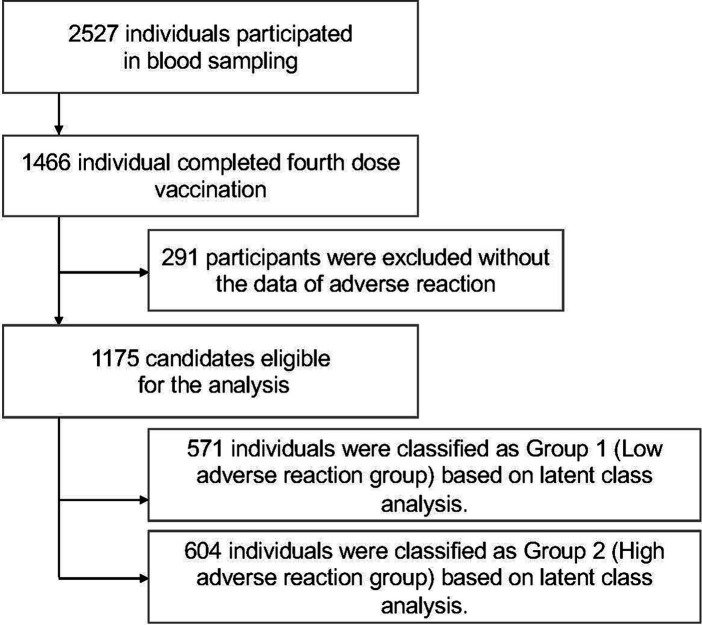
A total of 1,175 participants were included after excluding those without any adverse events. The median age of the participants in Group 1 was 70 years, and in Group 2 it was 51 years. The proportion of female participants was 298 in Group 1 and 353 in Group 2. Patients in Group 2 were significantly younger ( < 0.001) and more likely to be female ( < 0.001) than those in Group 1. Furthermore, the median IgG(S) value after the fourth vaccination was 3,233 AU/mL in Group 1 and 4,059.39 AU/mL in Group 2. The median T-spot value was 15.4 in Group 1 and 28.5 in Group 2. Group 2 showed significantly higher IgG(S) and T-spot values after the fourth vaccination ( < 0.001).
Our findings suggest that factors other than age, particularly sex and a history of allergies, significantly influence the likelihood of experiencing adverse events. Groups categorized by latent class analysis for longitudinal adverse events are expected to be valuable for optimizing vaccination strategies and formulating public health measures.
接种疫苗已被作为应对 COVID-19 大流行的一项有效措施实施。然而,由于不良反应的可能性,个人存在避免接种疫苗的倾向,因此研究 COVID-19 疫苗与不良反应之间的关系非常重要。本研究通过潜在类别分析,探讨了第二至第四剂 COVID-19 疫苗接种后纵向不良反应模式和影响因素。
参与者来自福岛县,包括已完成四剂 COVID-19 mRNA 疫苗接种的个体。本研究利用了 2021 年 9 月至 2022 年 11 月期间进行的问卷调查和血液采集的数据。在问卷中,记录了性别、年龄、病史、用药情况、接种疫苗类型和接种后不良反应等因素。此外,在血液数据中,测量了血清学试验[IgG(S)]和细胞免疫反应(T 斑点)。进行描述性统计分析、潜在类别分析、多变量逻辑回归和多元回归分析,以确定纵向不良反应模式和影响因素。通过随时间分析不良反应,我们确定了两个不同的群体:不易发生不良反应的群体(第 1 组)和更易发生不良反应的群体(第 2 组)。
在排除无任何不良反应的个体后,共有 1175 名参与者被纳入研究。第 1 组的参与者中位年龄为 70 岁,第 2 组为 51 岁。第 1 组中女性参与者有 298 人,第 2 组有 353 人。与第 1 组相比,第 2 组患者年龄明显较小(<0.001),女性比例更高(<0.001)。此外,第 4 剂接种后 IgG(S)中位数在第 1 组为 3233 AU/mL,在第 2 组为 4059.39 AU/mL。第 1 组 T 斑点中位数为 15.4,第 2 组为 28.5。第 4 剂接种后,第 2 组的 IgG(S)和 T 斑点值明显更高(<0.001)。
我们的研究结果表明,年龄以外的因素,特别是性别和过敏史,显著影响不良反应发生的可能性。通过潜在类别分析对纵向不良反应进行分类的组,有望为优化疫苗接种策略和制定公共卫生措施提供参考。