Department of Clinical and Experimental Medicine, Endocrinology Unit I, University of Pisa and University Hospital of Pisa, Via Paradisa 2, 56124, Pisa, Italy.
Department of Surgical, Medical and Molecular Pathology, Ophthalmology Unit I, University of Pisa and University Hospital of Pisa, Via Paradisa 2, 56124, Pisa, Italy.
J Endocrinol Invest. 2023 Feb;46(2):337-344. doi: 10.1007/s40618-022-01906-3. Epub 2022 Aug 27.
A relationship between thyroid and non-organ-specific autoimmunity could be relevant for Graves' orbitopathy (GO), which affects connective tissue. We investigated the association between GO and anti-nuclear antibodies (ANAs).
Retrospective investigation was conducted in 265 patients with Graves' disease (GD), 158 with and 107 without GO. Primary outcome was: prevalence of ANAs in GO vs no-GO. Secondary outcomes were: (1) relationship between ANAs and GO features; (2) prevalence of ANAs in GD compared with non-autoimmune hyperthyroidism [(78 patients with toxic nodular goiter (TNG)]; (3) distribution of ANA patterns.
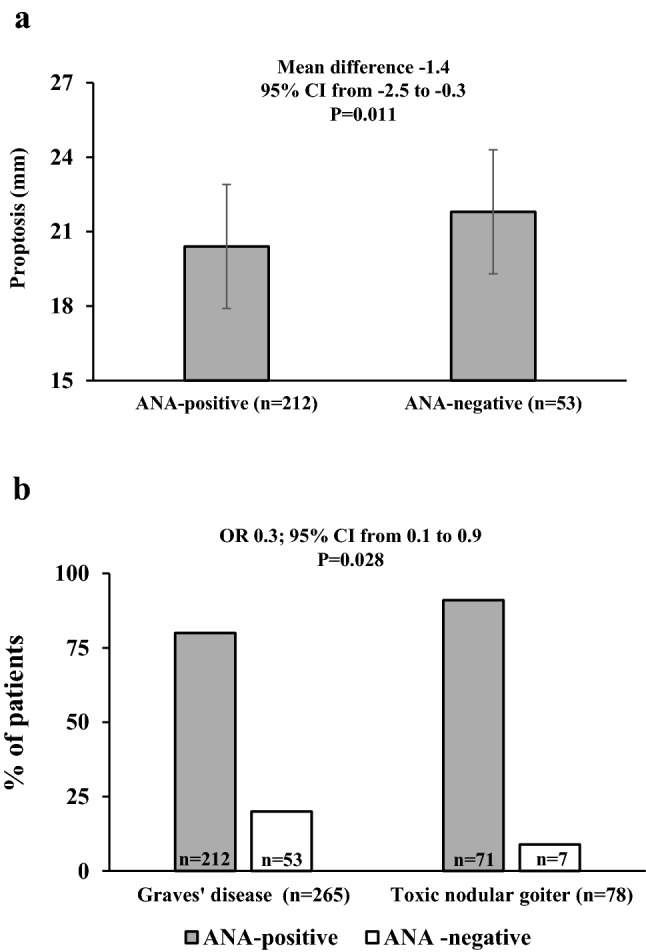
ANAs were detected in 212 (80%) GD patients, but prevalence did not differ between GO (79.7%) and no-GO (80.3%). Higher ANA titers (1:160) were more common in GO (51.5 vs 38.3%), but only nearly significantly (OR 0.5; 95% CI: 0.3-1; P = 0.059). Proptosis was lower in ANA-positive patients (mean difference: - 1.4 mm; 95% CI from - 2.5 to - 0.3; P = 0.011), in whom nearly significantly lower CAS (Mann-Whitney U: 1.5; P = 0.077) and eyelid aperture (mean difference: - 0.9 mm; 95% CI from - 2 to 0; P = 0.062) were observed. Prevalence of ANAs in GD was lower than in TNG (80 vs 91%; OR 0.3; 95% CI: 0.1-0.9; P = 0.028), but nuclear speckled pattern was more frequent (OR 22.9; 95% CI 1.3-381.3; P = 0.028).
Although ANAs are not more frequent in GO, they seem to exert a protective role on its severity and on development of GD. A switch of T cell population in ANA-positive patients, resulting in a different phenotype, may be responsible. Further studies are needed to investigate the mechanisms.
甲状腺与非器官特异性自身免疫之间的关系可能与 Graves 眼病(GO)有关,后者影响结缔组织。我们研究了 GO 与抗核抗体(ANA)之间的关联。
对 265 例 Graves 病(GD)患者进行回顾性调查,其中 158 例伴 GO,107 例无 GO。主要结局为:GO 与无 GO 之间 ANA 的患病率。次要结局为:(1)ANA 与 GO 特征之间的关系;(2)GD 与非自身免疫性甲状腺功能亢进症[78 例毒性结节性甲状腺肿(TNG)]相比,ANA 的患病率;(3)ANA 模式的分布。
212 例(80%)GD 患者检测到 ANA,但 GO 组(79.7%)与无 GO 组(80.3%)之间的患病率无差异。GO 组(51.5%)ANA 滴度(1:160)较高,但差异仅接近显著(比值比 0.5;95%可信区间:0.3-1;P=0.059)。ANA 阳性患者的突眼度较低(平均差异:-1.4 毫米;95%可信区间:-2.5 至-0.3;P=0.011),CAS(Mann-Whitney U:1.5;P=0.077)和睑裂(平均差异:-0.9 毫米;95%可信区间:-2 至 0;P=0.062)也接近显著降低。GD 中 ANA 的患病率低于 TNG(80 比 91%;比值比 0.3;95%可信区间:0.1-0.9;P=0.028),但核点彩模式更为常见(比值比 22.9;95%可信区间 1.3-381.3;P=0.028)。
尽管 GO 中 ANA 并不更常见,但它们似乎对其严重程度和 GD 的发展发挥保护作用。ANA 阳性患者 T 细胞群体的转变导致不同的表型可能是其原因。需要进一步研究以探讨其机制。