Reid Keith, Price Owen
Positive and Safe Care, Cumbria, Northumberland Tyne and Wear NHS Foundation Trust, Newcastle upon Tyne, United Kingdom.
Positive and Safe Care, Northumbria University, Newcastle upon Tyne, North East England, United Kingdom.
Front Digit Health. 2022 Aug 12;4:945635. doi: 10.3389/fdgth.2022.945635. eCollection 2022.
Restraint reporting varies, which undermines regulation, obfuscates analyses, and incentivises minimisation. The English Mental Health Units Use of Force Act 2018, "Seni's Law" mandates reporting. This paper analysed open data from all psychiatric and learning disability institutions in England from September 2020 to August 2021. We correlated logarithms of "people restrained per month", against "bed days" per month and "people under legal mental health detention" per month, per institution. We designated institutions reporting some restraint for at least 11 of 12 months as reporting "completely" and used their trend to infer rates from non-"complete" institutions. Allowance was made for size. Our a priori manual can be shared on request.
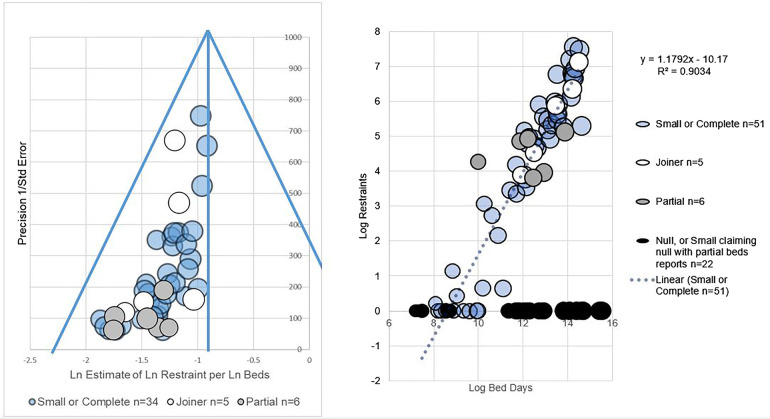
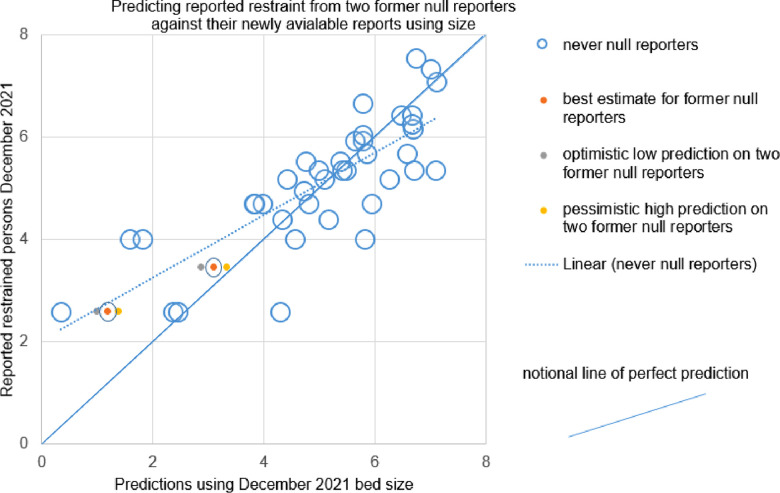
Logarithms of people restrained per month and bed-days per month correlated among complete reporters: R 0.90 (2.s.f). Persons detained per month also correlated with restraint: R 0.78. "Partial" institutions reported intermittently. "Joiner" institutions reported firstly null, then substantive reporting. "Null" institutions (including the largest) reported no restraint. Precisely-reporting institutions with high inverse variance between months reported similar restraint-rates but less-precise reported lower rates. In institutions reporting no restraint, two independent "true rate" estimations, by bed-days or people detained, correlated across institutions: R 0.95. Inference from size suggested non-complete reporters restrained 1,774 people in England per month 95% CI (1,449-2,174).
Restraint remains under-reported. Institutional size explains most restraint variation among complete reporting institutions, 90% of R. Institutional restraint reports can be compared per-bed per-month. Rates of people detained are a useful independent "checking" comparator in England.
约束措施的报告情况各异,这有损监管、使分析变得模糊,并促使人们尽量减少报告。2018年英国《精神卫生机构使用武力法案》(“塞尼法案”)规定必须进行报告。本文分析了2020年9月至2021年8月期间英格兰所有精神病院和学习障碍机构的公开数据。我们将每个机构每月“被约束人数”的对数与每月“床位占用天数”以及每月 “依法接受精神卫生拘留的人数” 进行了关联分析。我们将在12个月中至少有11个月报告了某种约束措施的机构指定为 “完全” 报告机构,并利用它们的趋势来推断非 “完全” 报告机构的发生率。考虑到了机构规模因素。如有需要,我们的先验手册可以共享。
在 “完全” 报告机构中,每月被约束人数的对数与每月床位占用天数相关:R = 0.90(保留两位有效数字)。每月被拘留人数也与约束措施相关:R = 0.78。“部分” 报告机构间歇性地进行报告。“加入者” 机构最初报告为零,然后开始实质性报告。“零” 报告机构(包括最大的机构)报告没有约束措施。每月报告数据差异较小的精确报告机构报告的约束发生率相似,但报告数据差异较大的机构报告的发生率较低。在报告没有约束措施的机构中,通过床位占用天数或被拘留人数进行的两个独立的 “真实发生率” 估计在各机构之间具有相关性:R = 0.95。根据机构规模推断,非 “完全” 报告机构在英格兰每月约束了1774人,95% 置信区间为(1449 - 2174)。
约束措施的报告仍然不足。机构规模解释了 “完全” 报告机构中约束措施差异的大部分原因,相关系数R的90%。机构约束措施报告可以按每月每张床位进行比较。在英格兰,被拘留人数是一个有用的独立 “核查” 比较指标。