Nam Ji Young, Lee Tae Ryeon, Tokmurzin Diyar, Park Sung Jin, Ra Ho Won, Yoon Sang Jun, Mun Tae-Young, Yoon Sung Min, Moon Ji Hong, Lee Jae Goo, Lee Dong Hyun, Seo Myung Won
Climate Change Research Division, Korea Institute of Energy Research (KIER), 152 Gajeong-ro, Yuseong-gu, Daejeon 34129, Republic of Korea.
School of Chemical Engineering, Sungkyunkwan University (SKKU), 2066 Seobu-ro, Jangangu, Suwon, Gyeonggi-do 16419, Republic of Korea.
Fuel (Lond). 2023 Jan 1;331:125720. doi: 10.1016/j.fuel.2022.125720. Epub 2022 Aug 24.
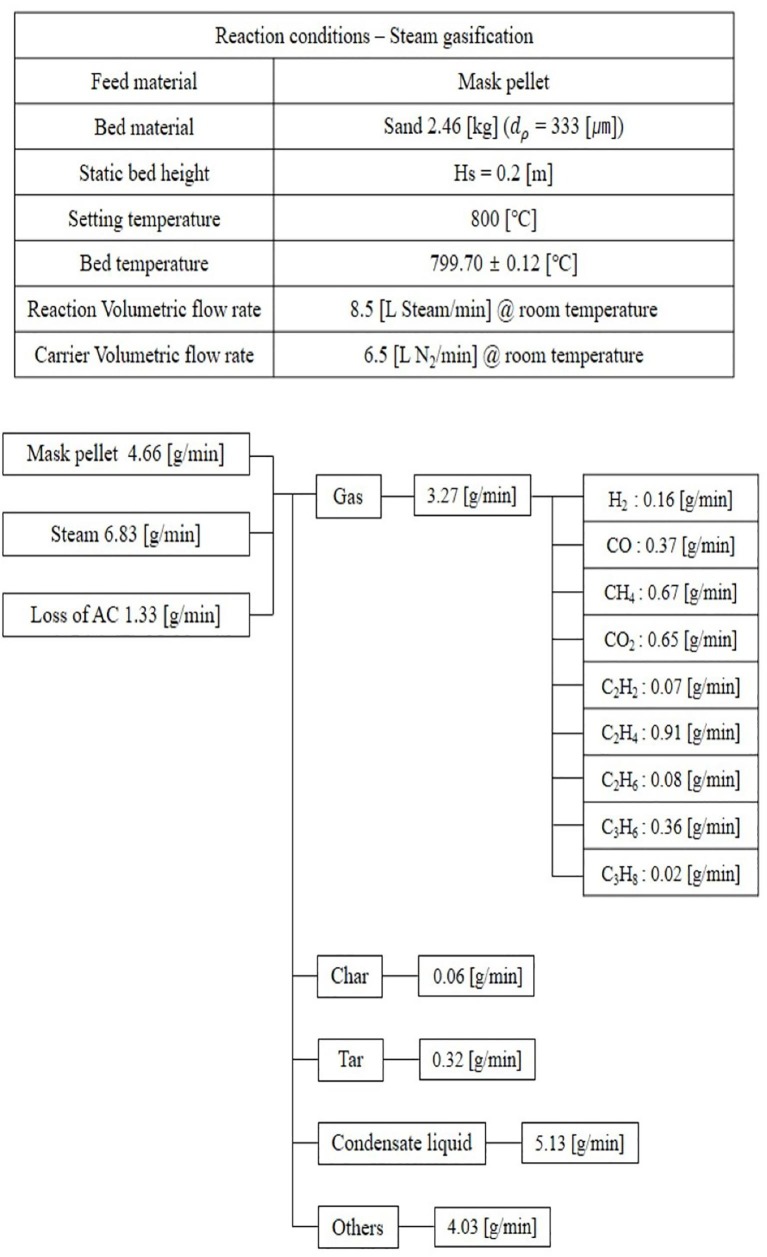
Globally, the demand for masks has increased due to the COVID-19 pandemic, resulting in 490,201 tons of waste masks disposed of per month. Since masks are used in places with a high risk of virus infection, waste masks retain the risk of virus contamination. In this study, a 1 kg/h lab-scale (diameter: 0.114 m, height: 1 m) bubbling fluidized bed gasifier was used for steam gasification (temperature: 800 °C, steam/carbon (S/C) ratio: 1.5) of waste masks. The use of a downstream reactor with activated carbon (AC) for tar cracking and the enhancement of hydrogen production was examined. Steam gasification with AC produces syngas with H, CO, CH, and CO content of 38.89, 6.40, 21.69, and 7.34 vol%, respectively. The lower heating value of the product gas was 29.66 MJ/Nm and the cold gas efficiency was 74.55 %. This study showed that steam gasification can be used for the utilization of waste masks and the production of hydrogen-rich gas for further applications.
在全球范围内,由于新冠疫情,口罩需求增加,导致每月有490201吨废弃口罩被处理。由于口罩在病毒感染风险高的地方使用,废弃口罩仍有病毒污染风险。在本研究中,使用一台1千克/小时的实验室规模(直径:0.114米,高度:1米)鼓泡流化床气化炉对废弃口罩进行蒸汽气化(温度:800℃,蒸汽/碳(S/C)比:1.5)。研究了使用带有活性炭(AC)的下游反应器进行焦油裂解并提高氢气产量的情况。用AC进行蒸汽气化产生的合成气中,氢气、一氧化碳、甲烷和二氧化碳的含量分别为38.89%、6.40%、21.69%和7.34%(体积)。产物气的低位发热量为29.66兆焦/标准立方米,冷煤气效率为74.55%。本研究表明,蒸汽气化可用于废弃口罩的利用以及生产富氢气体以供进一步应用。