Ma Xiao, Cao Dong-Yan, Dai Yu-Xin
Department of Obstetrics and Gynecology, Peking Union Medical College Hospital, Chinese Academy of Medical Sciences & Peking Union Medical College, Beijing, China.
National Clinical Research Center for Obstetric & Gynecologic Diseases, Beijing, China.
Front Surg. 2022 May 13;9:880875. doi: 10.3389/fsurg.2022.880875. eCollection 2022.
Vaginal cuff dehiscence (and evisceration) (VCD(E)) is an extremely rare and late-onset complication of total hysterectomy (TH). Limited evidence is available to guide clinicians in managing VCD(E). This study aimed to summarize the clinical characteristics of patients with VCD(E) treated in our center and share our experience in managing VCD(E).
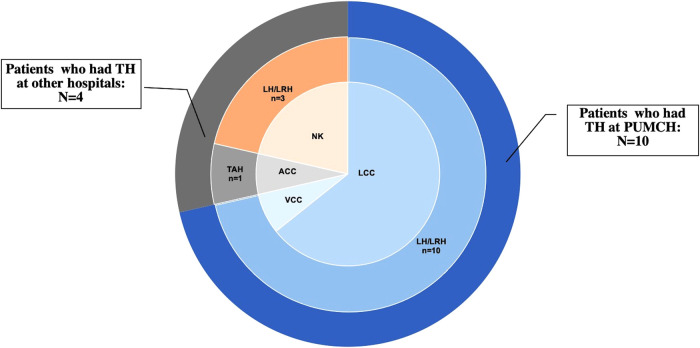
From 1983 to 2020, a total of 14 cases of VCD(E), including 10 cases in our hospital and 4 cases in other hospitals, were included. Medical records were reviewed to summarize the clinical features and management of VCD(E).
The incidence of VCD(E) in our hospital was 10/46,993 (0.02%), and all 10 patients underwent laparoscopic hysterectomy. The median TH-to-VCD(E) interval was 3.13 months (8 days-27.43 months), and 11/14 (78.57%) patients experienced VCD(E) after coitus. The 3 major symptoms included abdominal pain in 11 patients, irregular vaginal bleeding in 8, and sensation of bulging or prolapsed organs in 4. Except for 2, most patients presented to our hospital within 72 h since the onset of the discomfort. All 14 cases were diagnosed through speculum examination: 3 had simple VCD, and 11 had VCDE. The protruding bowels of 4 patients were immediately manually repositioned in the emergency department without anesthesia. Regarding the surgical approach, 11 patients underwent simple transvaginal, 2 patients underwent laparoscopic-vaginal combined (transvaginal cuff closures), and 1 patient underwent laparoscopic. All but 1 patient did not undergo resection of the eviscerated organs. The median follow-up period was 39.33 (7.9-159.33) months. No patients showed any evidence of recurrence to date.
Laparoscopic hysterectomy is a risk factor for VCD(E), and early initiation of sexual intercourse is the most common trigger of VCD(E). Clinicians should educate patients to postpone sexual intercourse for at least 3-6 months after TH. Immediate medical attention and patient-specific surgical management are crucial to avoid serious complications.
阴道残端裂开(及脏器脱出)(VCD(E))是全子宫切除术(TH)极为罕见的晚期并发症。目前可用于指导临床医生处理VCD(E)的证据有限。本研究旨在总结在我们中心接受治疗的VCD(E)患者的临床特征,并分享我们处理VCD(E)的经验。
1983年至2020年,共纳入14例VCD(E)患者,其中我院10例,其他医院4例。回顾病历以总结VCD(E)的临床特征及处理情况。
我院VCD(E)的发生率为10/46,993(0.02%),所有10例患者均接受了腹腔镜子宫切除术。TH至VCD(E)的中位间隔时间为3.13个月(8天至27.43个月),11/14(78.57%)的患者在性交后发生VCD(E)。3个主要症状包括11例腹痛、8例不规则阴道出血以及4例有器官膨出或脱垂感。除2例患者外,大多数患者在不适症状出现后72小时内就诊于我院。所有14例均通过窥器检查确诊:3例为单纯VCD,11例为VCDE。4例患者脱出的肠管在急诊科未麻醉情况下立即手动复位。关于手术方式,11例患者接受单纯经阴道手术,2例患者接受腹腔镜 - 阴道联合手术(经阴道缝合阴道残端),1例患者接受腹腔镜手术。除1例患者外,所有患者均未切除脱出的脏器。中位随访期为39.33(7.9 - 159.33)个月。迄今为止,无患者出现复发迹象。
腹腔镜子宫切除术是VCD(E)的一个危险因素,过早开始性生活是VCD(E)最常见的诱因。临床医生应告知患者在TH后至少推迟3至6个月进行性生活。及时就医及个体化的手术处理对于避免严重并发症至关重要。