Siderius Thomas, Zink Trevor
Present Address: Utrecht, Netherlands.
Department of Management, Loyola Marymount University, 1 LMU Drive, Los Angeles, CA 90045 USA.
Circ Econ Sustain. 2022 Aug 24:1-27. doi: 10.1007/s43615-022-00196-4.
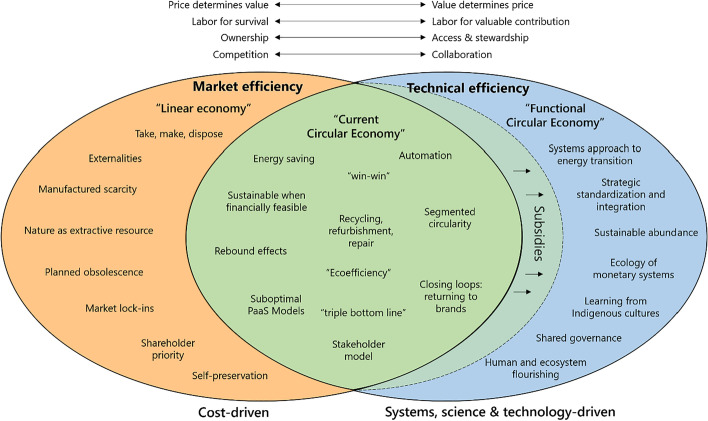
The circular economy stands at a crossroads between true systemic change and rebranded business-as-usual. It will either evolve to become -optimizing technical capabilities to mimic resilient ecosystems-or -reinforcing current destructive, destabilizing structures and incentives despite appearing to make marginal progress. This paper offers a unique critique of the circular economy: we argue that the circular economy is set up for failure precisely because it is required to conform to our current socio-econo-political system-that is, a . We identify four core characteristics of market systems: private property, competition, a market for labor, and value determined by price. Together, these characteristics create incentives that are antithetical to a functional circular economy: a requirement for infinite growth, short product lifetimes and limited material circularity, technically suboptimal products and systems, ineffective reverse logistics networks, and misplaced priorities from distorted notions of value. We then show that the fundamental organizing principle of market systems is , which is based on a false assumption of scarcity. In contrast, we suggest a competing worldview of sustainable abundance based on a principle of , which optimizes technical and environmental outcomes. Using this lens, we suggest alternatives to the core market characteristics, including an ecology of complementary currencies, a new understanding of private property, an adjusted balance of competition and cooperation, labor market alternatives, a reevaluation of true value, and lessons from Indigenous peoples. If-and only if-we embrace technical efficiency over market efficiency, we can unshackle the circular economy to create meaningful system change and a future of sustainable abundance.
循环经济正处于真正的系统性变革与重新包装的照常营业之间的十字路口。它要么演变成——优化技术能力以模仿有复原力的生态系统——要么——强化当前具有破坏性、不稳定的结构和激励措施,尽管看似取得了微小进展。本文对循环经济提出了独特的批判:我们认为循环经济注定会失败,恰恰是因为它被要求符合我们当前的社会经济政治体系——也就是说,一种……我们确定了市场体系的四个核心特征:私有财产、竞争、劳动力市场以及由价格决定的价值。这些特征共同创造了与功能性循环经济背道而驰的激励因素:对无限增长的要求、产品寿命短和物质循环有限、技术上次优的产品和系统、无效的逆向物流网络以及因扭曲的价值观念而错位的优先事项。然后我们表明,市场体系的基本组织原则是……,它基于稀缺性的错误假设。相比之下,我们提出了一种基于……原则的可持续富足的竞争世界观,该原则优化技术和环境成果。通过这个视角,我们提出了替代核心市场特征的方案,包括互补货币生态、对私有财产的新理解、竞争与合作的调整平衡、劳动力市场替代方案、对真正价值的重新评估以及从原住民那里汲取的经验教训。只有当——而且仅当——我们优先考虑技术效率而非市场效率时,我们才能解放循环经济,创造有意义的系统变革和可持续富足的未来。