Centre for Microbiology and Environmental Systems Science, University of Vienna, 1030 Vienna, Austria.
Doctoral School in Microbiology and Environmental Science, University of Vienna, 1030 Vienna, Austria.
Proc Natl Acad Sci U S A. 2022 Sep 6;119(36):e2205856119. doi: 10.1073/pnas.2205856119. Epub 2022 Aug 29.
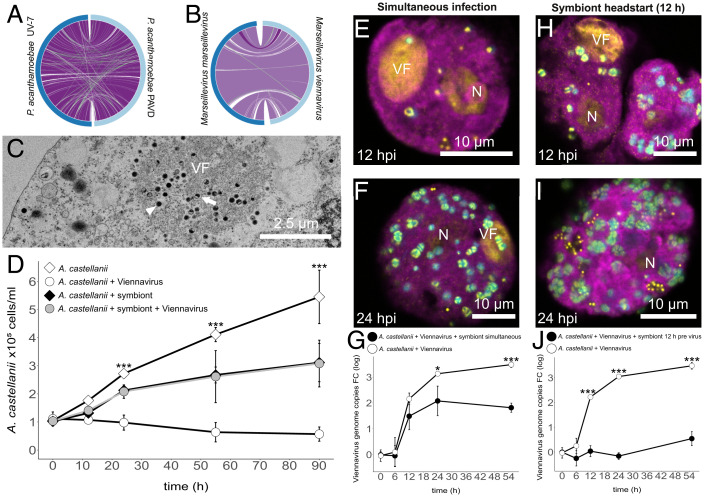
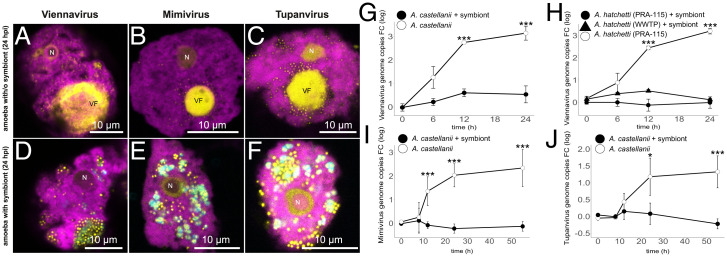
Protists are important regulators of microbial communities and key components in food webs with impact on nutrient cycling and ecosystem functioning. In turn, their activity is shaped by diverse intracellular parasites, including bacterial symbionts and viruses. Yet, bacteria-virus interactions within protists are poorly understood. Here, we studied the role of bacterial symbionts of free-living amoebae in the establishment of infections with nucleocytoplasmic large DNA viruses (Nucleocytoviricota). To investigate these interactions in a system that would also be relevant in nature, we first isolated and characterized a giant virus (Viennavirus, family Marseilleviridae) and a sympatric potential host infected with bacterial symbionts. Subsequently, coinfection experiments were carried out, using the fresh environmental isolates as well as additional amoeba laboratory strains. Employing fluorescence in situ hybridization and qPCR, we show that the bacterial symbiont, identified as , represses the replication of the sympatric Viennavirus in both recent environmental isolates as well as laboratory strains. In the presence of the symbiont, virions are still taken up, but viral factory maturation is inhibited, leading to survival of the amoeba host. The symbiont also suppressed the replication of the more complex and (Mimiviridae). Our work provides an example of an intracellular bacterial symbiont protecting a protist host against virus infections. The impact of virus-symbiont interactions on microbial population dynamics and eventually ecosystem processes requires further attention.
原生动物是微生物群落的重要调节者,也是食物网中的关键组成部分,对养分循环和生态系统功能有影响。反过来,它们的活动又受到各种细胞内寄生虫的影响,包括细菌共生体和病毒。然而,原生动物内的细菌-病毒相互作用还知之甚少。在这里,我们研究了自由生活变形虫的细菌共生体在核质大 DNA 病毒(核质病毒)感染中的作用。为了在一个在自然中也相关的系统中研究这些相互作用,我们首先分离并鉴定了一种巨型病毒(Viennavirus,马赛病毒科)和一种共生的潜在宿主,该宿主感染了细菌共生体。随后,进行了共感染实验,使用新鲜的环境分离物以及额外的变形虫实验室菌株。通过荧光原位杂交和 qPCR,我们表明,鉴定为 的细菌共生体抑制了同域 Viennavirus 在最近的环境分离物和 实验室菌株中的复制。在共生体存在的情况下,病毒仍被摄取,但病毒工厂的成熟被抑制,导致变形虫宿主存活。共生体还抑制了更复杂的 和 (Mimiviridae)的复制。我们的工作提供了一个例子,即细胞内细菌共生体保护原生动物宿主免受病毒感染。病毒-共生体相互作用对微生物种群动态,最终对生态系统过程的影响需要进一步关注。