Department of Radiology and Imaging Sciences, Indiana University School of Medicine Indianapolis, 550 N. University Blvd. Suite 0663, Indianapolis, IN, 46202, USA.
Department of Medicine Division of Gastroenterology, Hepatology & Nutrition University of Pittsburgh School of Medicine, Pittsburgh, PA, USA.
Abdom Radiol (NY). 2022 Nov;47(11):3792-3805. doi: 10.1007/s00261-022-03654-7. Epub 2022 Aug 29.
To determine if quantitative MRI techniques can be helpful to evaluate chronic pancreatitis (CP) in a setting of multi-institutional study.
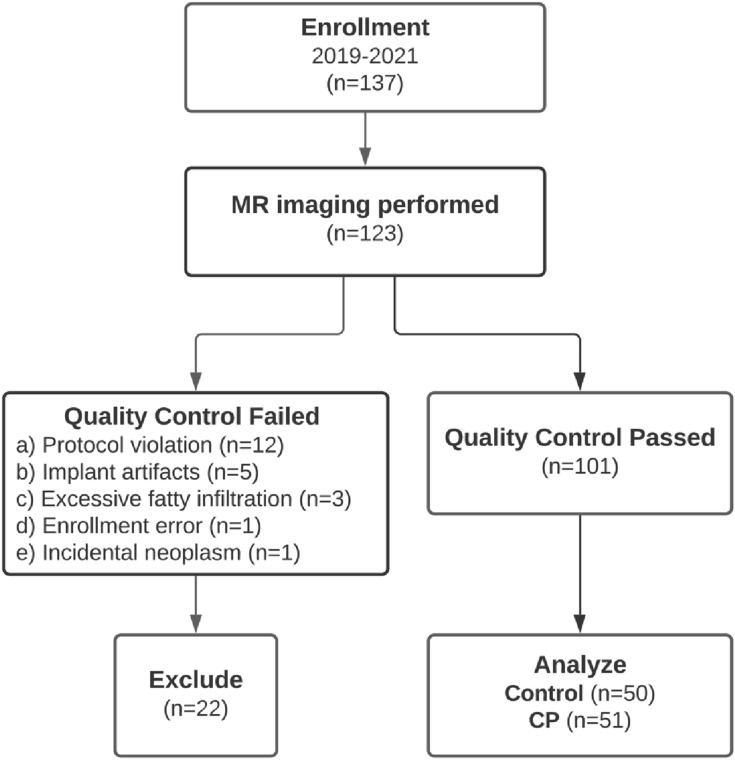
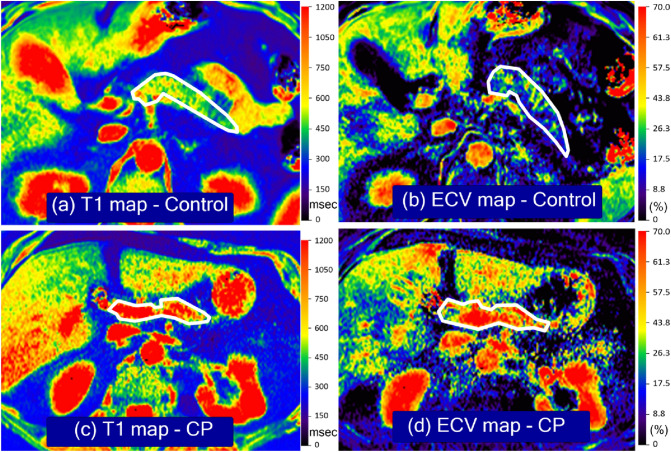
This study included a subgroup of participants (n = 101) enrolled in the Prospective Evaluation of Chronic Pancreatitis for Epidemiologic and Translational Studies (PROCEED) study (NCT03099850) from February 2019 to May 2021. MRI was performed on 1.5 T using Siemens and GE scanners at seven clinical centers across the USA. Quantitative MRI parameters of the pancreas included T1 relaxation time, extracellular volume (ECV) fraction, apparent diffusion coefficient (ADC), and fat signal fraction. We report the diagnostic performance and mean values within the control (n = 50) and CP (n = 51) groups. The T1, ECV and fat signal fraction were combined to generate the quantitative MRI score (Q-MRI).
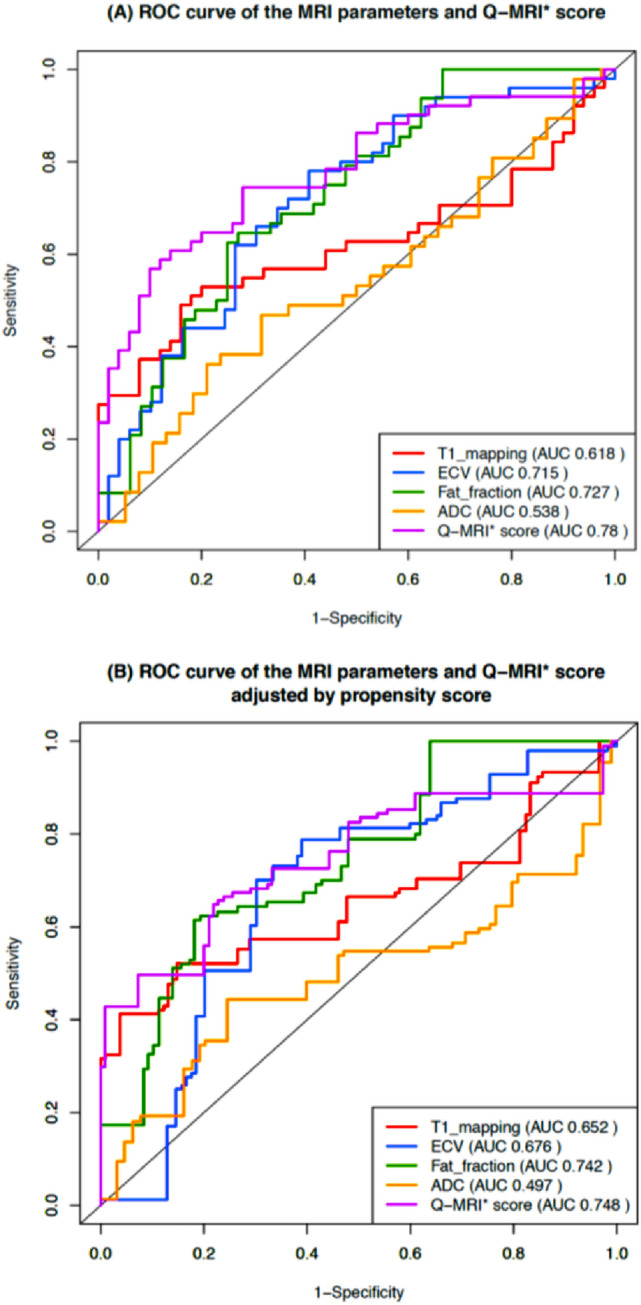
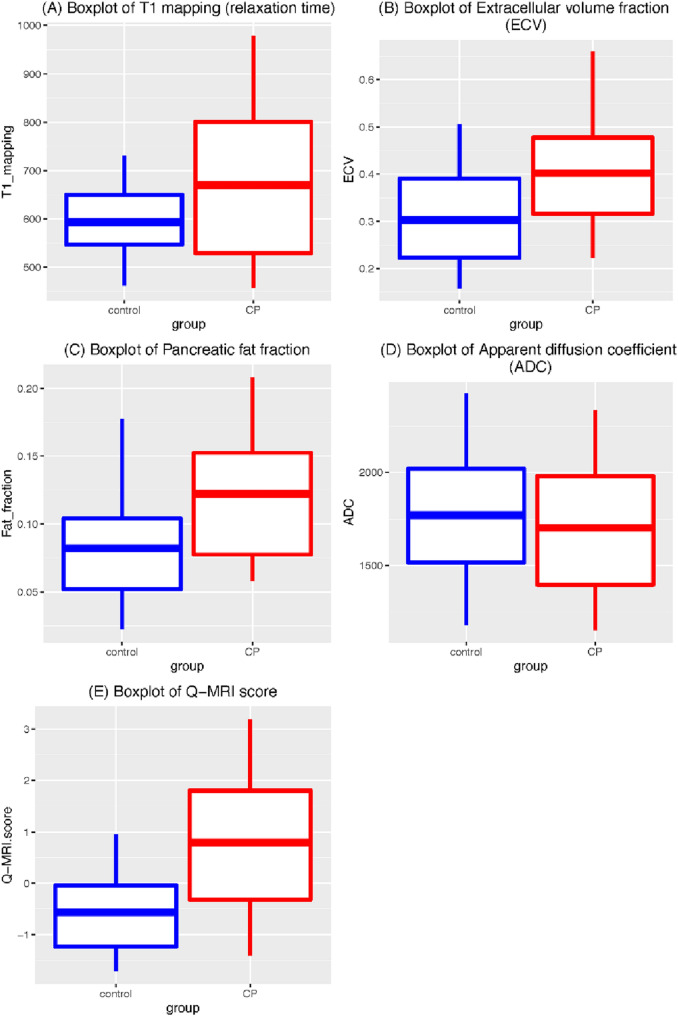
There was significantly higher T1 relaxation time; mean 669 ms (± 171) vs. 593 ms (± 82) (p = 0.006), ECV fraction; 40.2% (± 14.7) vs. 30.3% (± 11.9) (p < 0.001), and pancreatic fat signal fraction; 12.2% (± 5.5) vs. 8.2% (± 4.4) (p < 0.001) in the CP group compared to controls. The ADC was similar between groups (p = 0.45). The AUCs for the T1, ECV, and pancreatic fat signal fraction were 0.62, 0.72, and 0.73, respectively. The composite Q-MRI score improved the diagnostic performance (cross-validated AUC: 0.76).
Quantitative MR parameters evaluating the pancreatic parenchyma (T1, ECV fraction, and fat signal fraction) are helpful in the diagnosis of CP. A Q-MRI score that combines these three MR parameters improves diagnostic performance. Further studies are warranted with larger study populations including patients with acute and recurrent acute pancreatitis and longitudinal follow-ups.
确定定量 MRI 技术是否有助于在多机构研究中评估慢性胰腺炎(CP)。
本研究纳入了 2019 年 2 月至 2021 年 5 月期间参与 Prospective Evaluation of Chronic Pancreatitis for Epidemiologic and Translational Studies(PROCEED)研究(NCT03099850)的参与者亚组(n=101)。该研究在 7 个美国临床中心的西门子和 GE 扫描仪上进行了 1.5T MRI 检查。胰腺的定量 MRI 参数包括 T1 弛豫时间、细胞外体积(ECV)分数、表观扩散系数(ADC)和脂肪信号分数。我们报告了对照组(n=50)和 CP 组(n=51)的诊断性能和平均值。T1、ECV 和脂肪信号分数结合起来生成定量 MRI 评分(Q-MRI)。
CP 组的 T1 弛豫时间显著升高,平均为 669ms(±171)vs. 593ms(±82)(p=0.006),ECV 分数为 40.2%(±14.7)vs. 30.3%(±11.9)(p<0.001),胰腺脂肪信号分数为 12.2%(±5.5)vs. 8.2%(±4.4)(p<0.001)。与对照组相比,CP 组的 ADC 相似(p=0.45)。T1、ECV 和胰腺脂肪信号分数的 AUC 分别为 0.62、0.72 和 0.73。复合 Q-MRI 评分提高了诊断性能(交叉验证 AUC:0.76)。
评估胰腺实质的定量 MRI 参数(T1、ECV 分数和脂肪信号分数)有助于 CP 的诊断。结合这三个 MRI 参数的 Q-MRI 评分可提高诊断性能。需要进一步研究,纳入更多的急性和复发性胰腺炎患者以及进行纵向随访。