Department of Rehabilitation Medicine, Seoul National University College of Medicine, Seoul National University Bundang Hospital, Seongnam, Korea.
Department of Internal Medicine, Seoul National University College of Medicine, Seoul National University Bundang Hospital, Seongnam, Korea.
J Korean Med Sci. 2022 Aug 29;37(34):e262. doi: 10.3346/jkms.2022.37.e262.
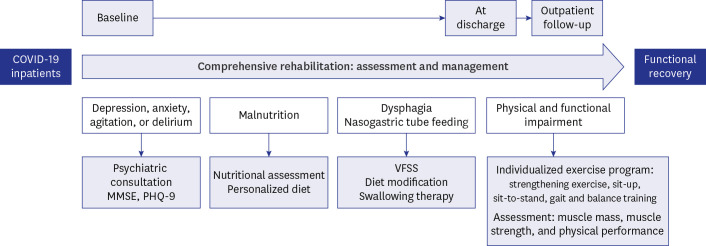
This study aimed to investigate the effects of comprehensive rehabilitation management on functional recovery and examine the correlation between clinical parameters and improvements in functional outcomes in severe-to-critical inpatients with coronavirus disease 2019 (COVID-19) in a tertiary hospital.
Post-acute COVID-19 patients who had a World Health Organization (WHO) ordinal scale of 5-7, underwent intensive care, and received comprehensive rehabilitation management, including exercise programs, nutritional support, dysphagia evaluation, and psychological care were included. The appendicular skeletal muscle mass index (SMI), Medical Research Council sum score, handgrip strength, number of repetitions in the 1-minute sit-to-stand test, gait speed, Berg Balance Scale (BBS), and Functional Ambulation Classification (FAC) were evaluated at hospital stay, discharge, and 1-month follow-up. The correlation between the rehabilitation dose and improvement in each outcome measure was analyzed.
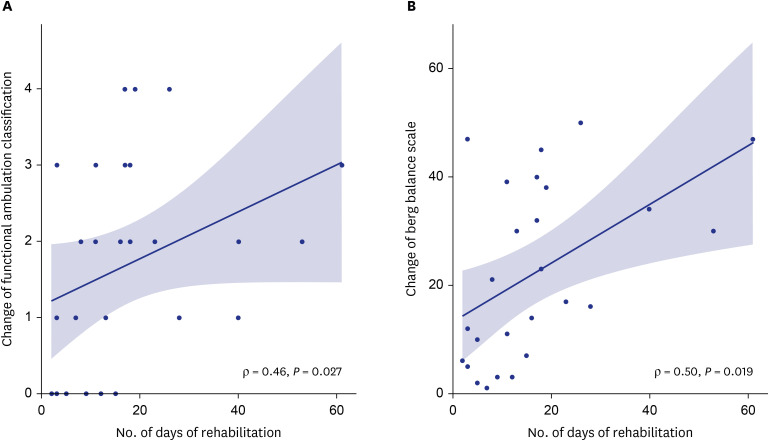
Overall, 37 patients were enrolled, of whom 59.5% and 32.4% had a score of 6 and 7 on the WHO ordinal scale, respectively. Lengths of stay in the intensive care unit and hospital were 33.6 ± 23.9 and 63.8 ± 36.5 days. Outcome measures revealed significant improvements at discharge and 1-month follow-up. The SMI was significantly increased at the 1-month follow-up (6.13 [5.24-7.76]) compared with that during the hospital stay (5.80 [5.39-7.05]). We identified dose-response associations between the rehabilitation dose and FAC (ρ = 0.46) and BBS (ρ = 0.50) scores. Patients with older age, longer hospitalization, longer stay at the intensive care unit, longer duration of mechanical ventilation, tracheostomy, a more depressive mood, and poorer nutritional status revealed poorer improvement in gait speed at the 1-month follow-up.
Comprehensive rehabilitation management effectively improved muscle mass, muscle strength, and physical performance in severe-to-critical COVID-19 patients. Dose-response relationship of rehabilitation and functional improvement emphasizes the importance of intensive post-acute inpatient rehabilitation in COVID-19 survivors.
ClinicalTrials.gov Identifier: NCT05104411.
本研究旨在探讨综合康复管理对功能恢复的影响,并研究三级医院中重症至危重症 2019 冠状病毒病(COVID-19)患者的临床参数与功能结局改善之间的相关性。
纳入符合以下标准的 COVID-19 后患者:世界卫生组织(WHO)等级量表评分为 5-7 分、入住重症监护病房、接受综合康复管理,包括运动方案、营养支持、吞咽困难评估和心理护理。在住院期间、出院时和 1 个月随访时评估四肢骨骼肌质量指数(SMI)、医学研究理事会总和评分、握力、1 分钟坐立试验重复次数、步速、伯格平衡量表(BBS)和功能性步行分类(FAC)。分析康复剂量与每个结局测量指标改善之间的相关性。
共纳入 37 例患者,其中 59.5%和 32.4%的患者 WHO 等级量表评分为 6 分和 7 分。入住重症监护病房和医院的时间分别为 33.6 ± 23.9 天和 63.8 ± 36.5 天。出院时和 1 个月随访时各项结局测量指标均有显著改善。SMI 在 1 个月随访时(6.13 [5.24-7.76])较住院期间(5.80 [5.39-7.05])显著增加。我们发现康复剂量与 FAC(ρ=0.46)和 BBS(ρ=0.50)评分之间存在剂量-反应关系。年龄较大、住院时间较长、入住重症监护病房时间较长、机械通气时间较长、气管切开术、抑郁情绪更严重以及营养状况较差的患者,在 1 个月随访时的步速改善更差。
综合康复管理可有效改善重症至危重症 COVID-19 患者的肌肉质量、肌肉力量和身体机能。康复和功能改善的剂量-反应关系强调了 COVID-19 幸存者在急性后期进行强化住院康复的重要性。
ClinicalTrials.gov 标识符:NCT05104411。