Prince of Wales Clinical School, University of New South Wales, Sydney, New South Wales, Australia.
Institute of Neurological Sciences, Prince of Wales Hospital, Sydney, New South Wales, Australia.
Eur J Neurol. 2022 Dec;29(12):3571-3579. doi: 10.1111/ene.15534. Epub 2022 Sep 14.
Nerve conduction studies (NCS) are the current objective measure for diagnosis of peripheral neuropathy in type 2 diabetes but do not assess nerve structure. This study investigated the utility of peripheral nerve ultrasound as a marker of the presence and severity of peripheral neuropathy in type 2 diabetes.
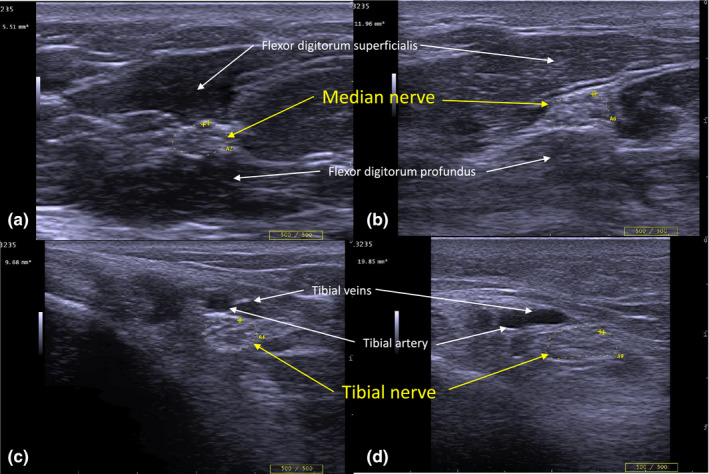
A total of 156 patients were recruited, and nerve ultrasound was undertaken on distal tibial and distal median nerves. Neuropathy severity was graded using the modified Toronto Clinical Neuropathy Scale (mTCNS) and Total Neuropathy Score (TNS). Studies were undertaken by a single ultrasonographer blinded to nerve conduction results.
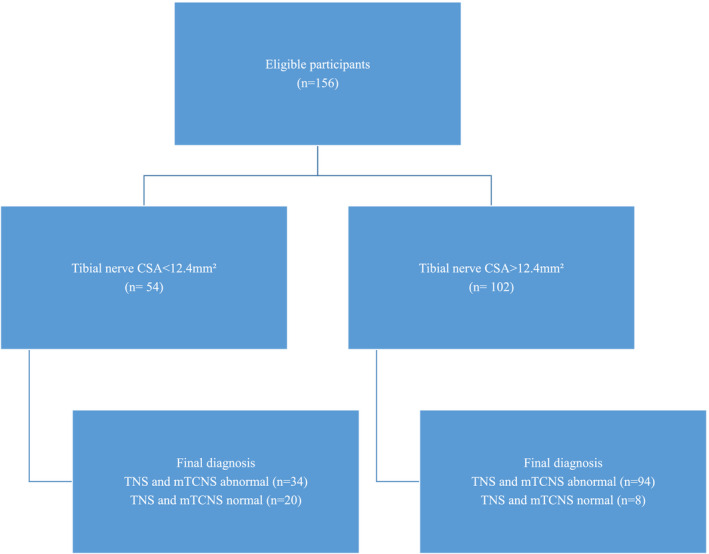
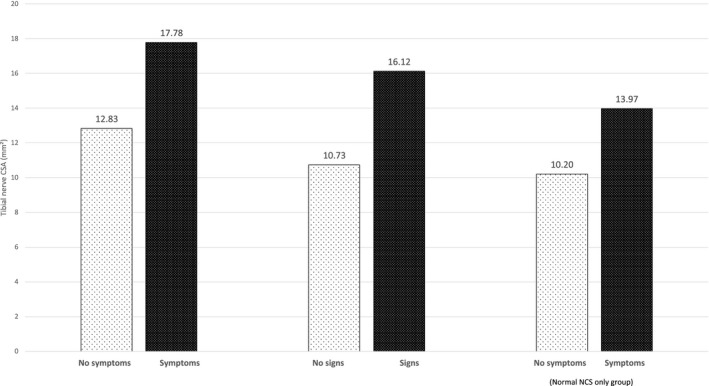
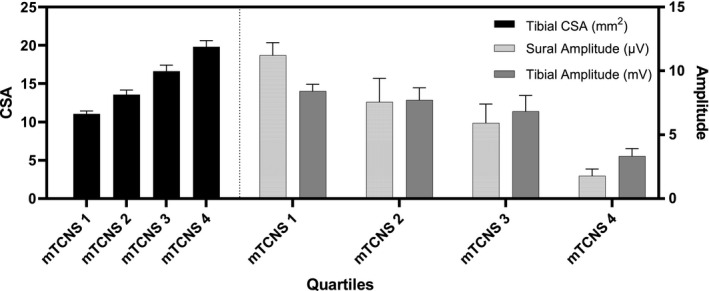
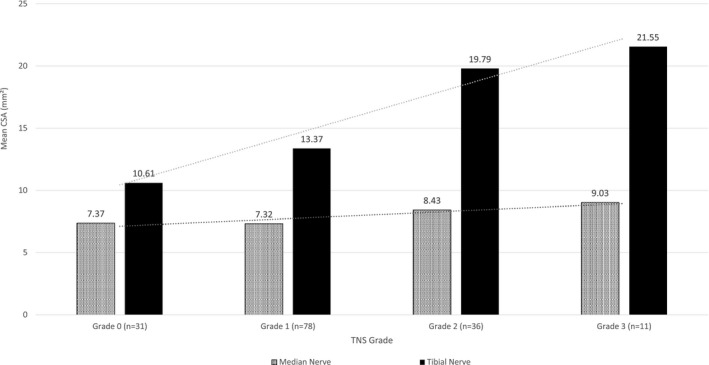
A stepwise increase in tibial nerve cross-sectional area (CSA) was noted with increasing TNS grade (p < 0.001) and each mTCNS quartile (p < 0.001). Regression analysis demonstrated a correlation between tibial nerve CSA and neuropathy severity (p < 0.001). Using receiver operator curve analysis, tibial nerve CSA of >12.88 mm yielded a sensitivity of 70.5% and specificity of 85.7% for neuropathy detection. Binary logistic regression revealed that tibial nerve CSA was a predictor of abnormal sural sensory nerve action potential amplitude (odds ratio = 1.239, 95% confidence interval [CI] = 1.142-1.345) and abnormal neuropathy score (odds ratio = 1.537, 95% confidence interval [CI] = 1.286-1.838).
Tibial nerve ultrasound has good specificity and sensitivity for neuropathy diagnosis in type 2 diabetes. The study demonstrates that tibial nerve CSA correlates with neuropathy severity. Future serial studies using both ultrasound and NCS may be useful in determining whether changes in ultrasound occur prior to development of nerve conduction abnormalities and neuropathic symptoms.
神经传导研究(NCS)是目前诊断 2 型糖尿病周围神经病的客观指标,但不能评估神经结构。本研究探讨了周围神经超声作为 2 型糖尿病周围神经病变存在和严重程度的标志物的效用。
共招募 156 例患者,对远端胫骨和远端正中神经进行神经超声检查。使用改良多伦多临床神经病学量表(mTCNS)和总神经病变评分(TNS)对神经病变严重程度进行分级。研究由一名对神经传导结果盲法的超声医师进行。
随着 TNS 分级(p<0.001)和每个 mTCNS 四分位数(p<0.001)的增加,胫骨神经横截面积(CSA)逐渐增加。回归分析显示胫骨神经 CSA 与神经病变严重程度之间存在相关性(p<0.001)。使用接受者操作特征曲线分析,胫骨神经 CSA 大于 12.88 mm 对周围神经病变的检测具有 70.5%的敏感性和 85.7%的特异性。二元逻辑回归显示胫骨神经 CSA 是异常腓肠感觉神经动作电位幅度(比值比=1.239,95%置信区间 [CI]:1.142-1.345)和异常神经病变评分(比值比=1.537,95%置信区间 [CI]:1.286-1.838)的预测因素。
胫骨神经超声对 2 型糖尿病周围神经病变具有良好的特异性和敏感性。该研究表明,胫骨神经 CSA 与神经病变严重程度相关。未来使用超声和 NCS 的系列研究可能有助于确定超声变化是否先于神经传导异常和神经病变症状的发生。