Child Development and Exercise Center, Wilhelmina Children's Hospital, University Medical Center Utrecht, Utrecht, The Netherlands.
UMC Utrecht Brain Center, University Medical Center Utrecht, Utrecht, The Netherlands.
Pediatr Pulmonol. 2022 Dec;57(12):3050-3059. doi: 10.1002/ppul.26133. Epub 2022 Sep 14.
Respiratory failure is a major cause of morbidity and mortality in patients with Spinal Muscular Atrophy (SMA). Lack of endurance, or "fatigability," is an important symptom of SMA. In addition to respiratory muscle weakness, respiratory function in SMA may be affected by Respiratory Muscle Fatigability (RMF).
The purpose of this study was to explore RMF in patients with SMA.
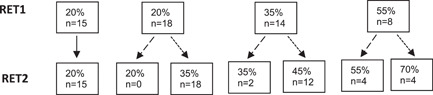
We assessed a Respiratory Endurance Test (RET) in 19 children (median age [years]: 11) and 36 adults (median age [years]: 34) with SMA types 2 and 3. Participants were instructed to breath against an inspiratory threshold load at either 20%, 35%, 45%, 55%, or 70% of their individual maximal inspiratory mouth pressure (PImax). RMF was defined as the inability to complete 60 consecutive breaths. Respiratory fatigability response was determined by change in maximal inspiratory mouth pressure (ΔPImax) and perceived fatigue (∆perceived fatigue).
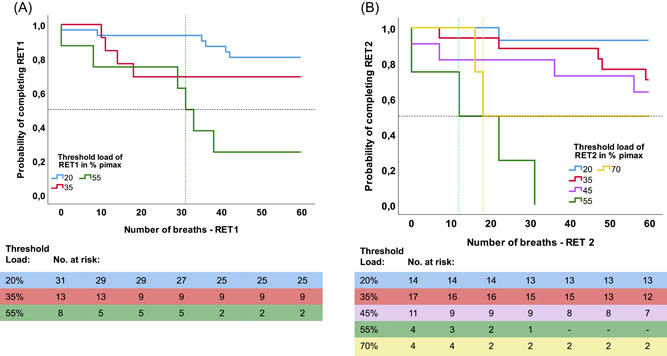
The probability of RMF during the RET increased by 59%-69% over 60 breaths with every 10% increase in inspiratory threshold load (%PImax). Fatigability response was characterized by a large variability in ΔPImax (-21% to +16%) and a small increase in perceived fatigue (p = 0.041, range 0 to +3).
Patients with SMA demonstrate a dose-dependent increase in RMF without severe increase in exercise-induced muscle weakness or perceived fatigue. Inspiratory muscle loading in patients with SMA seems feasible and its potential to stabilize or improve respiratory function in patients with SMA needs to be determined in further research.
呼吸衰竭是肌萎缩性脊髓侧索硬化症(SMA)患者发病率和死亡率的主要原因。耐力不足或“疲劳性”是 SMA 的一个重要症状。除了呼吸肌无力外,SMA 患者的呼吸功能还可能受到呼吸肌疲劳性(RMF)的影响。
本研究旨在探讨 SMA 患者的 RMF。
我们评估了 19 名儿童(中位数年龄[岁]:11 岁)和 36 名成人(中位数年龄[岁]:34 岁)的呼吸耐力测试(RET)。参与者被指示以其个体最大吸气口压(PImax)的 20%、35%、45%、55%或 70%的吸气阈负荷呼吸。RMF 定义为无法完成 60 次连续呼吸。通过最大吸气口压(ΔPImax)和感知疲劳(∆perceived fatigue)的变化来确定呼吸疲劳反应。
随着吸气阈负荷(%PImax)每增加 10%,RET 过程中 RMF 的发生概率增加了 59%-69%。疲劳反应的特点是 ΔPImax 变化很大(-21%至+16%),感知疲劳略有增加(p=0.041,范围 0 至+3)。
SMA 患者表现出与剂量相关的 RMF 增加,而运动引起的肌肉无力或感知疲劳没有明显增加。SMA 患者吸气肌负荷似乎是可行的,需要进一步研究确定其在稳定或改善 SMA 患者呼吸功能方面的潜力。