Institute of Food Chemistry and Food Biotechnology, Justus Liebig University Giessen, Heinrich-Buff-Ring 17, 35392, Giessen, Germany.
Institute of Inorganic and Analytical Chemistry, Justus Liebig University Giessen, Heinrich-Buff-Ring 17, 35392, Giessen, Germany.
Appl Microbiol Biotechnol. 2022 Sep;106(18):6095-6107. doi: 10.1007/s00253-022-12134-3. Epub 2022 Aug 30.
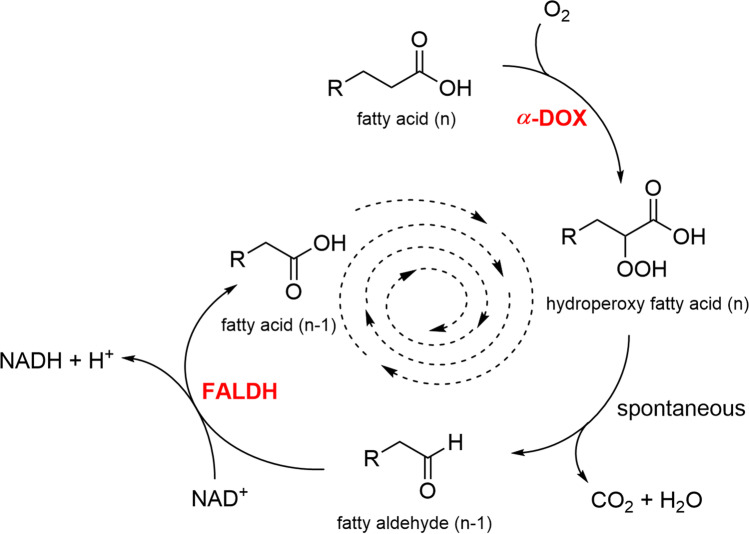
Aldehydes represent a versatile and favored class of flavoring substances. A biocatalytic access to odor-active aldehydes was developed by conversion of fatty acids with two enzymes of the α-dioxygenase pathway. The recombinant enzymes α-dioxygenase (α-DOX) originating from Crocosphaera subtropica and fatty aldehyde dehydrogenase (FALDH) from Vibrio harveyi were heterologously expressed in E. coli, purified, and applied in a coupled (tandem) repetitive reaction. The concept was optimized in terms of number of reaction cycles and production yields. Up to five cycles and aldehyde yields of up to 26% were achieved. Afterward, the approach was applied to sea buckthorn pulp oil as raw material for the enzyme catalyzed production of flavoring/fragrance ingredients based on complex aldehyde mixtures. The most abundant fatty acids in sea buckthorn pulp oil, namely palmitic, palmitoleic, oleic, and linoleic acid, were used as substrates for further biotransformation experiments. Various aldehydes were identified, semi-quantified, and sensorially characterized by means of headspace-solid phase microextraction-gas chromatography-mass spectrometry-olfactometry (HS-SPME-GC-MS-O). Structural validation of unsaturated aldehydes in terms of double-bond positions was performed by multidimensional high-resolution mass spectrometry experiments of their Paternò-Büchi (PB) photoproducts. Retention indices and odor impressions of inter alia (Z,Z)-5,8-tetradecadienal (Z,Z)-6,9-pentadecadienal, (Z)-8-pentadecenal, (Z)-4-tridecenal, (Z)-6-pentadecenal, and (Z)-8-heptadecenal were determined for the first time. KEY POINTS: • Coupled reaction of Csα-DOX and VhFALDH yields chain-shortened fatty aldehydes. • Odors of several Z-unsaturated fatty aldehydes are described for the first time. • Potential for industrial production of aldehyde-based odorants from natural sources.
醛类是一类用途广泛且受欢迎的调味物质。通过利用脂肪酸双加氧酶途径中的两种酶,开发了一种生物催化方法来获得具有气味活性的醛类。来源于类球红细菌(Crocosphaera subtropica)的α-双加氧酶(α-DOX)和来自 Harveyi 弧菌(Vibrio harveyi)的脂肪醛脱氢酶(FALDH)的重组酶在大肠杆菌中异源表达、纯化,并应用于偶联(串联)重复反应中。该方法在反应循环次数和生产产率方面进行了优化。最多可进行 5 个循环,醛的产率最高可达 26%。之后,该方法应用于沙棘果肉油作为原料,通过酶催化生产基于复杂醛混合物的调味/香料成分。沙棘果肉油中最丰富的脂肪酸,即棕榈酸、棕榈油酸、油酸和亚油酸,被用作进一步生物转化实验的底物。通过顶空固相微萃取-气相色谱-质谱-嗅闻(HS-SPME-GC-MS-O),鉴定、半定量和感官描述了各种醛类,并通过多维高分辨质谱实验对其 Paternò-Büchi(PB)光产物的双键位置进行了结构验证。首次测定了(Z,Z)-5,8-十四碳二烯醛(Z,Z)-6,9-十五碳二烯醛、(Z)-8-十五碳烯醛、(Z)-4-十三碳烯醛、(Z)-6-十五碳烯醛和(Z)-8-十七碳烯醛的保留指数和气味印象。关键点:• Csα-DOX 和 VhFALDH 的偶联反应生成链缩短的脂肪酸醛。• 首次描述了几种 Z-不饱和脂肪酸醛的气味。• 从天然来源工业生产基于醛的气味剂的潜力。