Musculoskeletal Research Unit, Translational Health Sciences, Bristol Medical School, University of Bristol, Bristol, UK.
Nuffield Department of Orthopaedics, Rheumatology and Musculoskeletal Sciences, University of Oxford, Oxford, UK.
Age Ageing. 2022 Aug 2;51(8). doi: 10.1093/ageing/afac183.
Despite established standards and guidelines, substantial variation remains in the delivery of hip fracture care across the United Kingdom. We aimed to determine which hospital-level organisational factors predict adverse patient outcomes in the months following hip fracture.
We examined a national record-linkage cohort of 178,757 patients aged ≥60 years who sustained a hip fracture in England and Wales in 2016-19. Patient-level hospital admissions datasets, National Hip Fracture Database and mortality data were linked to metrics from 18 hospital-level organisational-level audits and reports. Multilevel models identified organisational factors, independent of patient case-mix, associated with three patient outcomes: length of hospital stay (LOS), 30-day all-cause mortality and emergency 30-day readmission.
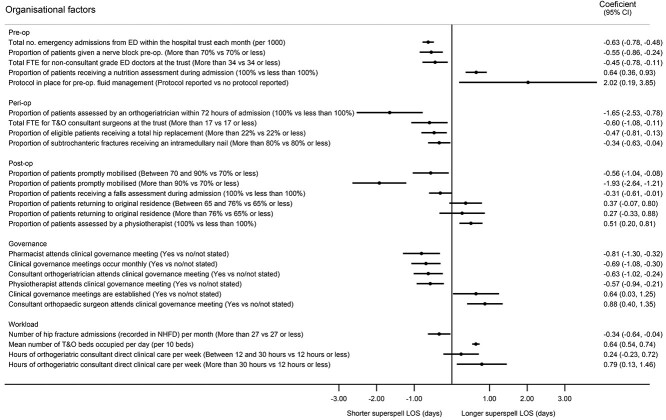
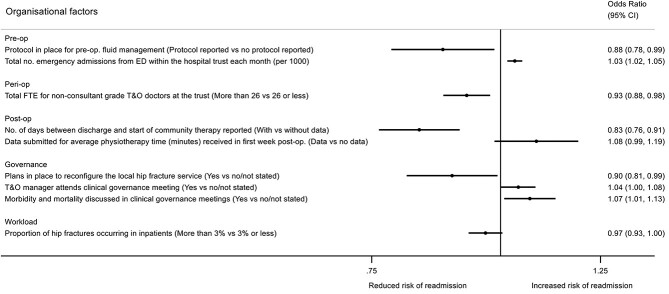
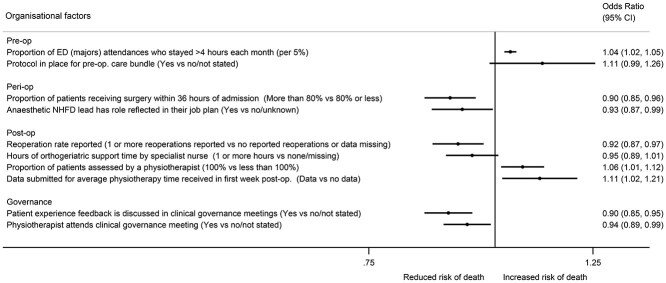
Across hospitals mean LOS ranged from 12 to 41.9 days, mean 30-day mortality from 3.7 to 10.4% and mean readmission rates from 3.7 to 30.3%, overall means were 21.4 days, 7.3% and 15.3%, respectively. In all, 22 organisational factors were independently associated with LOS; e.g. a hospital's ability to mobilise >90% of patients promptly after surgery predicted a 2-day shorter LOS (95% confidence interval [CI]: 1.2-2.6). Ten organisational factors were independently associated with 30-day mortality; e.g. discussion of patient experience feedback at clinical governance meetings and provision of prompt surgery to >80% of patients were each associated with 10% lower mortality (95%CI: 5-15%). Nine organisational factors were independently associated with readmissions; e.g. readmissions were 17% lower if hospitals reported how soon community therapy would start after discharge (95%CI: 9-24%).
Receipt of hip fracture care should be reliable and equitable across the country. We have identified multiple, potentially modifiable, organisational factors associated with important patient outcomes following hip fracture.
尽管有既定的标准和指南,但英国各地在髋部骨折护理的实施方面仍存在很大差异。我们旨在确定哪些医院层面的组织因素可以预测髋部骨折后数月内的患者预后不良。
我们研究了一个全国性的基于记录链接的队列,该队列包含了 2016 年至 2019 年期间在英格兰和威尔士因髋部骨折而住院的 178757 名年龄≥60 岁的患者。患者层面的住院数据集、国家髋部骨折数据库和死亡率数据与 18 个医院层面的组织层面审计和报告中的指标相链接。多水平模型确定了与三个患者结局相关的组织因素,这些因素独立于患者病例组合,即住院时间(LOS)、30 天全因死亡率和 30 天内紧急再入院率。
在各医院中,平均 LOS 范围为 12 至 41.9 天,30 天死亡率平均为 3.7 至 10.4%,30 天再入院率平均为 3.7 至 30.3%,总体平均值分别为 21.4 天、7.3%和 15.3%。共有 22 个组织因素与 LOS 独立相关;例如,医院在手术后及时让>90%的患者下床活动的能力可预测 LOS 缩短 2 天(95%置信区间 [CI]:1.2-2.6)。有 10 个组织因素与 30 天死亡率独立相关;例如,在临床治理会议上讨论患者的反馈意见以及及时为>80%的患者提供手术,这些因素均与死亡率降低 10%相关(95%CI:5-15%)。有 9 个组织因素与再入院独立相关;例如,如果医院报告出院后社区治疗将在多快开始,那么再入院率将降低 17%(95%CI:9-24%)。
髋部骨折护理的实施在全国范围内应是可靠和公平的。我们已经确定了多个与髋部骨折后重要患者结局相关的、潜在可改变的组织因素。