Department of Gastrointestinal and Plastic Surgery, Pu'er People's Hospital, Yunnan.
Department of Gastroenterology, Pu'er People's Hospital, Yunnan.
Medicine (Baltimore). 2022 Aug 26;101(34):e30218. doi: 10.1097/MD.0000000000030218.
Although several studies have identified an association between the rs4784227-cancer susceptibility candidate gene 16 (CASC16) polymorphism and breast cancer, the results remain inconclusive. Therefore, we conducted a meta-analysis to assess the relationship between the rs4784227-CASC16 polymorphism and breast cancer risk.
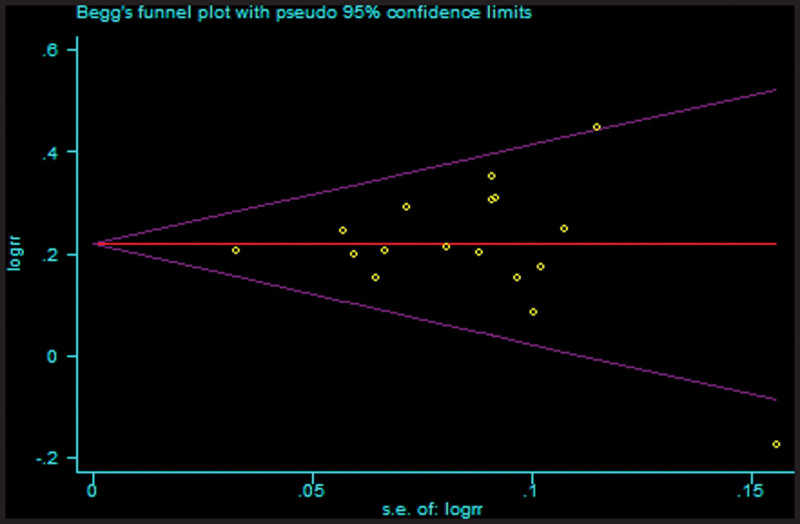
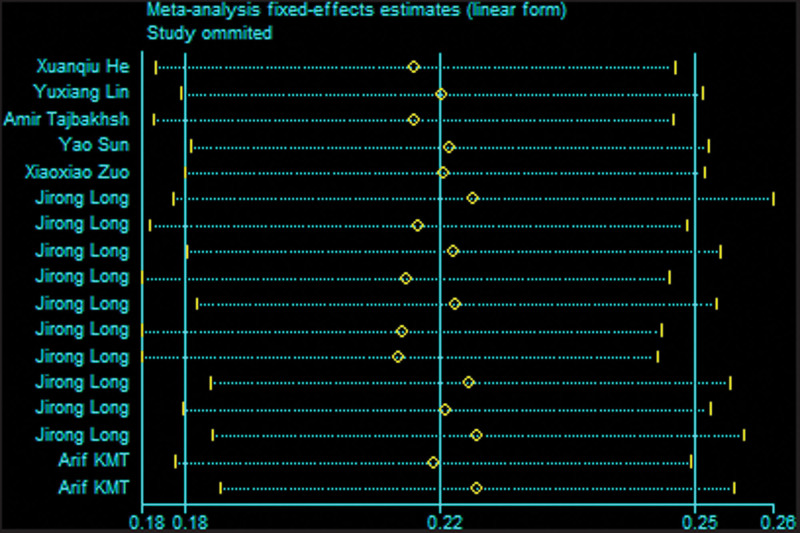
Studies were searched in the PubMed, Web of Science, Embase, Google Scholar, and Cochran Library databases until June 10, 2021, to identify all potential literature on rs4784227-CASC16 polymorphism and breast cancer risk association. Fixed-effect or random-effect models were used to calculate odds ratios (ORs) and their corresponding 95% confidence intervals (95% CIs). Subgroup analyses, publication bias, and sensitivity analyses were also conducted.
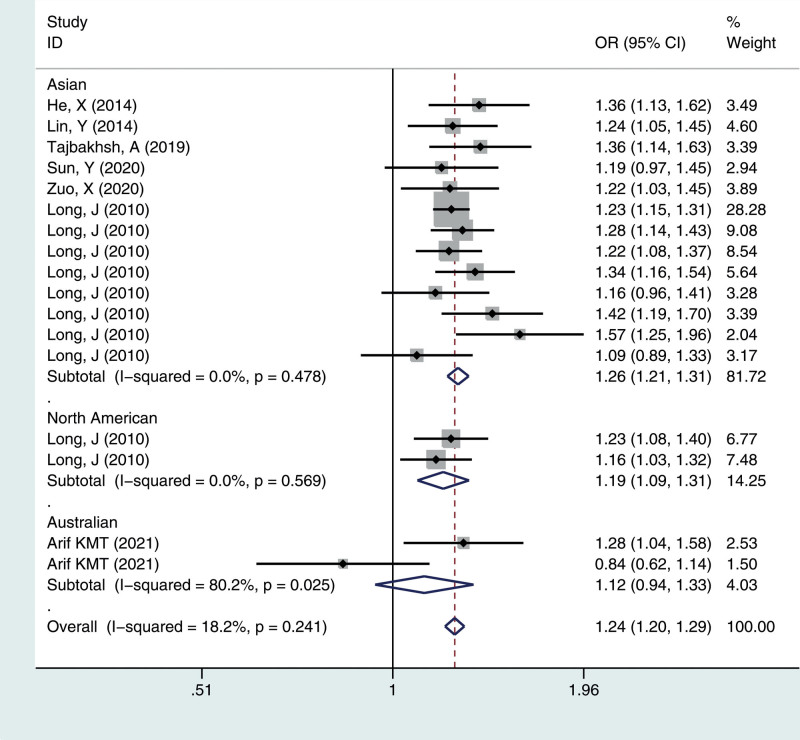
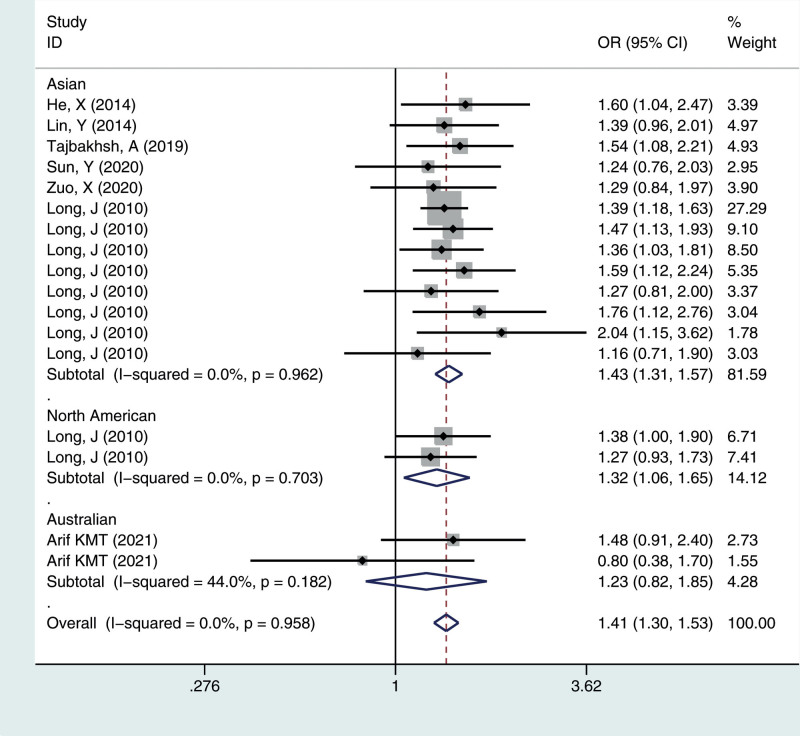
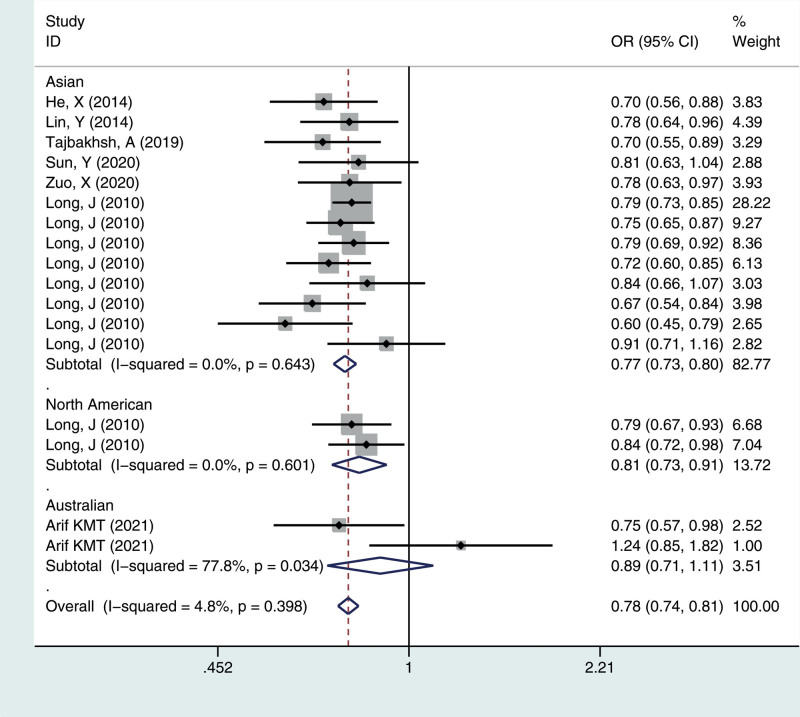
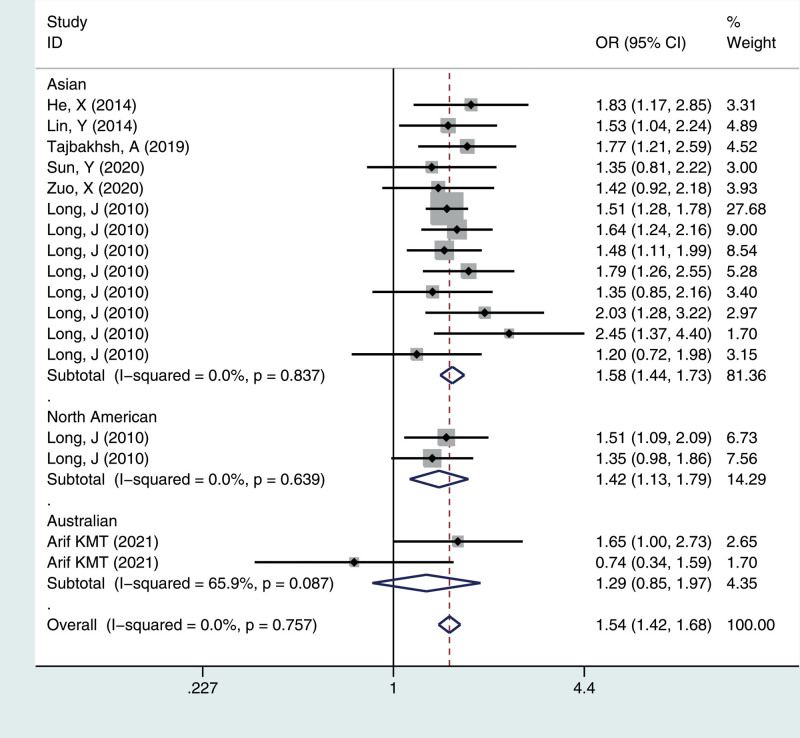
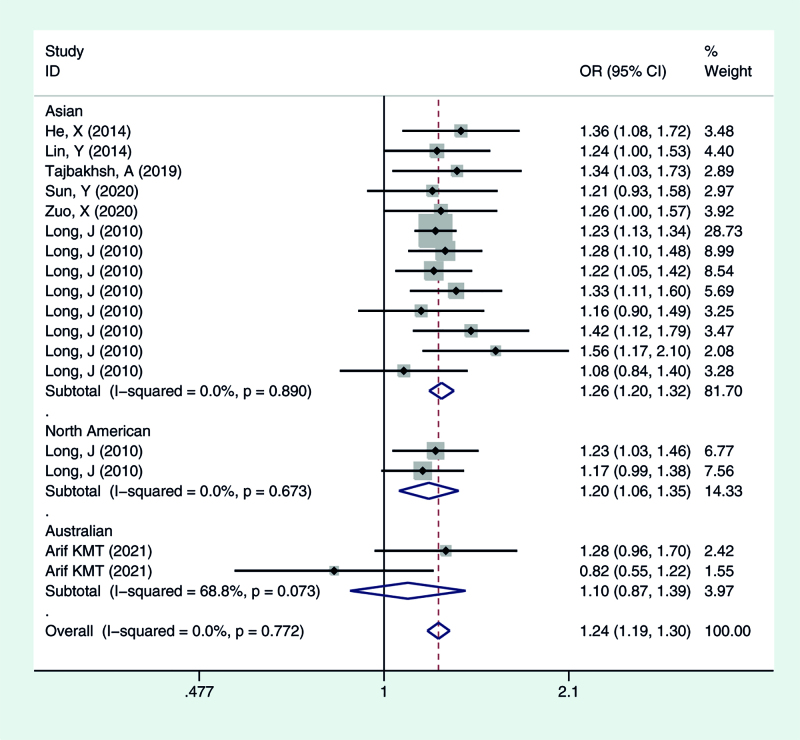
Seventeen eligible studies involving 34,719 subjects (18,445 cases and 16,274 healthy controls) from 7 articles were included in the current meta-analysis. The pooled ORs regarding the association between the rs4784227-CASC16 polymorphism and breast cancer risk were statistically significant [T vs C: OR = 1.244, 95% CI = 1.202-1.287; TT vs CT + CC: OR = 1.407, 95% CI = 1.296-1.528; CC vs CT + TT: OR = 0.777, 95% CI = 0.745-0.811; TT vs CC: OR = 1.544, 95% CI = 1.419-1.681; CT vs CC: OR = 1.244, 95% CI = 1.189-1.301]. On subgroup analysis, the rs4784227-CASC16 T/C gene has a certain correlation with breast cancer susceptibility in Asian and North American populations, but no significant risk in the Australian population.
Our pooled analysis showed a significant association between the rs4784227- (T) allele and breast cancer susceptibility in Asian and North American populations, and intervention with this mutation might be a new therapeutic strategy for breast cancer. However, large-scale and well-designed studies are needed in different populations to further evaluate the role of the rs4784227-CASC16 polymorphism in breast cancer.
尽管有几项研究已经确定了 rs4784227-癌症易感性候选基因 16(CASC16)多态性与乳腺癌之间的关联,但结果仍存在争议。因此,我们进行了一项荟萃分析,以评估 rs4784227-CASC16 多态性与乳腺癌风险之间的关系。
我们在 PubMed、Web of Science、Embase、Google Scholar 和 Cochran 图书馆数据库中进行了检索,以确定所有关于 rs4784227-CASC16 多态性与乳腺癌风险关联的潜在文献,直至 2021 年 6 月 10 日。使用固定效应或随机效应模型来计算比值比(OR)及其相应的 95%置信区间(95%CI)。还进行了亚组分析、发表偏倚和敏感性分析。
有 7 篇文章的 7 项研究共纳入了 34719 名受试者(18445 例病例和 16274 名健康对照者),符合纳入标准。荟萃分析结果显示,rs4784227-CASC16 多态性与乳腺癌风险之间的关联具有统计学意义[T 等位基因与 C 等位基因相比:OR=1.244,95%CI=1.202-1.287;TT 基因型与 CT+CC 基因型相比:OR=1.407,95%CI=1.296-1.528;CC 基因型与 CT+TT 基因型相比:OR=0.777,95%CI=0.745-0.811;TT 基因型与 CC 基因型相比:OR=1.544,95%CI=1.419-1.681;CT 基因型与 CC 基因型相比:OR=1.244,95%CI=1.189-1.301]。亚组分析结果显示,rs4784227-CASC16 T/C 基因与亚洲和北美人种的乳腺癌易感性有一定的相关性,但在澳大利亚人群中没有显著的风险。
我们的荟萃分析显示,rs4784227-(T)等位基因与亚洲和北美人种的乳腺癌易感性之间存在显著关联,针对这种突变的干预可能是一种治疗乳腺癌的新策略。但是,需要在不同人群中进行大规模和精心设计的研究,以进一步评估 rs4784227-CASC16 多态性在乳腺癌中的作用。