Université Paris Cité, Inserm, PARCC, F-75015 Paris, France.
Clin Sci (Lond). 2022 Aug 31;136(16):1241-1255. doi: 10.1042/CS20210990.
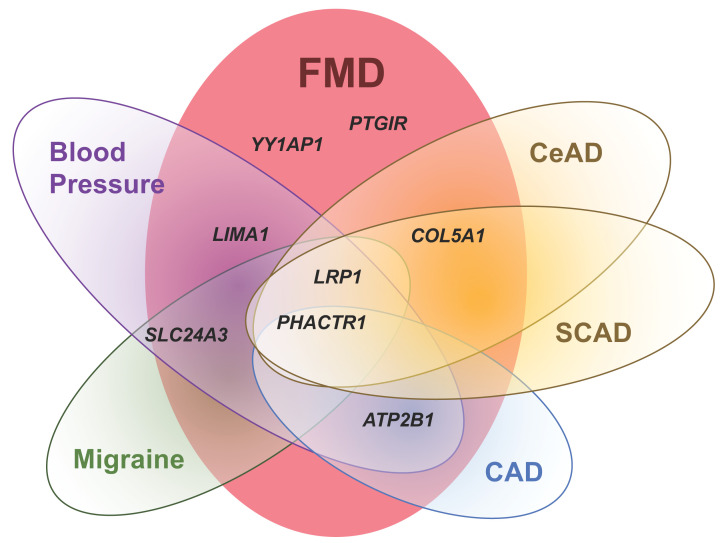
Artery stenosis is a common cause of hypertension and stroke and can be due to atherosclerosis accumulation in the majority of cases and in a small fraction of patients to arterial fibromuscular dysplasia (FMD). Artery stenosis due to atherosclerosis is widely studied with known risk factors (e.g. increasing age, male gender, and dyslipidemia) to influence its etiology, including genetic factors. However, the causes of noninflammatory and nonatherosclerotic stenosis in FMD are less understood. FMD occurs predominantly in early middle-age women, a fraction of the population where cardiovascular risk is different and understudied. FMD arteriopathies are often diagnosed in the context of hypertension and stroke and co-occur mainly with spontaneous coronary artery dissection, an atypical cause of acute myocardial infarction. In this review, we provide a comprehensive overview of the recent advances in the understanding of molecular origins of FMD. Data were obtained from genetic studies using complementary methodological approaches applied to familial, syndromic, and sporadic forms of this intriguing arteriopathy. Rare variation analyses point toward mechanisms related to impaired prostacyclin signaling and defaults in fibrillar collagens. The study of common variation, mainly through a recent genome-wide association study, describes a shared genetic link with blood pressure, in addition to point at potential risk genes involved in actin cytoskeleton and intracellular calcium homeostasis supporting impaired vascular contraction as a key mechanism. We conclude this review with future strategies and approaches needed to fully understand the genetic and molecular mechanisms related to FMD.
动脉狭窄是高血压和中风的常见原因,大多数情况下是由于动脉粥样硬化堆积,而在一小部分患者中则是由于动脉纤维肌发育不良(FMD)。由于动脉粥样硬化导致的动脉狭窄已得到广泛研究,已知的风险因素(如年龄增长、男性和血脂异常)会影响其病因,包括遗传因素。然而,对于 FMD 中非炎症性和非粥样硬化性狭窄的原因了解较少。FMD 主要发生在中年早期女性中,这部分人群的心血管风险不同且研究不足。FMD 动脉病变通常在高血压和中风的背景下诊断,主要与自发性冠状动脉夹层共现,这是急性心肌梗死的一种非典型病因。在这篇综述中,我们全面概述了对 FMD 分子起源的最新理解。这些数据来自使用互补方法学方法对家族性、综合征性和散发性 FMD 进行的遗传研究。罕见变异分析指出与前列腺素信号受损和纤维胶原缺陷有关的机制。常见变异的研究,主要通过最近的全基因组关联研究,描述了与血压的共同遗传联系,此外还指出了参与肌动蛋白细胞骨架和细胞内钙稳态的潜在风险基因,支持血管收缩受损作为关键机制。我们以理解与 FMD 相关的遗传和分子机制所需的未来策略和方法结束了这篇综述。