PhD International School in Clinical and Experimental Medicine, Department of Biomedical, Metabolic and Neural Sciences, University of Modena and Reggio Emilia, via Giuseppe Campi 287, 41125, Modena, Italy; Dipartimento ad Attività Integrata Salute Mentale e Dipendenze Patologiche, Azienda USL-IRCCS di Reggio Emilia, Reggio Emilia, Italia.
Associazione per la Ricerca in Psichiatria, Castelnuovo Rangone, Modena, Italy.
Acta Biomed. 2022 Aug 31;93(4):e2022258. doi: 10.23750/abm.v93i4.12463.
To explore gender differences in patients suffering from anxious-depressive symptoms, Metabolic Syndrome (MetS) and Colorectal Adenomas (CRAs) in a sample of outpatients undergoing colonoscopy for screening purposes.
Cross-sectional study. 126 consecutive outpatients of both sexes undergoing colonoscopy for non-specific abdominal symptoms between January 2015 and June 2021 at the Modena Policlinico General Hospital (Modena, Northern Italy) were enrolled. MetS was diagnosed according to ATPIII and IDF criteria. Anxiety and depression were assessed with the Hospital Anxiety and Depression Scale (HADS), while the Temperament and Character Inventory (TCI) was used to study personality. The SF-36 was also included as a measure of quality of life perception.
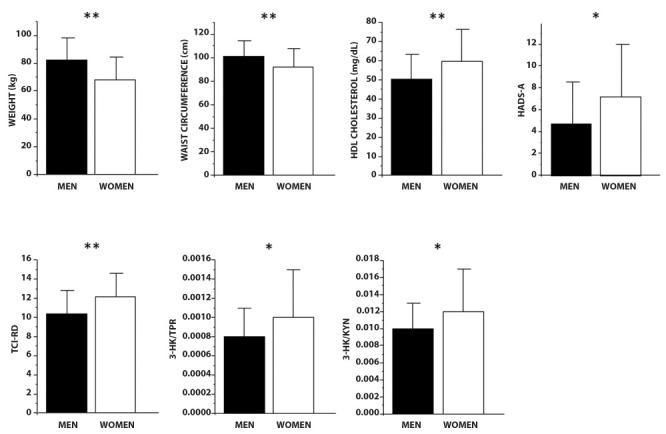
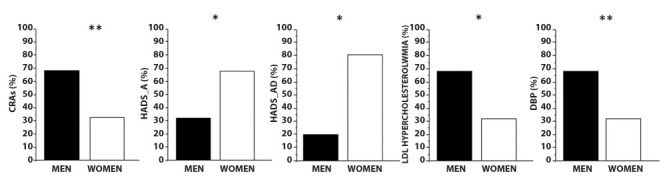
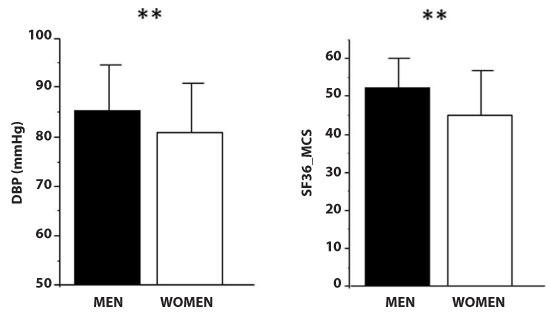
Among 126 outpatients (51.60% male) undergoing colonoscopy, 51 (44%) had CRAs, 54 (47%) MetS, 41 (41.40%) anxiety symptoms, 22 (22.20%) depressive symptoms and 13 (13.10%) combined anxious-depressive symptoms. HADS-Anxiety (t=2.68, p=0.01) and TCI Reward Dependence (TCI-RD) (t=3.01, p=0.00) mean scores were significantly higher in women; conversely, SF-36 Mental Component Summary scores were higher in men. CRAs were significantly prevalent in men (χ2=9.32, p=0.00) and were statistically significantly associated with male sex at the univariate logistic regression analysis (OR=3.27; p<0.01). At the multivariate logistic regression, diastolic hypertension (p<0.01) was positively associated with male sex, while TCI-RD (p=0.04) and HDL hypocholesterolemia (p=0.02) were inversely associated with male sex.
Several significant gender differences in anxious-depressive symptoms, MetS and CRAs were found. These preliminary data suggest the need to consider gender specificities while implementing therapeutic, diagnostic, and preventive strategies.
本研究旨在探讨在因非特异性腹部症状而接受结肠镜检查的门诊患者中,焦虑抑郁症状、代谢综合征(MetS)和结直肠腺瘤(CRA)患者的性别差异。
本研究为横断面研究。2015 年 1 月至 2021 年 6 月,意大利摩德纳综合医院(Modena,意大利北部)的 126 例连续因非特异性腹部症状而接受结肠镜检查的男女患者被纳入研究。MetS 根据 ATPIII 和 IDF 标准进行诊断。采用医院焦虑抑郁量表(HADS)评估焦虑和抑郁,采用气质与性格问卷(TCI)研究人格。还纳入了 SF-36 作为生活质量感知的衡量标准。
在 126 例接受结肠镜检查的患者中(51.60%为男性),51 例(44%)有 CRA,54 例(47%)有 MetS,41 例(41.40%)有焦虑症状,22 例(22.20%)有抑郁症状,13 例(13.10%)有焦虑抑郁共病。女性的 HADS 焦虑评分(t=2.68,p=0.01)和 TCI 奖赏依赖评分(TCI-RD)(t=3.01,p=0.00)显著更高;相反,男性的 SF-36 心理成分综合评分更高。男性 CRA 患病率显著更高(χ2=9.32,p=0.00),在单因素 logistic 回归分析中,男性与 CRA 显著相关(OR=3.27;p<0.01)。在多因素 logistic 回归分析中,舒张压升高(p<0.01)与男性显著相关,而 TCI-RD(p=0.04)和 HDL 低胆固醇血症(p=0.02)与男性显著相关。
在焦虑抑郁症状、MetS 和 CRA 方面发现了一些显著的性别差异。这些初步数据表明,在实施治疗、诊断和预防策略时,需要考虑性别特异性。