Shen Xin, Lv Kunming, Hou Baicun, Ao Qiangguo, Zhao Jiahui, Yang Guang, Cheng Qingli
Department of Geriatric Nephrology, The Second Medical Centre, National Clinical Research Centre for Geriatric Diseases, Chinese PLA General Hospital, No. 28 Fuxing Road, Beijing, China.
Department of Geriatric Gastroenterology, The Second Medical Centre, National Clinical Research Centre for Geriatric Diseases, Chinese PLA General Hospital, Beijing, China.
Diabetes Ther. 2022 Dec;13(11-12):1907-1920. doi: 10.1007/s13300-022-01309-w. Epub 2022 Aug 31.
While patients with diabetes are at higher risk of developing acute kidney injury (AKI), there are few studies on the recurrence of AKI in older adult patients. This study therefore aimed to examine the impact of diabetes on AKI recurrence and long-term outcomes in older male patients.
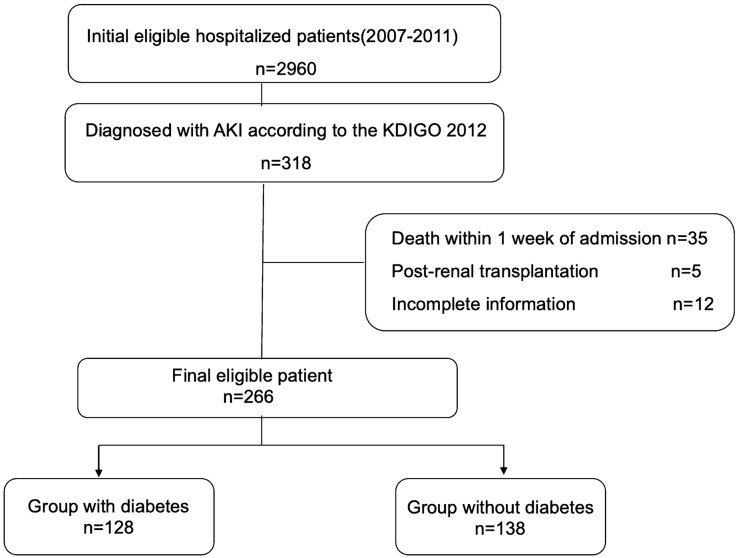
This retrospective cohort study included older male patients who experienced AKI during hospitalization from July 2007 to August 2011. Medical records of all patients were followed up for 10 years. Patients with AKI were classified into groups with and without diabetes. We analyzed differences in common geriatric comorbidities, AKI recurrence frequency, and severity between the two groups, identified risk factors affecting recurrence frequency, and assessed outcomes.
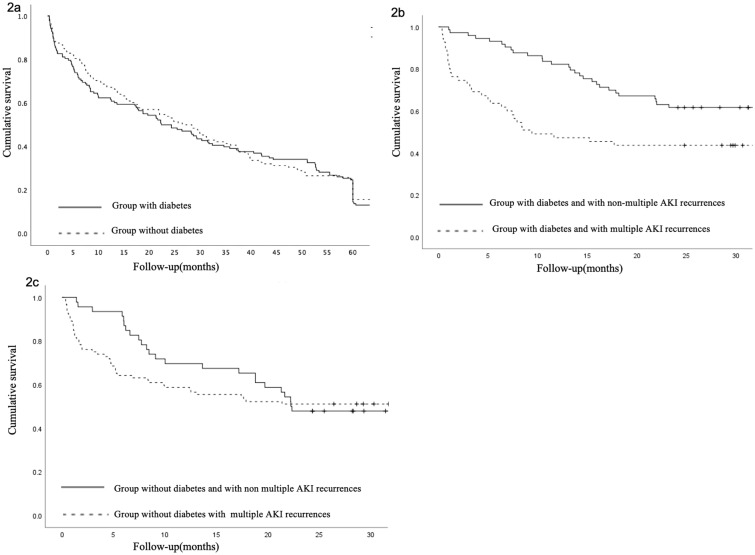
Of all 266 patients, 128 had diabetes and 138 did not. The AKI recurrence rate was significantly higher in the group with diabetes (80.5 vs. 66.7%; P = 0.011). There was a significantly higher proportion of AKI caused by infections in patients with diabetes (43.3 vs. 33.2%, P = 0.006). The proportion of patients with an AKI recurrence frequency ≥ 3 was significantly higher in the group with diabetes (44.7 vs. 29.4%, P = 0.027). Diabetes and coronary heart disease were independent risk factors for AKI recurrence (P < 0.05), diabetes control was associated with multiple AKI recurrences (P = 0.016), and no significant difference was found between the groups regarding the 10-year prognosis (P = 0.522). However, a subgroup analysis showed that patients with multiple AKI recurrences within 2 years had the worst survival outcome (P = 0.004).
Older male patients with diabetes are prone to AKI recurrence after initial onset of AKI. Diabetes is an independent risk factor for AKI recurrence, and active diabetes control (HbA1c < 7%) may thus reduce the recurrence of AKI and improve the very poor outcomes of patients with multiple recurrences of AKI within 2 years.
虽然糖尿病患者发生急性肾损伤(AKI)的风险较高,但关于老年患者AKI复发的研究较少。因此,本研究旨在探讨糖尿病对老年男性患者AKI复发及长期预后的影响。
这项回顾性队列研究纳入了2007年7月至2011年8月住院期间发生AKI的老年男性患者。对所有患者的病历进行了10年的随访。将发生AKI的患者分为有糖尿病组和无糖尿病组。我们分析了两组在常见老年合并症、AKI复发频率和严重程度方面的差异,确定了影响复发频率的危险因素,并评估了预后。
在所有266例患者中,128例患有糖尿病,138例未患糖尿病。糖尿病组的AKI复发率显著更高(80.5%对66.7%;P = 0.011)。糖尿病患者中因感染导致AKI的比例显著更高(43.3%对33.2%,P = 0.006)。AKI复发频率≥3次的患者比例在糖尿病组显著更高(44.7%对29.4%,P = 0.027)。糖尿病和冠心病是AKI复发的独立危险因素(P < 0.05),糖尿病控制与多次AKI复发相关(P = 0.016),两组在10年预后方面未发现显著差异(P = 0.522)。然而,亚组分析显示,2年内多次发生AKI的患者生存结局最差(P = 0.004)。
老年男性糖尿病患者在首次发生AKI后容易复发。糖尿病是AKI复发的独立危险因素,因此积极控制糖尿病(糖化血红蛋白<7%)可能会降低AKI的复发率,并改善2年内多次复发的AKI患者非常差的预后。