Elnaiem Walaa, Alhussain Wejdan Gad Alsaid, Salih Mugahid A
Faculty of Medicine, University of Khartoum, Sudan.
Ann Med Surg (Lond). 2022 Jul 11;80:104163. doi: 10.1016/j.amsu.2022.104163. eCollection 2022 Aug.
The accessory brachial artery is a rare arterial variation of the upper limb. It was observed in 0.1-0.8% of upper extremities. In comparison with the brachial artery, the accessory brachial artery has a narrow caliber.
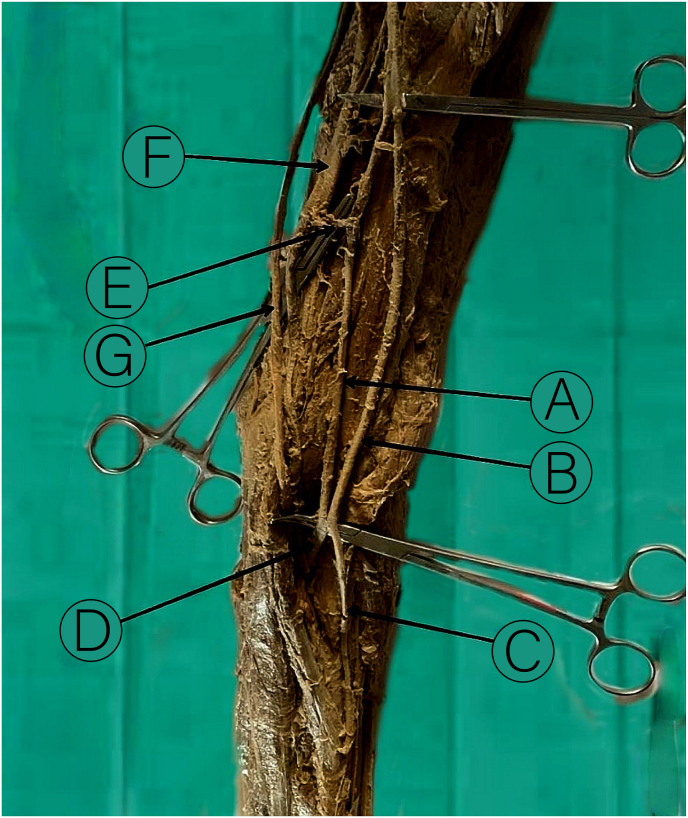
During dissection of an old African male cadaver, the brachial artery was observed bifurcating into accessory brachial artery medially and main brachial artery laterally. These two arteries then rejoined in the cubital fossa, forming a common stem, which bifurcated directly into radial and ulnar arteries.
Detailed knowledge about such arterial variation is clinically essential for angiographic images evaluation, -ulnar or -radial coronary catheterization, venipuncture, traumatic injuries and fracture management, and many other procedures in the arm or the forearm.
The accessory brachial artery is a rare upper limb arterial variation. Knowing such variation is essential for medical workers, especially for surgeons and radiologists.
副肱动脉是上肢一种罕见的动脉变异。在0.1%至0.8%的上肢中可观察到。与肱动脉相比,副肱动脉管径较窄。
在解剖一具老年非洲男性尸体时,观察到肱动脉在内侧分叉为副肱动脉,在外侧为主要肱动脉。这两条动脉随后在肘窝重新汇合,形成一个共同的主干,该主干直接分叉为桡动脉和尺动脉。
对于血管造影图像评估、尺侧或桡侧冠状动脉导管插入术、静脉穿刺、创伤性损伤和骨折处理以及手臂或前臂的许多其他操作,关于这种动脉变异的详细知识在临床上至关重要。
副肱动脉是一种罕见的上肢动脉变异。了解这种变异对外科医生和放射科医生等医务人员至关重要。