Centre for Research On Planning and Development (CRAD), Laval University, Quebec, G1V 0A6, Canada.
Evaluation Platform On Obesity Prevention, Quebec Heart and Lung Institute, Quebec, G1V 4G5, Canada.
Int J Equity Health. 2022 Sep 1;21(1):124. doi: 10.1186/s12939-022-01732-2.
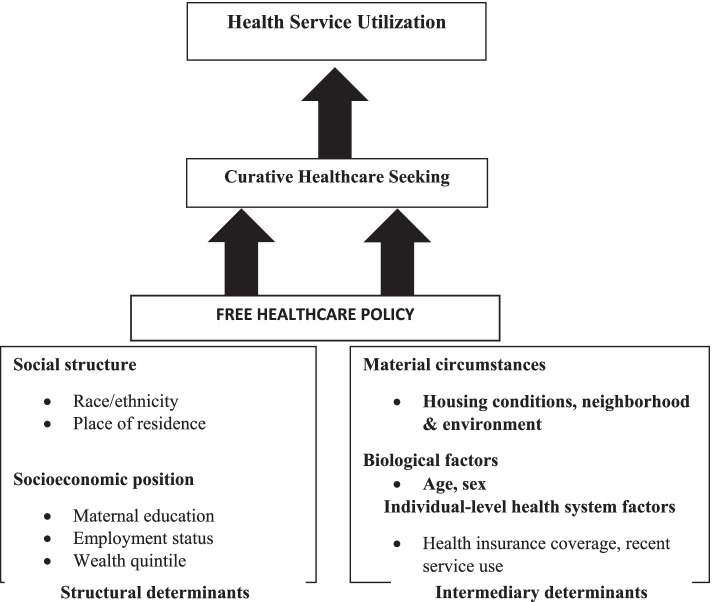
In 2016, Burkina Faso implemented a free healthcare policy as an initiative to remove user fees for women and under-5 children to improve access to healthcare. Socioeconomic inequalities create disparities in the use of health services which can be reduced by removing user fees. This study aimed to assess the effect of the free healthcare policy (FHCP) on the reduction of socioeconomic inequalities in the use of health services in Burkina Faso.
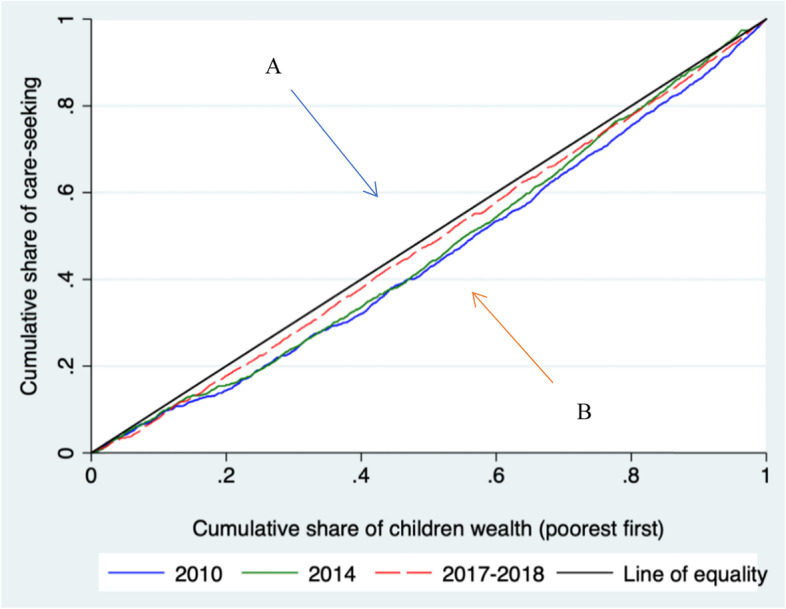
Data were obtained from three nationally representative population based surveys of 2958, 2617, and 1220 under-5 children with febrile illness in 2010, 2014, and 2017-18 respectively. Concentration curves were constructed for the periods before and after policy implementation to assess socioeconomic inequalities in healthcare seeking. In addition, Erreyger's corrected concentration indices were computed to determine the magnitude of these inequalities.
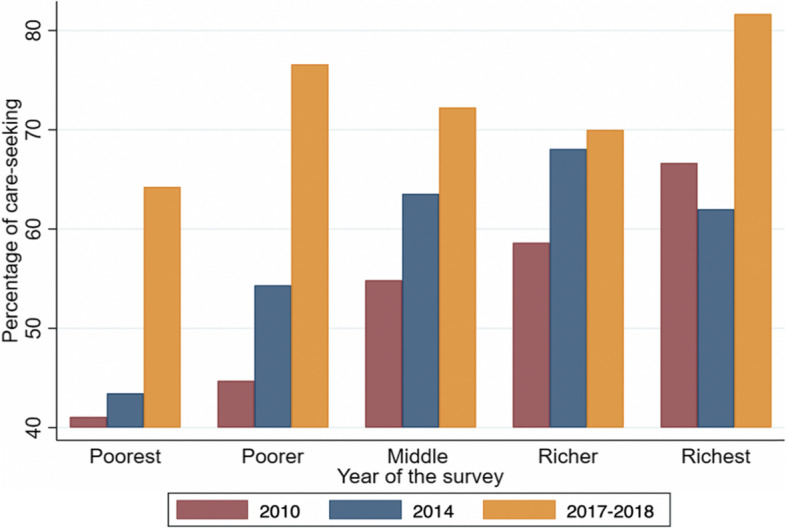
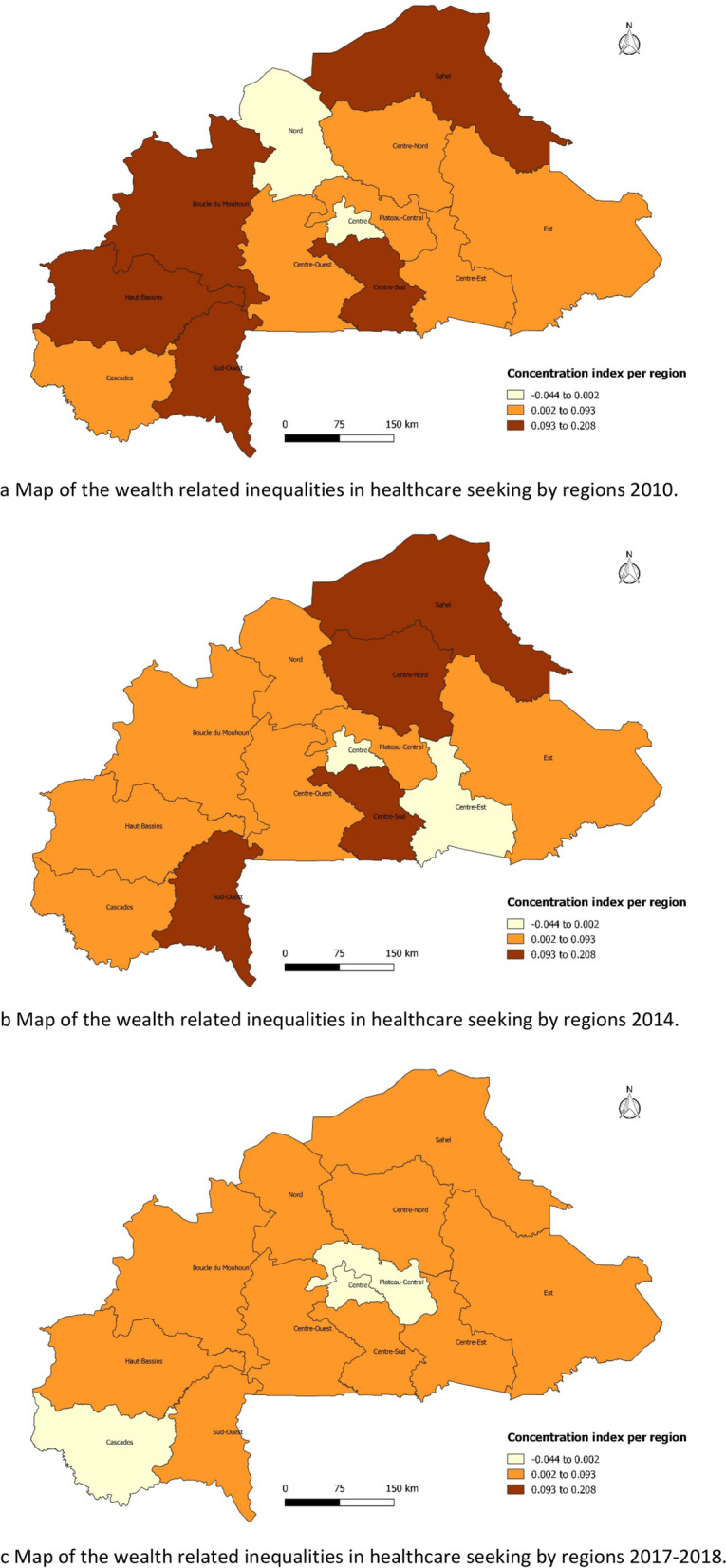
Prior to the implementation of the FHCP, inequalities in healthcare seeking for febrile illnesses in under-5 children favoured wealthier households [Erreyger's concentration index = 0.196 (SE = 0.039, p = 0.039) and 0.178 (SE = 0.039, p < 0.001) in 2010 and 2014, respectively]. These inequalities decreased after policy implementation in 2017-18 [Concentration Index (CI) = 0.091, SE = 0.041; p = 0.026]. Furthermore, existing pro-rich disparities in healthcare seeking between regions before the implementation of the FHCP diminished after its implementation, with five regions having a high CI in 2010 (0.093-0.208), four regions in 2014, and no region in 2017 with such high CI. In 2017-18, pro-rich inequalities were observed in ten regions (CI:0.007-0.091),whereas in three regions (Plateau Central, Centre, and Cascades), the CI was negative indicating that healthcare seeking was in favour of poorest households.
This study demonstrated that socioeconomic inequalities for under-5 children with febrile illness seeking healthcare in Burkina Faso reduced considerably following the implementation of the free healthcare policy. To reinforce the reduction of these disparities, policymakers should maintain the policy and focus on tackling geographical, cultural, and social barriers, especially in regions where healthcare seeking still favours rich households.
2016 年,布基纳法索实施了一项免费医疗政策,旨在取消妇女和 5 岁以下儿童的医疗费用,以改善医疗服务的可及性。社会经济不平等导致卫生服务利用方面存在差异,而取消医疗费用可以减少这种差异。本研究旨在评估免费医疗政策(FHCP)对布基纳法索卫生服务利用中社会经济不平等的减少程度。
数据来自于 2010 年、2014 年和 2017-18 年分别对 2958 名、2617 名和 1220 名发热儿童进行的三次全国代表性人口调查。在政策实施前后分别构建了集中曲线,以评估医疗服务寻求方面的社会经济不平等。此外,还计算了 Erreyger 校正的集中指数,以确定这些不平等的程度。
在 FHCP 实施之前,5 岁以下儿童发热就医的不平等现象有利于富裕家庭[2010 年和 2014 年分别为 Erreyger 集中指数=0.196(SE=0.039,p=0.039)和 0.178(SE=0.039,p<0.001)]。这些不平等现象在 2017-18 年政策实施后有所减少[集中指数(CI)=0.091,SE=0.041;p=0.026]。此外,在 FHCP 实施之前,地区间存在的医疗服务寻求方面有利于富裕地区的现有不平等现象在实施后有所减少,2010 年有五个地区的 CI 较高(0.093-0.208),2014 年有四个地区,2017 年没有地区的 CI 如此高。2017-18 年,10 个地区(CI:0.007-0.091)存在有利于富裕地区的不平等现象,而在中央高原、中心和 Cascades 三个地区,CI 为负,表明医疗服务寻求有利于最贫困家庭。
本研究表明,布基纳法索 5 岁以下发热儿童的医疗服务利用方面的社会经济不平等在免费医疗政策实施后大大减少。为了加强减少这些差距,政策制定者应维持该政策,并注重解决地理、文化和社会障碍,特别是在医疗服务仍然有利于富裕家庭的地区。