Liu Li-Ying, Li Xiang, Tian Zi-Lei, Zhang Qi, Shen Zhi-Fu, Wei Wei, Guo Xiao-Li, Chen Ling, Su Meng-Hua, Yang Lu, Yu Si-Yi, Yang Jie
Acupuncture and Tuina School, Chengdu University of Traditional Chinese Medicine, Chengdu, China.
Chongqing Hospital of Traditional Chinese Medicine, Chongqing, China.
Front Neurosci. 2022 Aug 16;16:917721. doi: 10.3389/fnins.2022.917721. eCollection 2022.
The study aimed to investigate how acupuncture modulates brain activities across multiple frequency bands to achieve therapeutic effects in PDM.
A total of 47 patients with PDM were randomly assigned to the verum acupuncture group and sham acupuncture group with three menstrual cycles of the acupuncture course. The fMRI scans, visual analog scale (VAS) scores, and other clinical evaluations were assessed at baseline and after three menstrual-cycles treatments. The global functional connectivity density (gFCD) analyses were performed between the pre-and post-acupuncture course of two groups at full-low frequency band, Slow-3 band, Slow-4 band, and Slow-5 band.
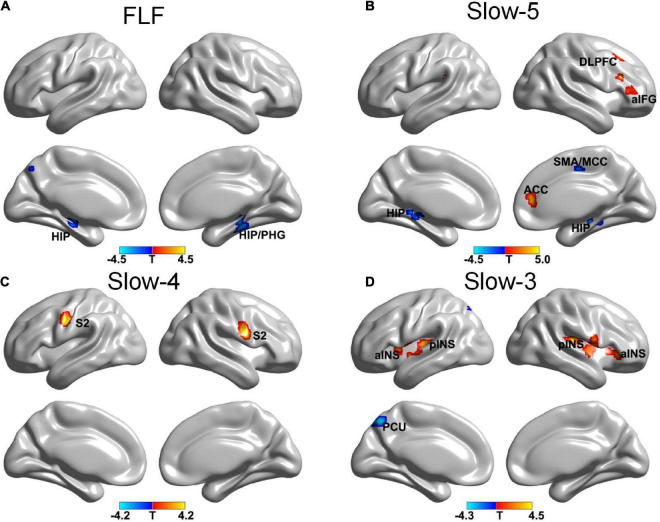
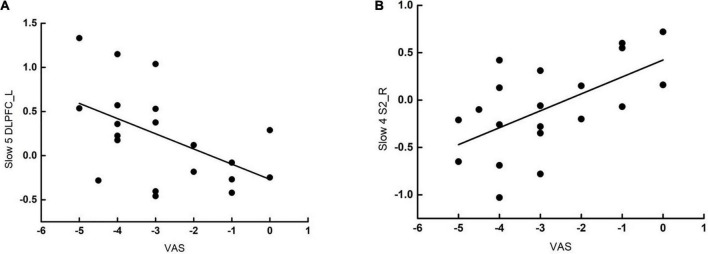
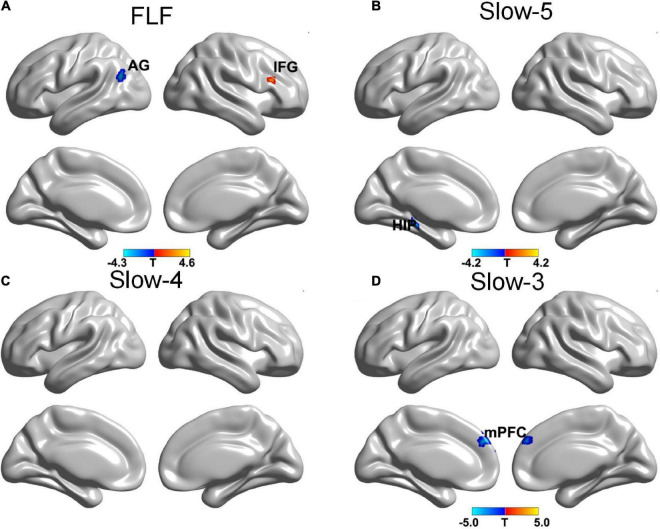
After the acupuncture treatments, the patients with PDM in the verum acupuncture group showed significantly decreased VAS scores ( < 0.05). The frequency-dependent gFCD alternations were found in the verum acupuncture group, altered regions including DLPFC, somatosensory cortex, anterior cingulate cortex (ACC), middle cingulate cortex (MCC), precuneus, hippocampus, and insula. The sham acupuncture modulated regions including angular gyrus, inferior frontal gyrus, and hippocampus. The gFCD alternation in DLPFC at the Slow-5 band was negatively in the patients with PDM following verum acupuncture, and S2 at the Slow-4 band was positively correlated with VAS scores.
These findings supported that verum acupuncture could effectively modulate frequency-dependent gFCD in PDM by influencing abnormal DLPFC at Slow-5 band and hippocampus at the Slow-3 band. The outcome of this study may shed light on enhancing the potency of acupuncture in clinical practice.
本研究旨在探讨针刺如何调节多个频段的脑活动以实现对原发性痛经(PDM)的治疗效果。
将47例原发性痛经患者随机分为真穴针刺组和假穴针刺组,进行三个月经周期的针刺疗程。在基线期和三个月经周期治疗后进行功能磁共振成像(fMRI)扫描、视觉模拟评分(VAS)及其他临床评估。对两组针刺疗程前后全低频段、慢3频段、慢4频段和慢5频段进行全脑功能连接密度(gFCD)分析。
针刺治疗后,真穴针刺组原发性痛经患者的VAS评分显著降低(<0.05)。真穴针刺组发现频率依赖性gFCD改变,改变区域包括背外侧前额叶皮质(DLPFC)、体感皮层、前扣带回皮质(ACC)、中扣带回皮质(MCC)、楔前叶、海马体和脑岛。假穴针刺调节的区域包括角回、额下回和海马体。真穴针刺后原发性痛经患者慢5频段DLPFC的gFCD改变为负,慢4频段的第二体感区(S2)与VAS评分呈正相关。
这些发现支持真穴针刺可通过影响慢5频段异常的DLPFC和慢3频段的海马体,有效调节原发性痛经患者频率依赖性gFCD。本研究结果可能有助于提高针刺在临床实践中的疗效。